What Is Dynamic Equilibrium? Nothing Has Stopped
Root Concept
A reversible reaction reaches dynamic equilibrium when the forward and reverse reactions are proceeding at the same rate, so the amounts of everything stay constant even though both reactions are still running — which is why nothing appears to change and why nothing has actually stopped.
CodePLU Goal
Upgrading Human Mental Models
Learn how to think in Workflows

Concept Development By codeplu.com
A graph of amounts would show two flat lines and look exactly like a reaction that had stopped. This one cannot.
Looks Finished, Is Not
Run a reversible reaction in a sealed container and leave it. After a while nothing appears to change: the colour settles, the pressure settles, and weighing anything gives the same answer it gave ten minutes ago. The obvious conclusion is that the reaction has finished. It has not, and the gap between how it looks and what is happening is the whole of this tutorial.
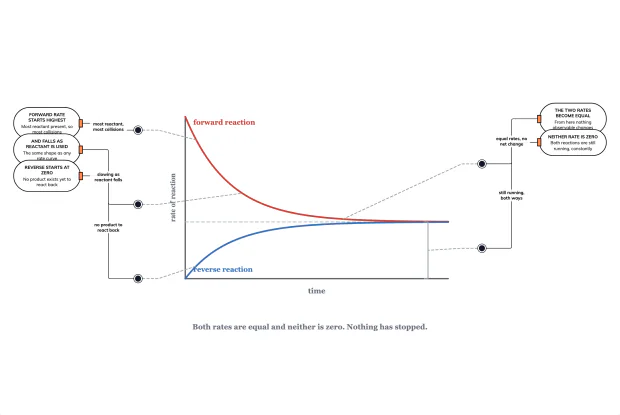
What is actually going on is that two reactions are running at once. The forward reaction starts fast, because at the beginning all the reactant is present and none of the product — the rate curve from the rates track, exactly as described there. As reactant is used up the forward rate falls. Meanwhile product is accumulating, so the reverse reaction, which started at zero because there was nothing to react back, begins to speed up.
Those two rates are moving towards each other, and at some point they meet. From that moment the forward reaction is producing exactly as much product per second as the reverse reaction is destroying, so the amount of everything stays constant. That is equilibrium, and the word for it is dynamic: both reactions are still running, at full speed, in opposite directions.
The figure plots rates rather than amounts on purpose. A graph of amounts would show two flat lines and look identical to a reaction that had stopped — which is the misunderstanding this tutorial exists to prevent.
Reading the Two Rates
Why does the forward rate fall?
For exactly the reason the rates track gave: a rate counts successful collisions per second, and collisions need particles that are still there. At the start every reactant particle is available and the forward reaction is at its fastest. As those particles are consumed, encounters become rarer and the rate drops — which is why every rate curve is steepest at the beginning and bends over. Nothing new is happening here; this is the ordinary behaviour of any reaction, and it is half of what makes equilibrium possible. The other half is that the reverse reaction is doing the opposite thing at the same time. Neither curve would be surprising on its own; drawing them together is what makes the meeting point obvious.
Why does the reverse rate rise from zero?
Because at the start there is no product, and a reaction with nothing to react has a rate of zero. As the forward reaction makes product, that product accumulates, and the more of it there is the more often its particles collide and turn back. So the reverse rate climbs for the same reason the forward rate falls — both are tracking how much of their own reactant is present. The two curves are mirror images of each other driven by the same mechanism, which is why they are certain to meet rather than merely likely to. One rate can only fall and the other can only rise, so they cannot miss each other — which is why every reversible reaction in a closed vessel ends up somewhere.
What is special about the moment they meet?
Nothing is special about the moment; what matters is that it persists. When the two rates are equal, every particle of product formed is matched by one turning back, so the amount of everything stops changing. And because the amounts stop changing, the rates stop changing too — which means the balance holds itself. That is the difference between equilibrium and a coincidence: it is a state the system settles into and stays in, not a moment it passes through. Disturb it and the rates become unequal again until a new balance is reached, which is the next tutorial. A balance that restores itself after being pushed is a much stronger thing than a balance that merely happens to exist.
Why does equilibrium need a closed system?
Because anything that escapes cannot come back and react. Heating limestone in an open kiln lets the carbon dioxide leave, so the reverse reaction has nothing to work with and the forward reaction simply runs to completion — which is what the mole track calculated and why a kiln is built open. Seal the same reaction in a container and the carbon dioxide stays, the reverse reaction becomes possible, and an equilibrium establishes itself with limestone still present. The same chemistry gives two entirely different outcomes depending on whether the lid is on. Open or closed is not a detail of the apparatus; it decides which chemistry you get. It is the first thing to check about any equilibrium question.
Real World Example
Three Equilibria, and What Steady Really Means
The pattern of a balance that holds itself turns up well outside chemistry, which is a useful way to get a feel for what dynamic means.
Step 1
A sealed bottle of fizzy drink
Carbon dioxide dissolved in the liquid is constantly escaping into the space above it, and gas from that space is constantly dissolving back. Sealed, those two rates are equal and the drink stays fizzy indefinitely — nothing appears to happen. Open the bottle and the gas above escapes, so the returning half of the balance disappears and the dissolved gas leaves steadily until the drink goes flat. The same system, closed and open, behaving completely differently. Nothing about the drink changed when the cap came off except which of the two directions still had a partner.
Step 2
A crowd on an escalator
If people step onto a down escalator at the same rate they step off at the bottom, the number of people on it stays constant. A photograph taken a minute apart would look identical, and nobody would conclude the escalator had stopped. That is dynamic equilibrium in a form with no chemistry in it at all, and it makes the key point by itself: constant does not mean motionless. The rates being equal is what holds the number steady, not the motion having ceased. Watch one person and you see constant motion; count the people and you see a constant number.
Step 3
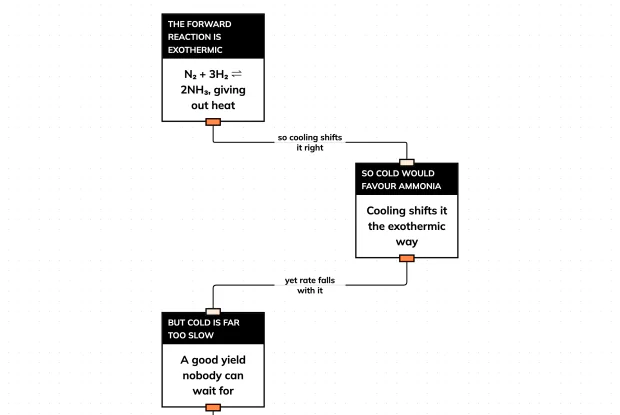
The ammonia process never finishes
Nitrogen and hydrogen combine to make ammonia reversibly, so a reactor reaches equilibrium with all three present and converts only a fraction of what goes in on each pass. That is not a fault in the process and no amount of waiting improves it — the balance is where the chemistry settles. The ammonia is separated out and the unreacted gases are fed back round, which is the recycling the yield tutorial described. The last part of this track is about how the conditions for that reactor are chosen. Recycling is the standard answer to an equilibrium that will not go far enough on its own.
FAQs
Final Words
A reversible reaction in a closed container settles into a state where nothing appears to change, and the appearance is misleading. The forward reaction starts fast and slows as its reactant is consumed; the reverse starts at zero and speeds up as product accumulates. The two rates move towards each other and meet, and from that moment every particle of product formed is matched by one turning back.
That is dynamic equilibrium, and both halves of the phrase matter. It is an equilibrium because the amounts stop changing and the state holds itself — disturb it and it returns to a balance. It is dynamic because nothing has stopped: both reactions are still running at full speed, and neither rate is zero. Two things are worth guarding against. Equal rates do not mean equal amounts. And the system has to be closed, because a product that escapes can never react back.
Continue This Track
This concept is part 2 of Reactions That Go Both Ways.
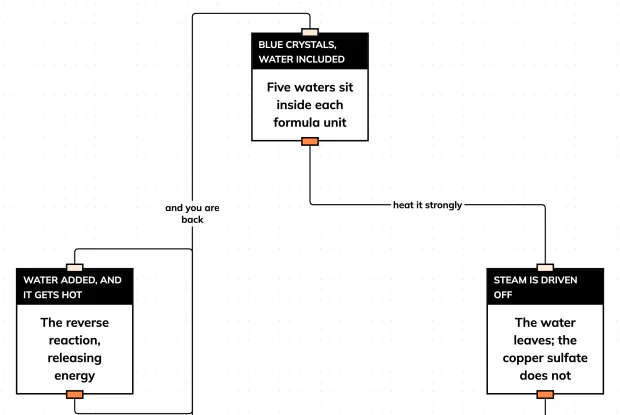
A Reaction You Can Run Backwards, and Watch
Heat blue copper sulfate and it turns white. Add water and it turns blue again, and gets hot. Follow a reaction round a closed loop in an interactive playground.
What Is Dynamic Equilibrium? Nothing Has Stopped
A reaction at equilibrium looks finished and is not — both directions are running at equal rates. Read it off a graph of rates in an interactive playground.
What Shifts an Equilibrium? Push It and See
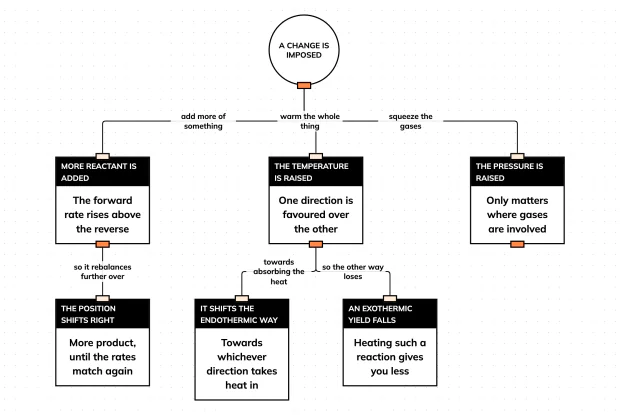
An equilibrium that is disturbed settles somewhere new, and which way it moves can be predicted. Trace three kinds of change and their consequences in an interactive playground.
Does a Catalyst Shift an Equilibrium? No — Here Is Why
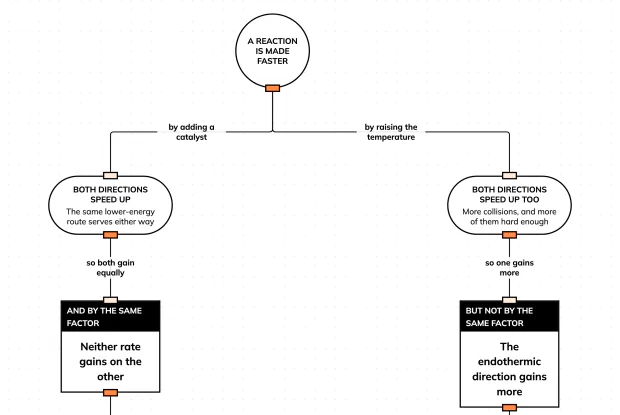
A catalyst and a temperature rise both speed a reversible reaction up, and only one changes where the balance sits. Follow both routes from one starting point in an interactive playground.
Why Is the Haber Process a Compromise? Rate vs Yield
The conditions that favour ammonia yield and the conditions that favour speed pull in opposite directions. Follow the argument to the figure a real plant uses, in an interactive playground.