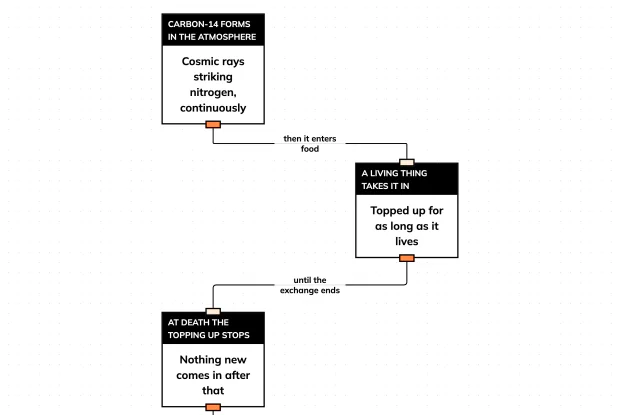
Why Are Some Nuclei Unstable?
Root Concept
Protons repel one another across the whole nucleus while the strong nuclear force that holds them together acts only over an extremely short range, so adding neutrons keeps larger nuclei together only up to a point — beyond which no combination is stable and the nucleus must eventually change.
CodePLU Goal
Upgrading Human Mental Models
Learn how to think in Workflows

Concept Development By codeplu.com
The whole argument turns on one asymmetry in the third and fifth steps: one force reaches everywhere and the other reaches only next door.
A Nucleus Should Not Be Possible
The chemistry category opened the atom and found protons and neutrons packed into a nucleus, with electrons in shells around it. It established that the number of protons is what makes an element that element, and that changing it is not something chemistry can do. Then it said something easy to read past: proton numbers **do** change in nuclear processes, and those sit outside that subject. This track is what sits outside it.
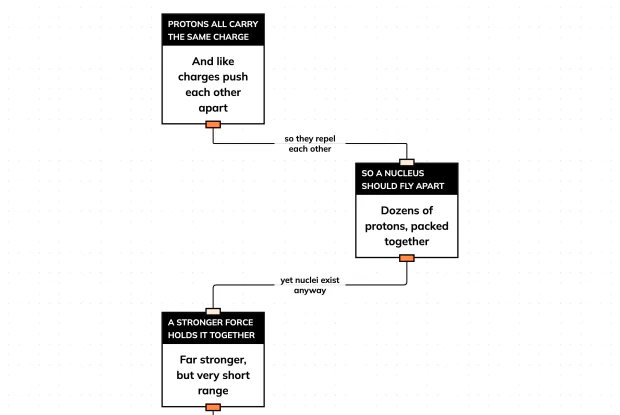
Start with a problem the chemistry track had no reason to raise. Protons all carry the same positive charge, and like charges repel. A uranium nucleus has ninety-two of them crammed into a space a hundred thousand times smaller than the atom around it, and the repulsion in there is enormous.
So why is there a nucleus at all? Something must be holding it together, and it has to be far stronger than the repulsion it overcomes. It is called the strong nuclear force. Without it no nucleus with more than one proton could hold — no element but hydrogen, no chemistry, and nothing to have this argument with.
But it has a catch, and the catch is the whole of this tutorial. The strong force is immensely powerful and reaches almost no distance at all — a proton feels it only from its immediate neighbours. Electrical repulsion has no such limit and reaches right across the nucleus. Make a nucleus big enough and the repulsion adds up faster than the glue can, and at that point nothing can hold it indefinitely.
Why the Balance Fails
What exactly does the strong force do?
It pulls protons and neutrons towards each other, and it does so about a hundred times more strongly than the electrical repulsion pushing the protons apart. At the distances inside a nucleus that is no contest, which is why nuclei exist and are, in fact, extremely difficult to break. What makes it unusual among forces is its reach. Gravity and electrical attraction weaken gradually with distance and never quite reach zero; the strong force effectively stops. A nucleon feels it from the particles touching it and from essentially nothing further away, which means it cannot hold a group together by sheer strength the way a long-range force could. Strength and reach are separate properties, and this force has one in abundance and almost none of the other.
Why do bigger nuclei need proportionally more neutrons?
Because neutrons supply pull without supplying push. A neutron feels and exerts the strong force exactly as a proton does, but carries no charge, so it adds glue to the nucleus without adding any repulsion to be overcome. In a small nucleus roughly equal numbers work — helium has two of each, carbon six of each. As the proton count climbs, the repulsion grows faster than the number of protons does, because every proton repels every other one, so the glue has to grow faster too. By the time you reach lead there are about one and a half neutrons for every proton, and that extra neutron count is the nucleus buying stability.
So why does it stop working?
Because the two forces scale differently, and eventually the one with unlimited reach wins. Adding a proton to a large nucleus adds repulsion felt by every other proton in it, right across the whole thing. Adding a neutron adds attraction felt only by the few particles next to it. One grows with the size of the nucleus and the other does not, so past a certain size no ratio of neutrons to protons can keep up. That point arrives at bismuth, element 83: **every element beyond it is radioactive, without exception**, and so are many isotopes of lighter ones whose particular combination sits off the balance. The limit is not a rule somebody wrote down; it is where the arithmetic of the two forces crosses over.
What does "unstable" actually mean here?
That the nucleus will, sooner or later, change into a different one that holds together better — and that nothing outside it has any say in when. This is the part that separates the topic from everything in the chemistry category. Fifteen chemistry tracks were about changing reaction rates: heat it, concentrate it, add a catalyst, grind it finer. **None of that does anything whatsoever to radioactive decay.** Heat a radioactive sample, freeze it, dissolve it, bond it into a compound, put it under pressure — the rate is identical, because the event is happening in the nucleus and chemistry only ever touches the electrons. It is the one process on this site that ignores every lever the rest of science relies on.
Real World Example
Three Things This Explains
The argument makes predictions about which nuclei exist and which do not, and the periodic table is the place to check them.
Step 1
The periodic table simply stops being stable
Bismuth is element 83 and is the heaviest with any effectively stable isotope. Every element past it — polonium, radon, radium, uranium, all of them — is radioactive, and that is not a coincidence about those particular elements. It is the size limit this argument predicts, arriving exactly where the growing repulsion finally outruns what short-range glue can do. A table that went on being stable forever would mean the two forces scaled the same way, and they do not. The table stopping where it does is the prediction being confirmed by every element that exists.
Step 2
The heaviest elements last for fractions of a second
Elements beyond uranium are made in laboratories rather than found, and the further past the limit they sit the shorter they last. Some of the heaviest exist for milliseconds before falling apart, which is why confirming their discovery is such difficult work. This is the same trend continuing rather than a new effect: the further beyond the point where repulsion wins, the less time a nucleus can hold itself together at all. Each new one is harder to make and lasts less time than the last, which is the balance failing more severely rather than differently.
Step 3
Nothing you can do to a sample changes its rate
This was tested thoroughly, because it is such a strange claim. Radioactive material has been heated, cooled to near absolute zero, put under crushing pressure and chemically combined into different compounds, and the decay rate is unmoved. Compare that with chemistry, where a ten degree rise can double a reaction rate. The difference is that chemistry rearranges electrons and this happens in the nucleus, which the electrons shield from everything the outside world can do. A result this strange is worth the trouble it took to establish, because it is what marks the nucleus off from everything else.
FAQs
Final Words
A nucleus is a group of particles that all repel one another, held in a space far smaller than the atom around it, and the reasonable expectation is that it cannot exist. It does because of the strong nuclear force, which is about a hundred times more powerful than the repulsion it overcomes — and which reaches almost no distance at all.
That asymmetry decides everything. Repulsion acts right across the nucleus while the strong force binds only immediate neighbours. Adding neutrons buys glue without extra push, which is why heavy nuclei carry about one and a half neutrons per proton. But repulsion grows with the size of the nucleus and the glue does not, so past bismuth nothing holds.
One consequence carries into the rest of this track: nothing outside the nucleus affects any of it. Heat, pressure, dissolving and catalysts do nothing here. The next tutorial asks what an unstable nucleus actually does about it.
Continue This Track
This concept is part 1 of Inside the Nucleus.
Why Are Some Nuclei Unstable?
Every proton repels every other, so a nucleus packed with them ought to fly apart instantly. Find out what holds it together and when that fails, in an interactive playground.
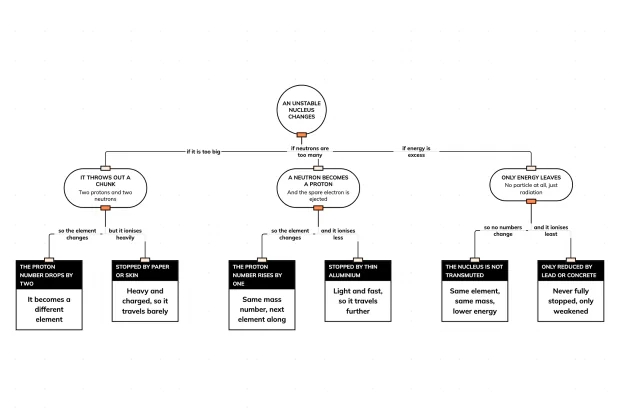
What Happens When a Nucleus Decays? Alpha, Beta, Gamma
An unstable nucleus has three ways to fix itself, and each changes something different about the atom. Sort what comes out and what is left behind, in an interactive playground.
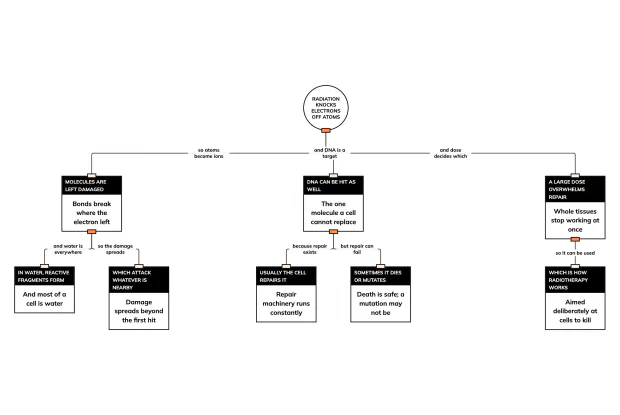
What Does Radiation Actually Do? One Mechanism
Light is radiation and so is radio, and neither is dangerous. Find out what separates those from the kind that is, and what it does when it arrives, in an interactive playground.
What Is a Half-Life? Random Events, Predictable Totals
Nobody can say when one nucleus will decay, yet a sample halves on an exact schedule. Follow how both of those are true at once, in an interactive playground.
How Does Carbon Dating Work?
Every living thing is slightly radioactive, and stops being topped up the moment it dies. Follow the six steps that turn that into a date, in an interactive playground.