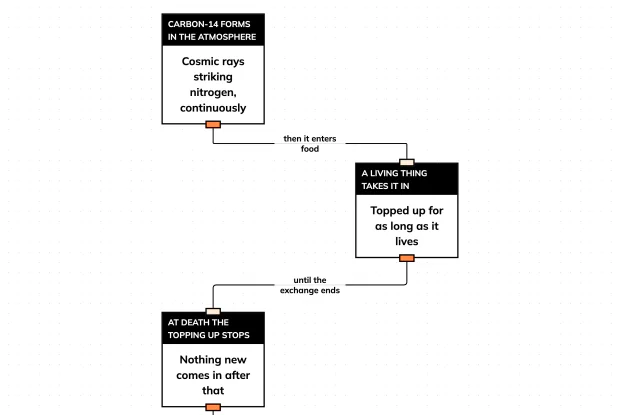
What Happens When a Nucleus Decays? Alpha, Beta, Gamma
Root Concept
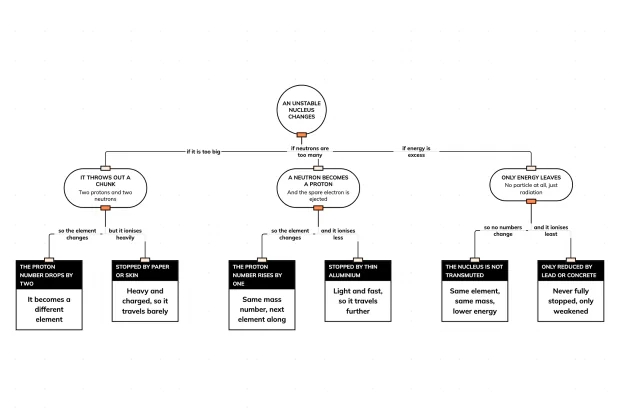
An unstable nucleus can emit an alpha particle of two protons and two neutrons, which lowers its proton number by two, or convert a neutron into a proton and eject a beta particle, which raises it by one, or emit gamma radiation, which carries away energy and changes no numbers at all.
CodePLU Goal
Upgrading Human Mental Models
Learn how to think in Workflows

Concept Development By codeplu.com
The third column is the odd one: energy leaves and the nucleus is the same nucleus afterwards. The other two are transmutations and it is not.
Three Different Problems, Three Different Fixes
An unstable nucleus will change into one that holds together better. The previous tutorial explained why some have to; this one is about what they actually do, and the useful surprise is that there is more than one answer because there is more than one way to be unstable.
A nucleus can be too big outright — so many protons that no amount of neutron glue reaches far enough. The fix is to get smaller, and it does that by throwing out a tight packet of two protons and two neutrons, which is called an alpha particle and is in fact a helium nucleus. The atom left behind has two protons fewer, so by the rule chemistry established, **it is a different element**.
Or a nucleus can be the right size but carry too many neutrons for its protons. Making itself smaller would not help; what it needs is to convert some of the surplus. So one neutron turns into a proton, and because charge has to balance, an electron is created and ejected at speed. That electron is a beta particle, the mass number is unchanged, and the proton number has gone **up** by one — a different element again, in the other direction.
Or a nucleus can have the right particles and simply too much energy, usually just after one of the other two has left it jostled. Then only the energy leaves, as a burst of gamma radiation. No particle, no change of element, no change of mass.
What Each One Leaves Behind
What does alpha decay change?
Both numbers, and by a known amount every time. An alpha particle is two protons and two neutrons, so the nucleus emitting it loses two from its proton number and four from its mass number. Uranium-238 has 92 protons and a mass number of 238; after alpha decay it is thorium, with 90 protons and a mass number of 234. That is a genuine transmutation — one element has become another, which is the thing the chemistry track said could not be done chemically and then noted happens in nuclear processes. The alchemists were not wrong that elements can change; they were wrong about what it would take. No chemical process reaches the nucleus; this one happens there and nowhere else.
How can a neutron turn into a proton?
Because a neutron is not an indivisible object, and it can convert into a proton provided the books balance. A proton carries a positive charge and a neutron carries none, so turning one into the other creates a positive charge that was not there — and charge is conserved, so a negative one has to appear alongside it. That is the electron that shoots out, and it is the beta particle. It is worth being clear that this electron did not come from a shell around the atom: it was made in the nucleus at the moment of the conversion, out of the energy available. Calling it an electron is accurate; calling it one of the atom’s electrons is not.
Why does gamma change nothing?
Because nothing material leaves. After an alpha or beta event the new nucleus is often left holding more energy than its lowest state allows, rather like a struck bell, and it sheds that excess as a very high-energy burst of electromagnetic radiation. Gamma is the same kind of thing as light and radio waves, far up the scale. Since it carries no charge and no mass, the proton number and mass number are both untouched — the atom is the same element it was a moment earlier, simply calmer. This is why gamma usually accompanies the other two rather than occurring by itself. It is the settling-down afterwards rather than the event itself.
Why do the three penetrate so differently?
Because stopping radiation means getting it to interact, and the three interact at wildly different rates. An alpha particle is heavy and carries two charges, so it collides constantly and dumps its energy almost immediately — a sheet of paper or the dead outer layer of skin stops it. A beta particle is far lighter with one charge, so it gets further before being absorbed, and a few millimetres of aluminium will do it. Gamma has no charge at all and interacts only occasionally, so it is **reduced** by lead and concrete rather than stopped — thicker shielding means less gets through, and there is no thickness that blocks it entirely.
Real World Example
Three Uses, Each Picking a Different Type
Nothing here uses radiation in general. Each application needs one particular type, chosen for exactly the property that distinguishes it.
Step 1
A smoke alarm uses alpha, because it cannot travel
Inside most smoke alarms is a tiny amount of americium emitting alpha particles across a small gap, ionising the air so a current flows. Smoke entering the gap absorbs the particles, the current drops and the alarm sounds. Alpha is chosen precisely because it goes nowhere: the particles cannot escape the plastic case, let alone reach anybody in the room, while being ionising enough to make the detection work. The property that makes alpha harmless at a distance is the property that makes it useful here. Choosing a type of radiation is choosing how far you want it to get, and here the answer is barely anywhere.
Step 2
A paper mill uses beta, because it half gets through
Measuring the thickness of paper as it runs through a mill is done by putting a beta source on one side and a detector on the other. Thicker paper absorbs more, so the reading falls and the rollers adjust. Alpha would be stopped by any thickness of paper and tell you nothing; gamma would pass through almost unaffected and tell you nothing either. Beta is used because paper happens to sit in the range where its absorption actually varies with thickness. A measurement needs a quantity that responds, and only beta responds across this range.
Step 3
Medical imaging uses gamma, because it gets out
A tracer given to a patient has to be detectable from outside the body, which rules out alpha and beta immediately — both would be absorbed by tissue long before reaching a detector, delivering their energy to the patient and no information to anybody. Gamma passes through tissue with only partial absorption, so a camera outside can build an image of where the tracer went. The same penetration that makes gamma the hardest to shield against is what makes it the only usable option. The hardest type to protect against is the only one that can carry information out of a body.
FAQs
Final Words
There are three ways out of instability because there are three different things that can be wrong. A nucleus that is simply too big sheds bulk, throwing out two protons and two neutrons as an alpha particle, which leaves it two elements lower and four lighter. A nucleus with too many neutrons converts one into a proton, creating and ejecting an electron to balance the charge — that is beta, and it moves the element one place up with no change in mass.
The third is the odd one. A nucleus holding surplus energy releases it as gamma radiation: nothing material leaves, no number changes, and the element is what it was. Two of the three are transmutations and one is not.
How far each travels runs opposite to how strongly it ionises: alpha is stopped by skin, beta by thin aluminium, and gamma is only ever reduced. The next tutorial asks what that ionising does inside something living.
Continue This Track
This concept is part 2 of Inside the Nucleus.
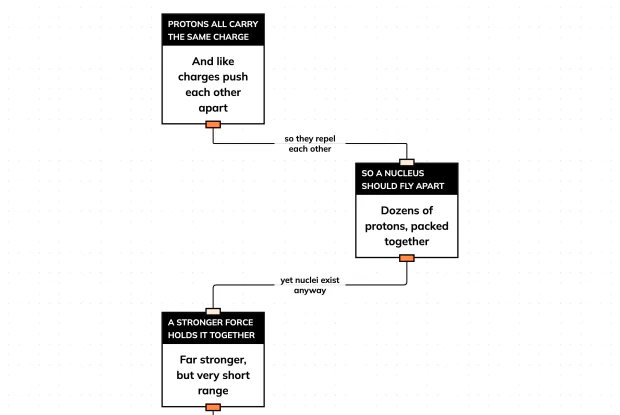
Why Are Some Nuclei Unstable?
Every proton repels every other, so a nucleus packed with them ought to fly apart instantly. Find out what holds it together and when that fails, in an interactive playground.
What Happens When a Nucleus Decays? Alpha, Beta, Gamma
An unstable nucleus has three ways to fix itself, and each changes something different about the atom. Sort what comes out and what is left behind, in an interactive playground.
What Does Radiation Actually Do? One Mechanism
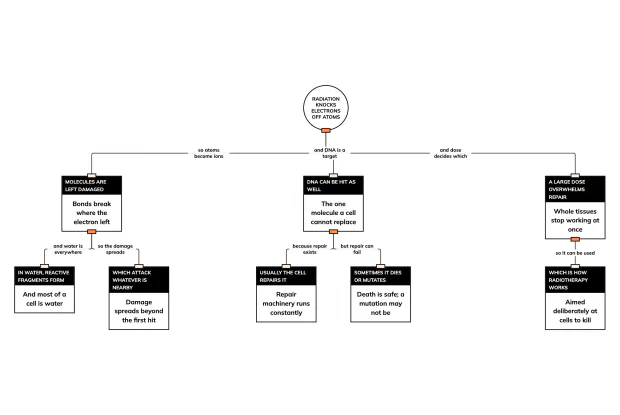
Light is radiation and so is radio, and neither is dangerous. Find out what separates those from the kind that is, and what it does when it arrives, in an interactive playground.
What Is a Half-Life? Random Events, Predictable Totals
Nobody can say when one nucleus will decay, yet a sample halves on an exact schedule. Follow how both of those are true at once, in an interactive playground.
How Does Carbon Dating Work?
Every living thing is slightly radioactive, and stops being topped up the moment it dies. Follow the six steps that turn that into a date, in an interactive playground.