How Does Carbon Dating Work?
Root Concept
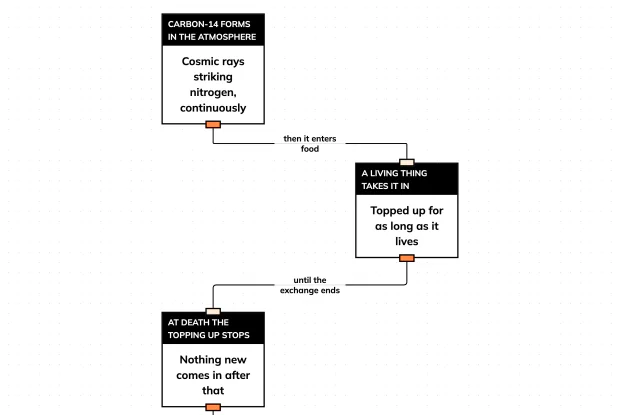
Carbon-14 is made continuously in the atmosphere and taken in by living things, which stop replenishing it at death, so the proportion remaining falls by half every 5,730 years and measuring it against ordinary carbon gives the time since the organism died.
CodePLU Goal
Upgrading Human Mental Models
Learn how to think in Workflows

Concept Development By codeplu.com
The third step is the only one that is an event. Everything before it is continuous and everything after it is a countdown.
Everything Alive Is Slightly Radioactive
A half-life is a clock with an unusual property: it runs at a rate nothing can change. The last tutorial established why — heat, pressure, chemistry and catalysts all act on electrons, and the decay happens in the nucleus. A clock that cannot be disturbed, sped up or reset is exactly what you want for measuring something that happened before anybody was watching.
Carbon-14 is the one used for things that were once alive, and the reason starts in the upper atmosphere. Cosmic rays striking nitrogen produce carbon-14 continuously, so the air contains a small and fairly steady proportion of it alongside ordinary carbon-12. Chemically it behaves identically, which the chemistry track explains: isotopes differ in neutrons, and neutrons do not affect bonding.
So it enters the carbon cycle like any other carbon. Plants take it up in photosynthesis, animals eat the plants, and every living thing ends up carrying the same small proportion as the atmosphere — continuously topped up for as long as it keeps exchanging carbon with its surroundings.
Death stops the exchange. Nothing new comes in, and what is already there carries on decaying with a half-life of 5,730 years. From that moment the proportion of carbon-14 only falls, at a rate nobody can alter, which makes the shortfall a direct measure of how long ago the exchange stopped. The clock starts at death because death is the only event in the whole sequence.
Working the Steps
Why is there any carbon-14 at all?
Because it is being made continuously, which it has to be — with a half-life of only 5,730 years, any carbon-14 present when the Earth formed disappeared long ago. The supply comes from cosmic rays striking the upper atmosphere and converting nitrogen into carbon-14, at a rate that has stayed roughly steady. That gives a balance: new carbon-14 arriving at about the rate existing carbon-14 decays, so the proportion in the air stays near enough constant. It is worth noticing this is the opposite situation from uranium, which is still around only because its half-life is comparable to the age of the Earth. A short half-life only survives if something keeps making more, and a long one survives on its own.
Why does the proportion stay constant while alive?
Because a living thing keeps swapping carbon with its surroundings. A plant takes carbon dioxide from the air continuously, and an animal eats plants or other animals continuously, so the carbon in a living body is being replaced all the time rather than sitting there from birth. Any carbon-14 that decays is replaced by more from the same source, which means the proportion inside matches the proportion outside. That is why the method dates the end of life rather than its beginning — the carbon in a creature is not the carbon it was born with. Every atom in a body is on loan from its surroundings, and the clock measures when the borrowing stopped.
What is actually measured?
The ratio of carbon-14 to ordinary carbon-12, not the amount of carbon-14 on its own. That distinction is what makes the method work on a fragment of unknown size: a bigger sample has more of both, so the ratio is unaffected, while a raw count would depend entirely on how much you happened to have. Carbon-12 is stable and does not decay, so it acts as a record of how much carbon-14 there must have been originally. The measurement is a comparison against an internal reference rather than against an assumption. That is also why a tiny fragment can be dated as confidently as a large piece, provided enough of it survives to measure at all.
How does a ratio become a date?
By counting halvings. If a sample has half the expected proportion of carbon-14, one half-life has passed and it is about 5,730 years since the organism died. A quarter means two half-lives and about 11,460 years; an eighth means three and about 17,190. Between those points the decay curve from the previous tutorial gives the figure directly. The method runs out at around 50,000 years, not because the physics stops but because so little carbon-14 is left by then that measuring it reliably against the background becomes impossible. The limit is a measurement limit rather than a physical one, which is why better instruments have pushed it outward over time.
Real World Example
Three Things the Method Settled
Carbon dating changed archaeology by replacing argument about sequence with measurement of date, and it needed a correction of its own.
Step 1
The Dead Sea Scrolls, dated independently of their contents
The scrolls were dated by the linen they were wrapped in and the parchment itself, giving ages consistent with the handwriting styles scholars had proposed. That agreement matters more than the number: two completely independent methods — one based on physics in the nucleus, the other on how letters were formed — arriving at the same answer is far stronger evidence than either alone. Dating a document without reading it is exactly the kind of check a field full of interpretation needs. Agreement between unrelated methods is worth more than precision in either of them.
Step 2
The Iceman, who was older than anyone expected
A body found in an Alpine glacier in 1991 was initially thought to be a recent climbing casualty. Carbon dating put him at around 5,300 years old, which reclassified the find entirely and made it one of the most informative archaeological discoveries ever made. Nothing about his appearance gave the answer; the carbon in his tissue had simply been counting down since he died, and the measurement read what the appearance could not. A find can be misclassified entirely until something in it is measured rather than judged. Here the gap between the two was five thousand years.
Step 3
The correction that made it accurate
The method assumes the atmospheric proportion of carbon-14 has been steady, and it has varied a little — and more recently a lot, because burning fossil fuels released carbon with no carbon-14 left in it while atmospheric weapons testing added extra. So raw results are calibrated against tree rings, which give an independent year-by-year record going back thousands of years. The correction is a good example of a method being improved by its known weakness rather than undermined by it. A calibrated date is more trustworthy than an uncalibrated one precisely because the weakness was found and accounted for.
FAQs
Final Words
Carbon dating works because a half-life is a clock that nothing can disturb, and because living things keep winding it. Cosmic rays make carbon-14 in the upper atmosphere continuously, it enters the carbon cycle like any other carbon, and every living thing carries the same small proportion as the air because it is constantly exchanging carbon with its surroundings.
Death ends the exchange, and that is the only event in the sequence. From then on nothing is added and what remains halves every 5,730 years, so comparing the carbon-14 left against the carbon-12 that never decays says how many halvings have passed. Measuring a ratio rather than an amount is what lets it work on a fragment of any size.
That is the nucleus: unstable because repulsion outruns a short-range force, changing by three routes, ionising what it passes through, and keeping time so reliably that it can date something nobody saw die.
Continue This Track
This concept is part 5 of Inside the Nucleus.
Why Are Some Nuclei Unstable?
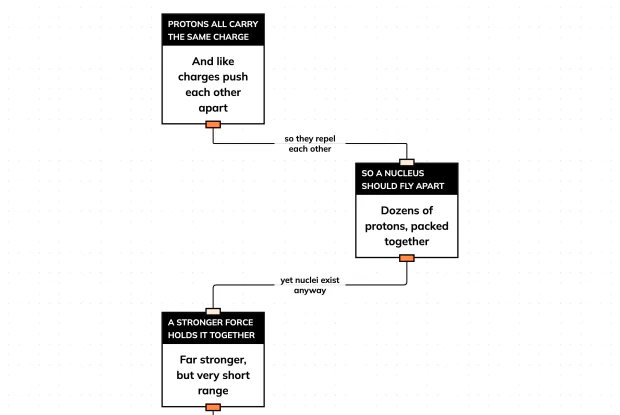
Every proton repels every other, so a nucleus packed with them ought to fly apart instantly. Find out what holds it together and when that fails, in an interactive playground.
What Happens When a Nucleus Decays? Alpha, Beta, Gamma
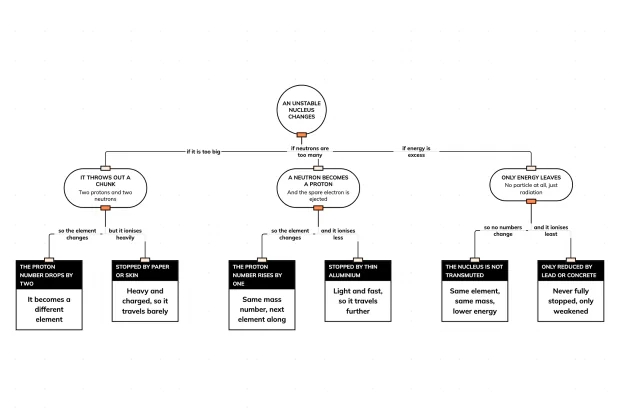
An unstable nucleus has three ways to fix itself, and each changes something different about the atom. Sort what comes out and what is left behind, in an interactive playground.
What Does Radiation Actually Do? One Mechanism
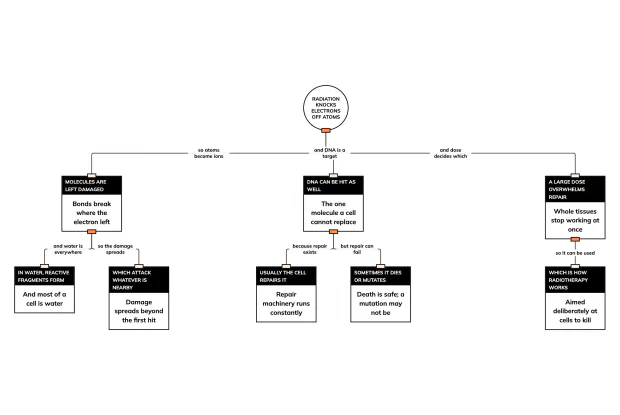
Light is radiation and so is radio, and neither is dangerous. Find out what separates those from the kind that is, and what it does when it arrives, in an interactive playground.
What Is a Half-Life? Random Events, Predictable Totals
Nobody can say when one nucleus will decay, yet a sample halves on an exact schedule. Follow how both of those are true at once, in an interactive playground.
How Does Carbon Dating Work?
Every living thing is slightly radioactive, and stops being topped up the moment it dies. Follow the six steps that turn that into a date, in an interactive playground.