What Does Radiation Actually Do? One Mechanism
Root Concept
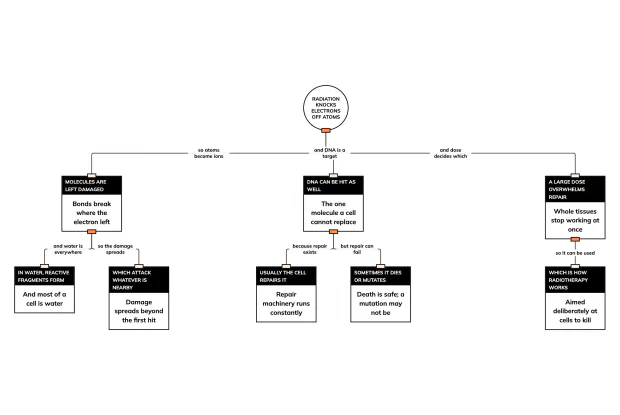
Ionising radiation carries enough energy to knock electrons off atoms, which breaks molecules apart and creates reactive fragments, and the resulting damage to DNA is usually repaired but can occasionally kill a cell or alter it — which is both the hazard and the basis of radiotherapy.
CodePLU Goal
Upgrading Human Mental Models
Learn how to think in Workflows

Concept Development By codeplu.com
One cause, and the two outer branches are the same mechanism at different doses — which is why the same thing treats cancer and causes it.
Most Radiation Is Harmless, and the Word Does Not Say Which
The word radiation alarms people, and a great deal of what it covers is entirely ordinary. Light is radiation. So is the radio signal reaching a phone, the microwave heating a meal, and the infrared the greenhouse tutorial spent so long on. None of those is dangerous in the way the word implies, and calling them all radiation is correct.
What matters is not whether something is radiation but whether it carries enough energy in a single packet to tear an electron off an atom. That threshold has a name — **ionising** — and it is the only thing that separates the harmless kinds from the hazardous ones. Below it, radiation deposits energy as warmth and nothing more. Above it, it rearranges matter.
Alpha, beta and gamma are all comfortably above that threshold, which is why they are grouped together as ionising radiation despite being three completely different things — two particles and a wave. What they have in common is not what they are but what they do on arrival.
And what they do is a single mechanism, which chemistry already described from the other side. An atom that loses an electron becomes an ion, and the bonding track explained that an atom’s electrons are exactly what holds it to its neighbours. Remove one and the molecule it belonged to may no longer hold together. Everything in this tutorial — the hazard, the caution, the treatment of cancer — is that one event, repeated.
Following the Damage
Why does losing an electron break a molecule?
Because the electrons are the bonds. The chemistry category built its whole account of bonding on shared and transferred electrons: a covalent bond is a shared pair, and removing one of the pair leaves a bond that cannot do its job. The molecule either falls apart at that point or becomes an unstable fragment desperate to react with something. This is why ionising radiation is destructive in a way that heat at ordinary temperatures is not — warming a molecule makes it vibrate more, which it recovers from, while ionising it removes a piece of its structure. The energies are not comparable: a single gamma photon carries thousands of times what a chemical bond is worth.
Why does water matter so much?
Because a cell is mostly water, so most of what radiation hits is water, and what it makes out of water goes on to do further damage. Splitting a water molecule produces extremely reactive fragments that attack whatever they meet next — which may be a protein or a strand of DNA some distance from where the radiation actually arrived. This is the indirect route, and it accounts for most of the biological damage rather than being a footnote to it. It is also why the damage is spread out rather than confined to a neat track: one arrival creates a small cloud of chemistry that keeps going after the particle has stopped.
What happens when DNA is damaged?
Usually nothing lasting, because cells repair DNA constantly and are good at it. Damage from background radiation, from ordinary chemistry and from the business of copying DNA happens all the time, and repair machinery deals with almost all of it. Two outcomes matter when it does not. The cell may be damaged badly enough to die, which is inconvenient but safe — a dead cell does nothing. Or it may survive with an altered instruction, and an alteration in the wrong place can remove the controls on how often a cell divides. That is the route from radiation to cancer, and the reason it is a matter of probability rather than certainty.
Why does the same thing treat cancer and cause it?
Because dose and aim change everything about the outcome, not the mechanism. A small dose spread over a whole body gives many cells a little damage, nearly all of which is repaired, leaving a small increase in the chance that one alteration goes wrong somewhere. A large dose concentrated on a small volume overwhelms repair entirely and the cells there die. Radiotherapy is the deliberate use of the second: beams aimed from several directions so they overlap only on the tumour, where the total is lethal, while any single beam passing through healthy tissue is not. Nothing about the biology changed between the hazard and the treatment — only how much arrived, and where.
Real World Example
Three Everyday Encounters
Radiation is not an exceptional circumstance. These are ordinary, and comparing them is what makes the word dose mean something.
Step 1
Background radiation, which never stops
You are being irradiated now, and always have been. Radon seeping from rock, potassium-40 inside your own body, cosmic rays arriving from space and traces of uranium in building materials all contribute, and together they are the largest exposure most people ever receive. The level varies with geology — granite areas read considerably higher — which means people have always lived across a wide range of it. This is the baseline any other dose has to be compared against rather than an alarming discovery. Everything that has ever lived has done so inside it. There is no unirradiated baseline to compare against.
Step 2
A chest X-ray, roughly a few days of background
A single chest X-ray delivers a dose comparable to a few days of ordinary background exposure, which is why it is a routine procedure rather than a considered risk. A scan of the whole body delivers considerably more and is weighed more carefully. The principle in every case is that the information gained has to be worth the dose given, which is a judgement made by the people ordering it — and the reason the radiographer steps behind a screen is that they would otherwise accumulate many patients’ worth in a week. Dose accumulates for the person in the room every day, not for the one having the scan.
Step 3
Radiotherapy, aimed and enormous
A therapeutic dose is thousands of times a diagnostic one and would be severely harmful if delivered to the whole body. It is not. The beam rotates around the patient so that it passes through different healthy tissue each time while always crossing the tumour, which therefore receives the sum of every pass and everything else receives a fraction. Cancer cells are also more vulnerable because they divide frequently, and a cell with damaged DNA is most likely to fail when it next tries to copy it. Two separate advantages, both coming from the same mechanism this tutorial has been following.
FAQs
Final Words
Radiation is a wide word and most of what it covers is harmless. Light, radio and microwaves are all radiation and none of them can damage a molecule, because the thing that matters is not being radiation but carrying enough energy in one packet to tear an electron off an atom. That threshold is called ionising, and alpha, beta and gamma are all well above it.
What follows is one mechanism. Electrons are what hold molecules together, so removing one breaks something — and since a cell is mostly water, most arrivals split water into reactive fragments that attack whatever they meet. DNA damaged this way is usually repaired. Occasionally the cell dies, which is safe, and occasionally it survives altered, which is the route to cancer.
Dose and aim turn the same mechanism into a treatment. The next tutorial returns to the nucleus and asks how long any of this goes on for.
Continue This Track
This concept is part 3 of Inside the Nucleus.
Why Are Some Nuclei Unstable?
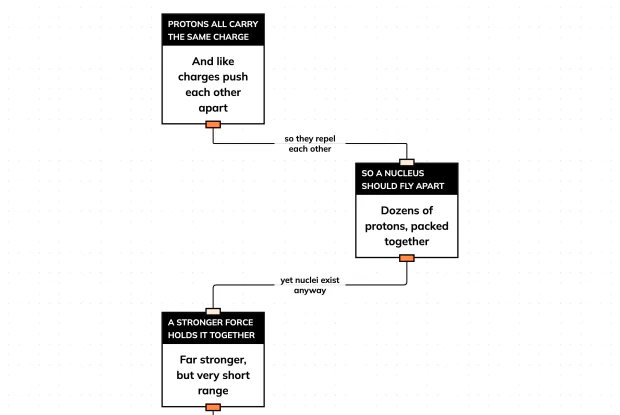
Every proton repels every other, so a nucleus packed with them ought to fly apart instantly. Find out what holds it together and when that fails, in an interactive playground.
What Happens When a Nucleus Decays? Alpha, Beta, Gamma
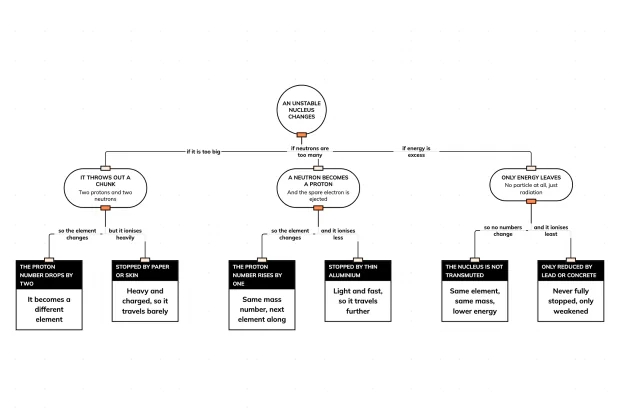
An unstable nucleus has three ways to fix itself, and each changes something different about the atom. Sort what comes out and what is left behind, in an interactive playground.
What Does Radiation Actually Do? One Mechanism
Light is radiation and so is radio, and neither is dangerous. Find out what separates those from the kind that is, and what it does when it arrives, in an interactive playground.
What Is a Half-Life? Random Events, Predictable Totals
Nobody can say when one nucleus will decay, yet a sample halves on an exact schedule. Follow how both of those are true at once, in an interactive playground.
How Does Carbon Dating Work?
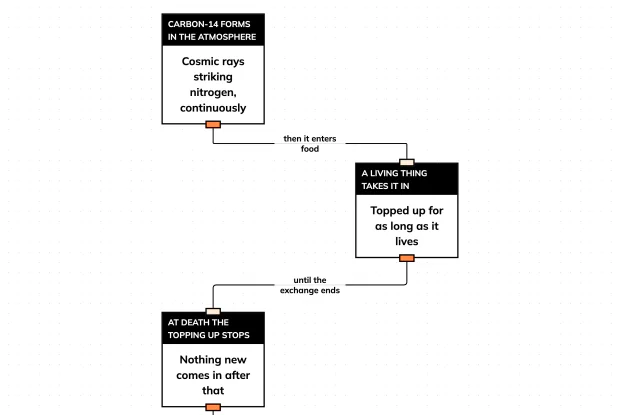
Every living thing is slightly radioactive, and stops being topped up the moment it dies. Follow the six steps that turn that into a date, in an interactive playground.