What Is a Half-Life? Random Events, Predictable Totals
Root Concept
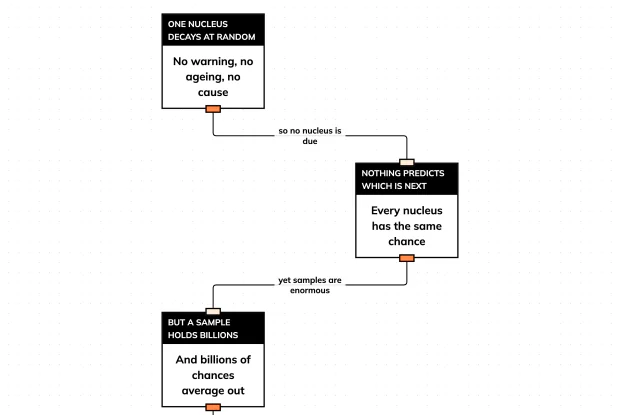
Radioactive decay is random for any individual nucleus, with no ageing and no way to tell which will go next, but a sample contains so many that a fixed fraction decays in each interval — so the time for half of them to go is constant whatever the starting amount, and that time is the half-life.
CodePLU Goal
Upgrading Human Mental Models
Learn how to think in Workflows

Concept Development By codeplu.com
The third step is where the argument turns. Everything above it is about one nucleus and everything below it is about a population, and only the second kind can be predicted.
Two Things That Sound Contradictory
Pick one unstable nucleus and ask when it will decay. There is no answer. Not an answer nobody has worked out yet — there is genuinely nothing that determines it. It may go in the next second or sit there for a million years, and no measurement you could make on it in advance would tell you which.
Now take a lump containing billions of the same nuclei and ask how long until half have gone. That has an exact answer, the same answer every time, and it can be looked up in a table. Carbon-14 takes 5,730 years. Uranium-238 takes four and a half billion. Some isotopes take fractions of a second.
Both of those are true at once, and holding them together is the whole of this tutorial. It is not that the individual is unpredictable because we lack information and the bulk is predictable because we have more — the individual is unpredictable in principle, and the bulk is predictable **because** of how many individuals there are.
The key is that each nucleus has the same fixed chance of decaying in the next second, regardless of anything about it, including how long it has already survived. Nuclei do not age. One that has sat unchanged since the Earth formed is exactly as likely to go in the next second as one made this morning — and that is what makes the fraction, rather than the count, the thing that stays the same.
How Both Can Be True
What does "random" mean here, exactly?
That no cause determines the moment, and nothing about a particular nucleus marks it out as due. This is stronger than ordinary unpredictability. A tossed coin is unpredictable in practice but the result follows from the force and the spin; knowing enough would give the answer. Radioactive decay is not like that. There is no hidden quantity ticking down, no accumulating strain, no measurement that distinguishes a nucleus about to decay from one that will last another million years. The previous tutorials said nothing outside the nucleus affects the rate; this says nothing inside it does either, in the sense of determining the timing. It is one of the few places in school science where the honest answer is that there is no reason.
Why do nuclei not age?
Because decay is not wearing out, and that is the intuition worth discarding. Things in ordinary experience fail because something accumulates — a bearing wears, a battery depletes, a rope frays — so an older one is more likely to fail soon. If nuclei worked that way, a sample would last a while and then mostly go at once, and the survivors would be the ones closest to failing. They do not. A nucleus that has survived a billion years is in exactly the state it started in, with exactly the same chance in the next second as any other. **Having survived tells you nothing about what comes next**, which is the precise opposite of how most failure works.
So why is the bulk behaviour so reliable?
Because of the numbers involved. A gram of almost anything contains well over a thousand billion billion atoms — the chemistry category established that when it dealt with moles — so even a tiny sample holds an enormous population. With that many independent chances, the proportion that actually decays in a given second lands extremely close to the probability every time, in the same way that a thousand coin tosses land near half even though no single toss is predictable. The law of large numbers is doing the work, and it is the same reason insurers can price a policy without knowing anything about any one customer. Unpredictable individually and reliable in bulk is an ordinary combination once the numbers are large enough.
Why is the halving time always the same?
Because a fixed FRACTION goes in each interval rather than a fixed number. If a tenth of what remains decays each year, then starting from a million you lose a hundred thousand in the first year, and starting from half a million you lose fifty thousand — different amounts, the same proportion. Whatever you start with, the time to get down to half of it works out the same, which is why the quantity is worth naming. It also means the decay never formally finishes: each half-life removes half of what is left, so the amount gets very small and approaches zero without reaching it. Halving is the one operation that can be repeated forever without ever finishing.
Real World Example
Three Ways to See It
The claim is strange enough to be worth checking from more than one direction.
Step 1
Dice, which have no memory either
Roll six thousand dice, remove every six, and roll the rest. Each die has a one in six chance every time and no die remembers how often it has been rolled — which is exactly the property nuclei have. You cannot predict which dice will go, and yet the number remaining follows a smooth, repeatable curve, falling by the same proportion each round. The "half-life" of this population is about four rolls. It is a model rather than a mechanism, and what it models correctly is the thing people find hardest to believe. No die is ever due, and the curve appears anyway.
Step 2
Activity falls on exactly the same curve
You do not have to count nuclei to see this, which is fortunate. A detector measures activity — decays per second — and since a fixed fraction of what remains decays each second, the activity is proportional to how much is left. So the reading falls by half over each half-life, and plotting it gives the curve directly. That is how half-lives are actually measured, and for very long ones it is the only way: nobody waited four billion years to check uranium-238. The curve is measured over a convenient stretch and the half-life is read off it, which is how numbers far longer than a human life are known at all.
Step 3
Why some waste is a problem for far longer
Half-life decides how long a material stays hazardous, and the range is enormous. An isotope with a half-life of hours is essentially gone in a few days, which is why medical tracers are chosen that way — the patient is not left radioactive. An isotope with a half-life of thousands of years is still there in thousands of years, which is the whole of the nuclear waste problem stated in one sentence. The same number answers both questions. Choosing an isotope for a job is mostly choosing a half-life. Nothing else about it can be adjusted to suit.
FAQs
Final Words
Two things are true at once and neither softens the other. No one can say when a particular nucleus will decay, and that is not a gap in our instruments — nothing determines the moment, and nothing distinguishes one about to go from one that will last a million years. Nuclei do not age.
And yet a sample is entirely predictable, because of how many it contains. With billions of independent chances the proportion decaying in any interval lands extremely close to the probability. Since it is a fixed fraction rather than a fixed number, the time to fall to half is the same whatever you start with — and that time is a property of the isotope that nothing can alter.
It also makes a very good clock, because it runs at a known rate and cannot be disturbed. The last tutorial of this track uses one to date something that died thousands of years ago.
Continue This Track
This concept is part 4 of Inside the Nucleus.
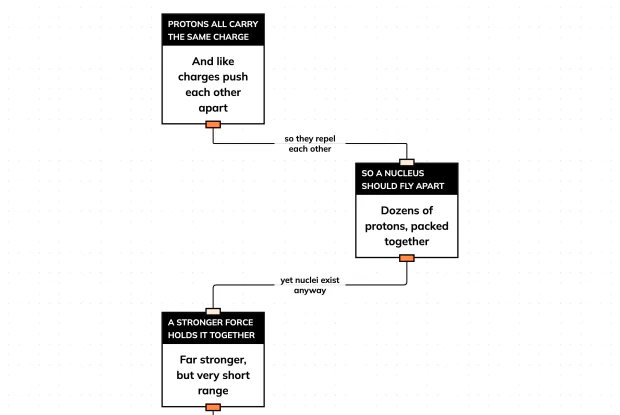
Why Are Some Nuclei Unstable?
Every proton repels every other, so a nucleus packed with them ought to fly apart instantly. Find out what holds it together and when that fails, in an interactive playground.
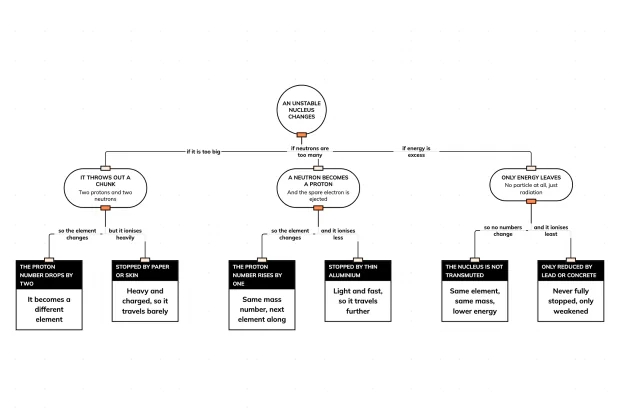
What Happens When a Nucleus Decays? Alpha, Beta, Gamma
An unstable nucleus has three ways to fix itself, and each changes something different about the atom. Sort what comes out and what is left behind, in an interactive playground.
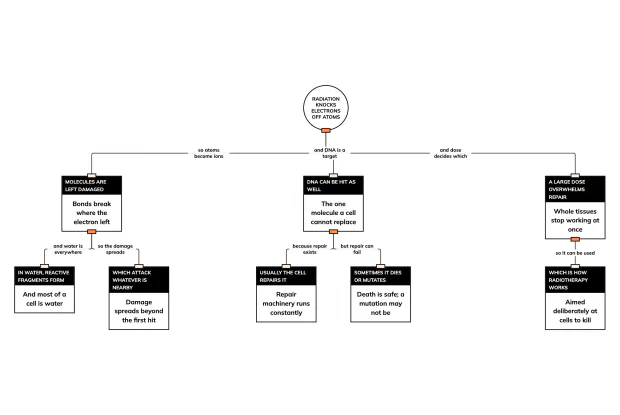
What Does Radiation Actually Do? One Mechanism
Light is radiation and so is radio, and neither is dangerous. Find out what separates those from the kind that is, and what it does when it arrives, in an interactive playground.
What Is a Half-Life? Random Events, Predictable Totals
Nobody can say when one nucleus will decay, yet a sample halves on an exact schedule. Follow how both of those are true at once, in an interactive playground.
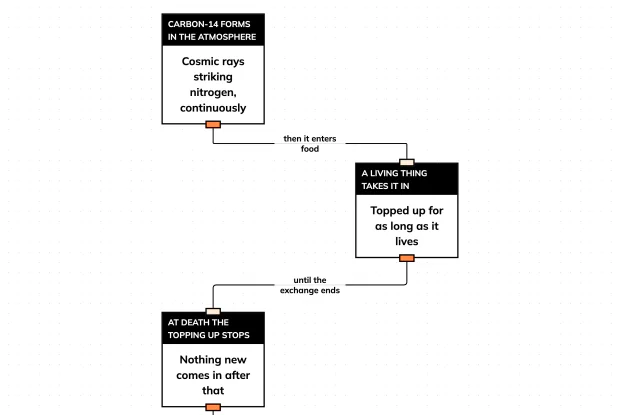
How Does Carbon Dating Work?
Every living thing is slightly radioactive, and stops being topped up the moment it dies. Follow the six steps that turn that into a date, in an interactive playground.