Inside the Nucleus
Five parts settling a debt owed to another category. The chemistry track that opened the atom said the proton number cannot be changed by anything chemistry does, then noted that it does change in nuclear processes — and that those sit outside the subject. This is what sits outside it. It starts from a problem chemistry had no reason to raise: every proton in a nucleus repels every other, so a nucleus should not exist. It does because of a force about a hundred times stronger, which reaches almost no distance at all — and that asymmetry decides everything, because repulsion acts right across the nucleus while the glue binds only neighbours. Past bismuth nothing can hold. The second part sorts the three ways out, where alpha and beta transmute one element into another and gamma changes no number at all. The third asks what the radiation does on arrival, which is one mechanism — knocking electrons off atoms — and is why light and radio are radiation and harmless. The fourth holds two things that sound contradictory: no one can say when a single nucleus will decay, and a sample halves on an exact schedule, because nuclei do not age and billions of random chances average out. And the last uses that as a clock on something nobody saw die.
CodePLU Goal
Upgrading Human Mental Models
Learn how to think in Workflows
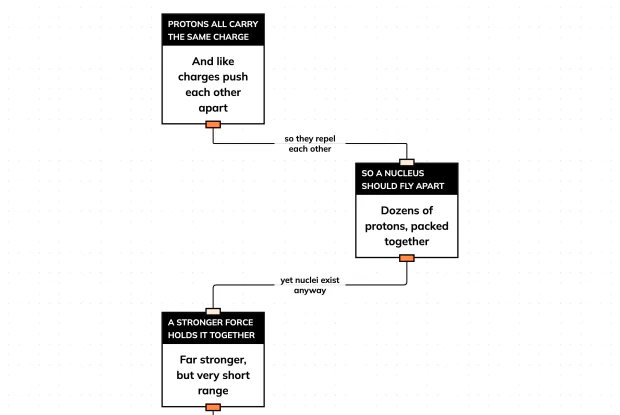
Why Are Some Nuclei Unstable?
Every proton repels every other, so a nucleus packed with them ought to fly apart instantly. Find out what holds it together and when that fails, in an interactive playground.
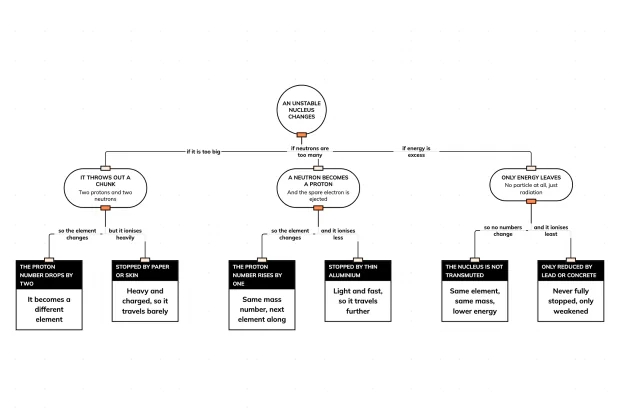
What Happens When a Nucleus Decays? Alpha, Beta, Gamma
An unstable nucleus has three ways to fix itself, and each changes something different about the atom. Sort what comes out and what is left behind, in an interactive playground.
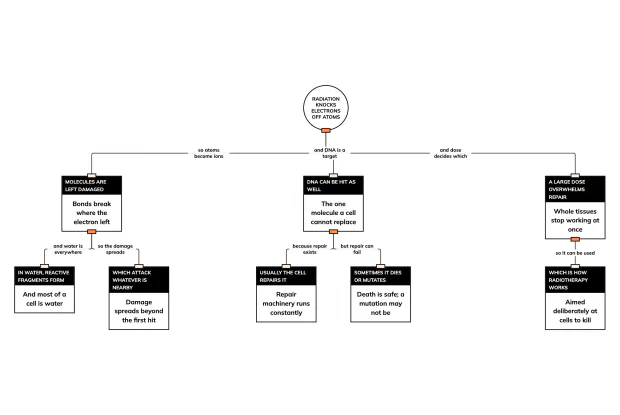
What Does Radiation Actually Do? One Mechanism
Light is radiation and so is radio, and neither is dangerous. Find out what separates those from the kind that is, and what it does when it arrives, in an interactive playground.
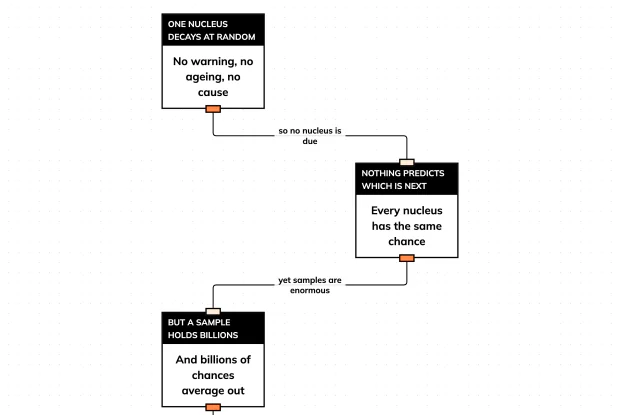
What Is a Half-Life? Random Events, Predictable Totals
Nobody can say when one nucleus will decay, yet a sample halves on an exact schedule. Follow how both of those are true at once, in an interactive playground.
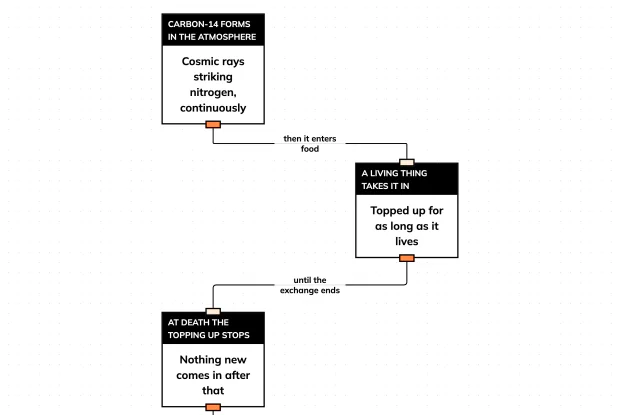
How Does Carbon Dating Work?
Every living thing is slightly radioactive, and stops being topped up the moment it dies. Follow the six steps that turn that into a date, in an interactive playground.