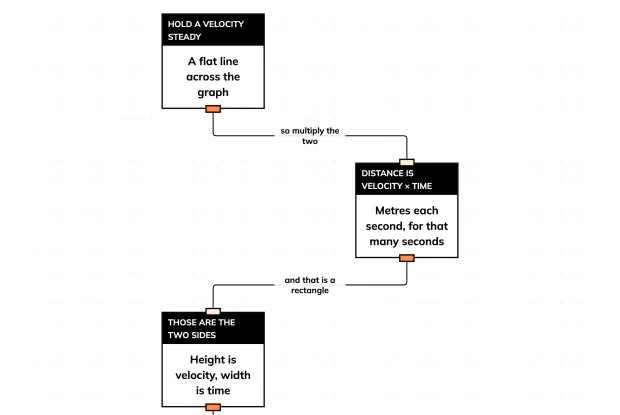
Why Slowing Down Is Also Acceleration
Root Concept
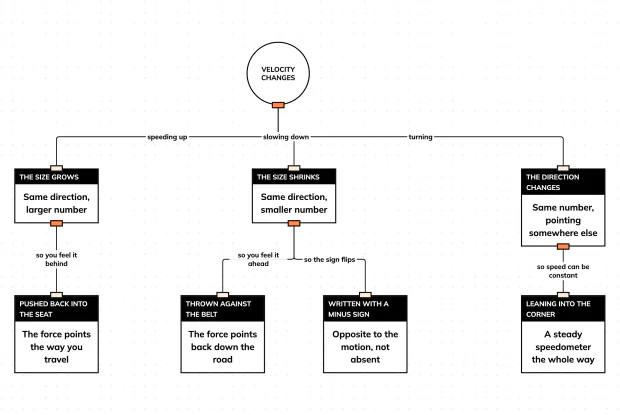
Acceleration is the rate at which velocity changes, so anything that alters a velocity counts — growing, shrinking or merely turning — which is why braking and cornering are both acceleration, and why something travelling extremely fast at a constant velocity has none at all.
CodePLU Goal
Upgrading Human Mental Models
Learn how to think in Workflows

Concept Development By codeplu.com
The three branches are the only three things that can happen to a velocity. Everyday speech has a word for the first one and treats the other two as something else entirely.
A Word That Means Something Narrower Than You Think
In ordinary English, accelerating means going faster, and the accelerator is the pedal that does it. In physics the word means something more specific: acceleration is the rate at which velocity changes. That sounds like a small adjustment to the definition and it changes which situations count.
Press the brake and your velocity is changing, so you are accelerating. Steer round a bend at a perfectly steady 30 km/h and your velocity is changing, because velocity includes direction, so you are accelerating then too — with the speedometer never moving. Meanwhile a train crossing a country at a constant 300 km/h in a straight line has **no acceleration at all**, despite being by far the fastest thing mentioned so far.
That last case is the one that settles it. Acceleration is not a measure of how fast something is going. It is a measure of how quickly the going is changing, and those are independent: you can have a lot of one with none of the other in either combination.
The reason physics insists on this is that acceleration is the quantity forces actually produce. A force does not maintain motion, it changes it — which the earlier tutorial on forces established — and acceleration is the name for what it changes. Defining it as change rather than as speed is what makes that connection work in every case rather than only when something is speeding up.
The Three Ways a Velocity Can Change
How is acceleration actually measured?
As the change in velocity divided by the time it took, which gives units of metres per second, per second. The doubled unit looks odd and is exactly right: it is saying how much the metres-per-second figure changes in each second. A car gaining 3 m/s every second has an acceleration of 3 m/s², so after one second it is doing 3 m/s, after two it is doing 6, and so on. The same arithmetic handles braking without modification — a car dropping from 20 m/s to zero in four seconds has changed velocity by −20 m/s in 4 s, giving −5 m/s². **Nothing special is done for slowing down; the subtraction simply comes out negative.** That is the mark of a definition that was chosen well rather than patched afterwards.
What does a negative acceleration mean?
That the acceleration points the opposite way to the motion, which usually means slowing down but not always. The sign is about direction, not about disapproval. If you choose forwards as positive, then braking gives a negative value because the change is backwards — and people often call this deceleration, which is a perfectly good everyday word that physics does not need, since the minus sign already carries the information. The catch is that a negative acceleration on something already moving backwards makes it move backwards faster. So the honest reading of a minus sign is "pointing the other way", and whether that speeds something up or slows it down depends on which way it was going to begin with.
How can turning be acceleration if the speed is steady?
Because velocity is a vector, so changing its direction changes it just as surely as changing its size. A car going round a roundabout at a constant 20 km/h has a velocity pointing north at one moment and east a few seconds later, and those are different velocities even though both have the same number attached. Something had to cause that change, and you can feel it: you lean, loose objects slide across the seat, and the tyres are working hard. All of that is the force producing the acceleration. The previous tutorial made velocity a vector; this is the first place where that choice does real work rather than being a definition to remember.
Why insist on this, when everyday language manages fine?
Because the everyday meaning breaks the link between force and motion, and that link is most of physics. Forces cause acceleration, so if acceleration meant only speeding up, then braking forces and cornering forces would need separate rules and separate names. Defining acceleration as any change of velocity makes one statement cover all three cases: a force changes velocity, and the acceleration is how fast that change happens. The same rule then explains a dropped stone, a braking lorry, a satellite in orbit and a ball on a string, which is a great deal of mileage from one sentence. Narrowing the word to mean only speeding up would cost every one of those cases, which is a steep price for matching everyday usage slightly better.
Real World Example
Three Cases, One Definition
Each of these is a situation where calling it acceleration sounds wrong and is right, or sounds right and is wrong.
Step 1
A lift, and the moment you feel heavy
Standing in a lift, you feel heavier for a second or two as it starts upwards and lighter as it slows to a halt at the top. In between, cruising between floors at a steady speed, you feel exactly normal — even though you are moving the whole time. The sensation tracks acceleration rather than speed, and it switches off completely when the velocity stops changing, however high that steady velocity happens to be. Your body turns out to be a perfectly good accelerometer, and it reports nothing whatsoever about how fast the lift is actually travelling.
Step 2
Why 0 to 100 is the number that gets quoted
Car advertisements give a time for reaching 100 km/h because that time is really a statement about acceleration: the same speed change, so a shorter time means a bigger acceleration. Top speed is a separate quality and the two do not go together reliably — a heavy car can have a high top speed and sluggish acceleration, while a small electric one does the opposite, because the two depend on quite different things about the car. Quoting both numbers is not marketing padding at all, because neither one of them can be worked out from the other.
Step 3
The orbit that is always accelerating
A satellite circling the Earth travels at a very nearly constant speed and is accelerating continuously, because its direction is changing the entire time. Gravity supplies the force, and rather than making the satellite faster it bends the path into a circle. This is impossible to state at all using the everyday meaning of the word, since nothing is getting faster, and it is entirely straightforward using the physics one. Falling and orbiting turn out to be the very same thing happening at two different speeds, and only the broader definition of the word can express that.
FAQs
Final Words
Acceleration is the rate at which velocity changes, and since velocity carries both a size and a direction there are three ways to produce one. The number can grow, which is the everyday meaning. It can shrink, which is braking and comes out as a negative value with no special rule needed. Or the direction alone can change, which is cornering, and happens with the speedometer sitting perfectly still.
None of it is about being fast. A train at a constant 300 km/h has no acceleration, and a car pulling away from traffic lights has a great deal — because acceleration measures how quickly the motion is changing rather than how much of it there is.
The last tutorial of this track puts velocity on a graph instead of distance. The steepness there gives acceleration, and the space underneath the line turns out to answer a question the line itself never asked.
Continue This Track
This concept is part 4 of Putting Numbers on Motion.
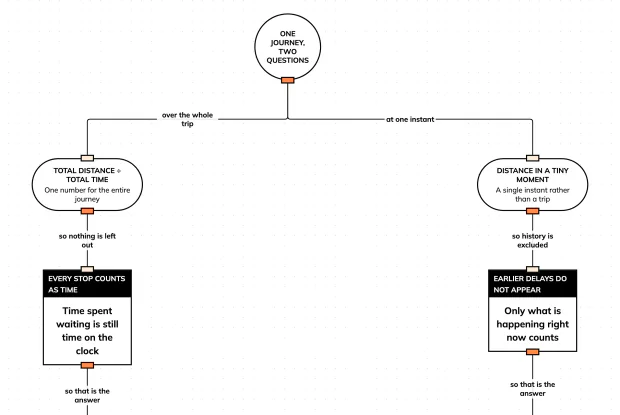
What Does Average Speed Hide? Two Kinds of Speed
A car averages 50 km/h and never once drives at 50. Find out why that is normal rather than contradictory, and sort the two kinds of speed in an interactive playground.
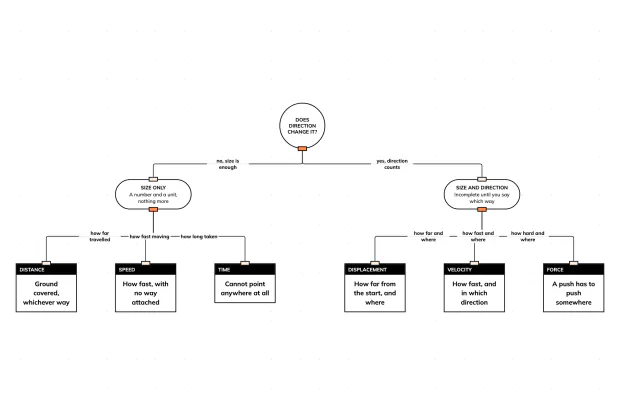
Why Direction Makes It Velocity, Not Just Speed
Run a full lap and your average velocity is zero, however hard you ran. Find out why direction changes the quantity itself, and sort six of them in an interactive playground.
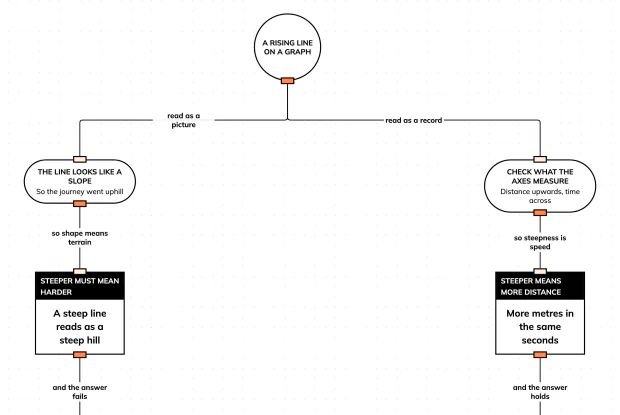
Why a Distance-Time Graph Is Not a Picture
A rising line does not mean a hill and a flat line does not mean level ground. Find out what a distance-time graph actually records, and read one properly in an interactive playground.
Why Slowing Down Is Also Acceleration
Braking is acceleration. So is turning a corner at a steady speed. Find out why acceleration means change rather than fastness, and build the three cases in an interactive playground.
Why Area on a Velocity-Time Graph Is Distance
On a velocity-time graph the steepness is acceleration and the area underneath is distance travelled. Follow why that is true rather than a rule to memorise, in an interactive playground.