Why Direction Makes It Velocity, Not Just Speed
Root Concept
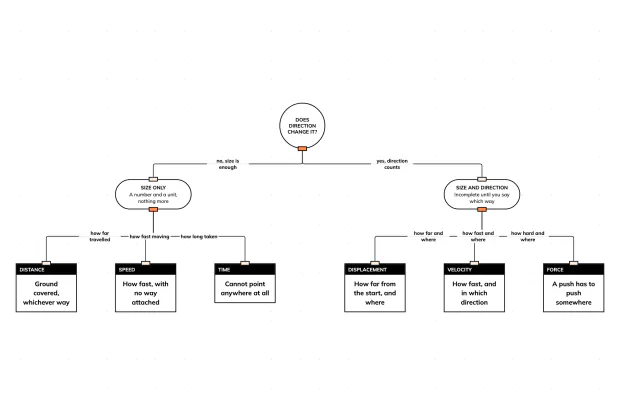
Speed and distance describe how much without saying which way, while velocity and displacement carry a direction as part of the quantity itself — so a journey that returns to its starting point has travelled a real distance at a real speed while its displacement and its average velocity are both exactly zero.
CodePLU Goal
Upgrading Human Mental Models
Learn how to think in Workflows

Concept Development By codeplu.com
The test on the top node is the only one that matters. If turning the quantity round would change it, direction is part of it and a number alone cannot finish the job.
A Lap That Gets You Nowhere
A runner does one full lap of a 400-metre track in 80 seconds. How far did they run? Four hundred metres, obviously. How fast? Five metres per second. Both answers are correct and both describe real effort that really happened.
Now ask a slightly different question: how far are they from where they started? Nothing. They are standing on the same line they set off from. And if you ask for their average velocity, the answer is zero metres per second — not small, not approximately zero, exactly zero. The runner is entitled to find this annoying.
This is not a trick. It is two different questions that English lets us ask with nearly the same words. **Distance** is how much ground went under your feet, and it only ever grows. **Displacement** is how far you have ended up from where you began, together with which way, and it can shrink, sit at zero, or go negative.
Speed and velocity are those same two ideas divided by time. Speed is distance per second and only ever grows. Velocity is displacement per second, so it carries a direction, and a journey that doubles back has velocity working against itself.
Quantities that need a direction to be complete are called vectors; ones finished by a number alone are scalars. The distinction looks like vocabulary and is actually about what can be added together, which is where it starts to matter.
Telling the Two Kinds Apart
What is the actual test for a vector?
Ask whether reversing it would change anything. Turn a five-metre walk east into a five-metre walk west and something genuinely different has happened — you end up ten metres from where you otherwise would have been — so displacement is a vector. Now try it with time: there is no such thing as thirty seconds pointing east, and the question does not even make sense, so time is a scalar. Mass is a scalar for the same reason. **If direction is part of the answer rather than part of the description, the quantity is a vector.** Temperature is a useful one to check against, because it feels like it should have a direction — heat flows somewhere — but twenty degrees is twenty degrees whichever way you face, so it is a scalar.
Why does it matter that they add differently?
Because scalars add straightforwardly and vectors do not. Walk three metres and then four metres and you have certainly walked seven metres of ground, whichever directions they were in — distances simply add. Displacements do not. Three metres east then four metres east leaves you seven metres east, but three east then four west leaves you one metre west, and three east then four north leaves you five metres away in a diagonal direction. Same two numbers, three different answers, because direction decides how much of the second one cancels the first. This is the real reason the distinction is taught rather than a naming convention, and it is why vectors need arrows drawn rather than just values written down.
Can speed stay constant while velocity changes?
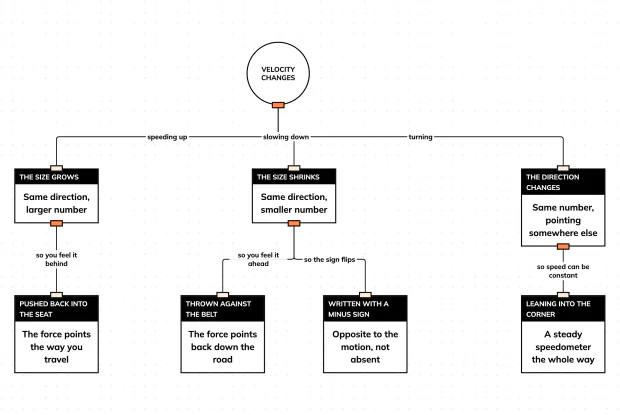
Yes, and it happens constantly. A car going round a roundabout at a steady 20 km/h has an unchanging speed — the speedometer never moves — while its velocity changes every instant, because the direction keeps turning. Velocity is only unchanged when both the size and the direction stay put, so anything travelling in a curve has a changing velocity by definition, however smoothly it is driven. This sounds like a technicality until you remember that changing velocity is exactly what a force produces, which is why you feel pushed sideways on a roundabout even though you are not speeding up. The earlier tutorial on what forces do made that point; this one supplies the word for what is changing.
Is average velocity ever useful, if a lap gives zero?
Very, as long as you want to know about the outcome rather than the effort. Average velocity answers where did this end up and how quickly, which is the question a navigator, a weather forecaster or anyone tracking a parcel actually has. A ship that sails in circles all day has done a great deal of work and made no progress, and average velocity is the quantity that says so honestly. Average speed would report a busy day. Neither is wrong — they are answering effort and progress, and those come apart whenever a journey is not a straight line. A long-distance walker crossing a country and a dog running back and forth beside them can share an average velocity while their average speeds differ enormously, and both numbers are worth having.
Real World Example
Three Journeys Where They Disagree
Each of these is a case where distance and displacement separate, and where using the wrong one gives a confidently wrong answer.
Step 1
The swimmer who finishes where they started
A swimmer doing twenty lengths of a 25-metre pool covers 500 metres, and if they finish at the end they started from, their displacement is zero. Their average speed might be a respectable 1.2 metres per second while their average velocity is zero. No coach would ever use the velocity figure, because the point of the session is the effort and not the destination. It is a clean case of the right quantity depending entirely on the question asked, and of two correct answers sitting side by side. Zero average velocity describes the pool, not the swimmer.
Step 2
Why aircraft are given headings, not speeds
A pilot told only to fly at 500 km/h has been given almost no instruction. Air traffic control issues a heading as well, because the aircraft needs a velocity rather than a speed. Wind makes this sharper still: an aeroplane pointing north while a crosswind blows east actually travels somewhere between the two, so its velocity through the air and its velocity over the ground are different vectors that have to be added properly before anyone knows where the aircraft is actually going. Pointing the nose where you want to go is not the same as going there, and only vectors show why.
Step 3
A satnav measuring the wrong thing
The distance a satnav reports for a route is a distance, not a displacement, which is why a winding mountain road of 40 kilometres can connect two towns 12 kilometres apart. Both numbers are real. The 12 kilometres is what a bird would fly and what the map scale shows; the 40 is what the car actually covers and what the fuel gauge responds to. Confusing them is how people underestimate mountain journeys so reliably, and why a map and a route planner can disagree without either being wrong. The straight-line figure answers how far apart, and the road figure answers how far to drive.
FAQs
Final Words
Distance and speed answer how much and how fast without ever saying which way, so they only grow and they add straightforwardly. Displacement and velocity carry a direction as part of the quantity, so they can cancel, sit at zero, or take a sign — and a lap of a track leaves a real distance and a real speed beside a displacement and an average velocity of exactly nothing.
The test is always the same. Ask whether turning the quantity round would change what it describes. If it would, no number on its own can finish the job.
Both tutorials so far have put numbers on motion one at a time. The next one draws a whole journey at once on a graph — and shows why the most natural way to read that graph is also the wrong one.
Continue This Track
This concept is part 2 of Putting Numbers on Motion.
What Does Average Speed Hide? Two Kinds of Speed
A car averages 50 km/h and never once drives at 50. Find out why that is normal rather than contradictory, and sort the two kinds of speed in an interactive playground.
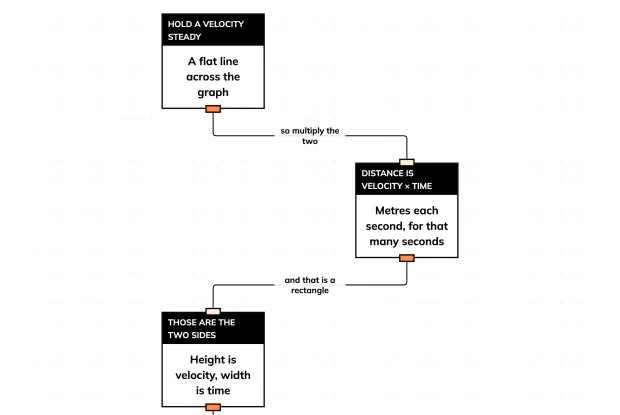
Why Direction Makes It Velocity, Not Just Speed
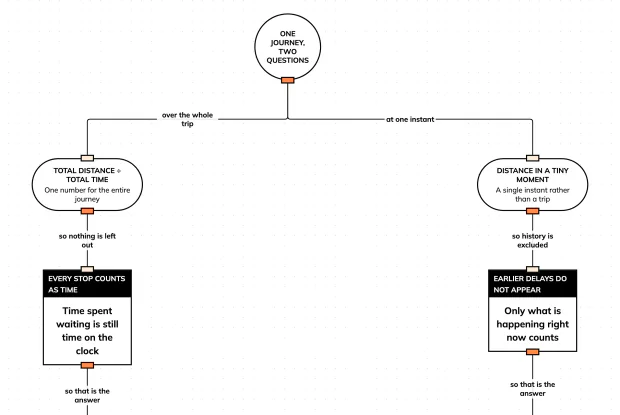
Run a full lap and your average velocity is zero, however hard you ran. Find out why direction changes the quantity itself, and sort six of them in an interactive playground.
Why a Distance-Time Graph Is Not a Picture
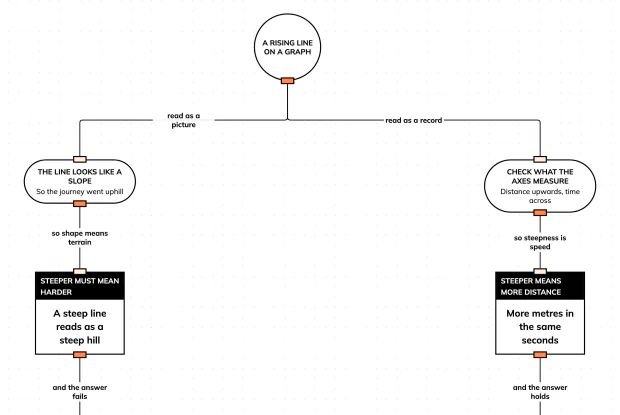
A rising line does not mean a hill and a flat line does not mean level ground. Find out what a distance-time graph actually records, and read one properly in an interactive playground.
Why Slowing Down Is Also Acceleration
Braking is acceleration. So is turning a corner at a steady speed. Find out why acceleration means change rather than fastness, and build the three cases in an interactive playground.
Why Area on a Velocity-Time Graph Is Distance
On a velocity-time graph the steepness is acceleration and the area underneath is distance travelled. Follow why that is true rather than a rule to memorise, in an interactive playground.