What Does Average Speed Hide? Two Kinds of Speed
Root Concept
Speed is distance divided by time, but which distance and which time you choose gives two different quantities: average speed covers an entire journey including every stop, while instantaneous speed covers a moment so short that nothing has time to change — which is why a speedometer reading and a journey average rarely agree.
CodePLU Goal
Upgrading Human Mental Models
Learn how to think in Workflows

Concept Development By codeplu.com
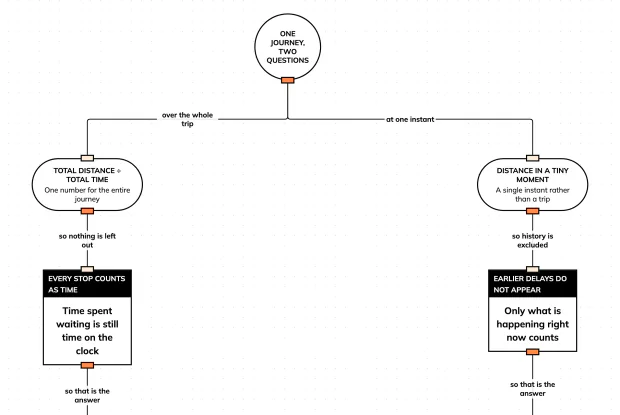
Both routes begin at the same journey and use the same division. What separates them is how much of the journey goes into the sum, and that choice is the whole difference.
A Number That Describes Nothing That Happened
A car drives from one city to another, 150 kilometres, and the trip takes three hours. The average speed is 50 kilometres per hour. Now here is the awkward part: there may not have been a single moment of that journey when the car was actually moving at 50. It sat at 110 on the motorway, crawled at 15 through a town, and stood completely still at a level crossing for six minutes.
That is not a flaw in the calculation. It is what an average is for. Average speed answers one specific question — how much ground was covered for how much time spent — and it answers it by deliberately throwing away everything about how the journey was distributed. Fast stretches and stationary minutes go into the same sum and come out as one number.
The speedometer is answering a completely different question. It is not interested in the trip at all. It reports how fast the car is going **at this instant**, and it changes the moment the car changes. Six minutes at the level crossing would show as zero, which is honest, while those same six minutes quietly drag the journey average down without ever showing up as a zero anywhere.
Both numbers are correct and neither is more real than the other. Knowing which one a question is asking for is the actual skill, because using the wrong one produces answers that are not slightly off but completely wrong.
Choosing Which Speed You Mean
What exactly does average speed average?
Distance and time, not speeds — and that is the part people get wrong. Average speed is the total distance divided by the total time, which is not the same as adding your speeds up and dividing by how many there were. Drive 60 kilometres at 60 km/h and then 60 kilometres at 20 km/h: the two speeds average to 40, but the real answer is 30, because the slow half took three times as long and therefore gets three times the weight. **Time spent at a speed is what matters, not the speed itself.** This is why a short burst of very fast driving barely moves a journey average while a long queue destroys it, and it is why averaging the numbers on the speedometer would give the wrong answer even if you wrote every one of them down.
How can a speed be measured at an instant?
By making the interval short enough that nothing has time to change within it. Strictly, dividing distance by time needs some time to pass, so a truly instantaneous measurement sounds impossible. The way round it is to shrink the interval: measure over a second, then a hundredth of a second, then a thousandth. As the interval gets smaller the answer stops wobbling and settles on a value, and that settled value is the instantaneous speed. A car speedometer does something close to this by counting wheel rotations over a very short window and updating constantly. The interval is never actually zero — it just becomes short enough that the difference stops mattering for any practical purpose.
Why does a stop hurt the average so much?
Because standing still adds time to the bottom of the fraction while adding nothing to the top. Every other part of a journey at least contributes some distance for the time it uses. A stop contributes none, so it is pure penalty — and the longer it lasts the more it drags. A ten-minute delay on a two-hour drive takes roughly eight per cent off the average, and no amount of speeding afterwards gets it back cheaply, because catching up means covering the same distance in less of the remaining time. This is the honest reason journey times are so hard to make up, and it is arithmetic rather than bad luck.
When is each one the right number to use?
Average speed answers planning questions and instantaneous speed answers safety ones. If you want to know when you will arrive, the average is exactly right, because arrival depends on total distance and total time and on nothing else about how the journey was distributed. If you want to know whether a corner can be taken or whether a speed limit is being broken, only the instantaneous value means anything — a driver caught at 90 in a 50 zone cannot defend it by pointing at a journey average of 45. **The question decides the quantity**, and the two are not interchangeable even though both are measured in the same units and both are called speed.
Real World Example
Three Places the Difference Shows
Each of these is a case where the two kinds of speed give genuinely different numbers, and only one of them answers the question asked.
Step 1
Average speed cameras on a motorway
Ordinary speed cameras measure instantaneous speed at one point, which is why drivers learned to brake for them and accelerate away afterwards. Average speed cameras defeat that completely by photographing a car entering a stretch and again leaving it, then dividing the known distance by the measured time. There is no moment to brake for, because the whole section is the measurement. It is exactly the same arithmetic as a journey average, used here quite deliberately to make the instantaneous value irrelevant. Choosing which quantity to measure changed the behaviour it was meant to control.
Step 2
A world record that nobody ran
A sprinter covering 100 metres in 10 seconds has an average speed of 10 metres per second, and that number describes no part of the race accurately. The start is from rest, so the first instant is zero. Peak speed comes somewhere past halfway and is closer to 12 metres per second. The average sits between the two and matches the runner only in passing, on the way up. Comparing athletes by average speed is still fair, because they all cover the same distance — it just does not describe the running. A fair comparison and an accurate description are not the same requirement.
Step 3
Why a satnav keeps changing its mind
An arrival estimate is a prediction about average speed, so it has to guess how much of the route will be spent stopped. That guess is the unreliable part. Current instantaneous speed tells it very little — sitting at a red light at zero does not mean the journey has failed, and 120 on a clear motorway does not mean the rest will be clear. So it leans on traffic data about how long sections have been taking, which is other people’s averages. The estimate updates constantly because it is predicting a quantity that only finishes existing when the journey does.
FAQs
Final Words
Speed is distance divided by time, and the reason there are two kinds is that the phrase does not say which distance and which time. Take the whole journey and you get average speed, a single number that includes every stop and describes how much ground was covered for the time spent. Take an interval short enough that nothing changes within it and you get instantaneous speed, describing one moment and knowing nothing about the rest.
Neither is the real one. A car that averages 50 while never driving at 50 is not a paradox, it is two honest answers to two different questions — and picking the wrong one is how a journey estimate gets used to argue about a speed limit.
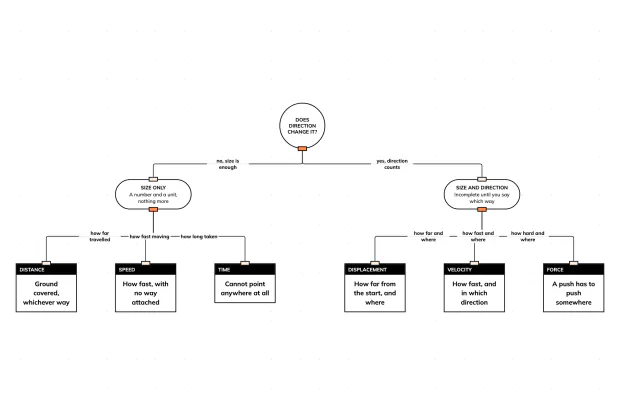
Both of these describe how fast, and neither says anything at all about which way. The next tutorial shows why adding direction turns speed into a different quantity, and why that matters for a journey that ends where it began.
Continue This Track
This concept is part 1 of Putting Numbers on Motion.
What Does Average Speed Hide? Two Kinds of Speed
A car averages 50 km/h and never once drives at 50. Find out why that is normal rather than contradictory, and sort the two kinds of speed in an interactive playground.
Why Direction Makes It Velocity, Not Just Speed
Run a full lap and your average velocity is zero, however hard you ran. Find out why direction changes the quantity itself, and sort six of them in an interactive playground.
Why a Distance-Time Graph Is Not a Picture
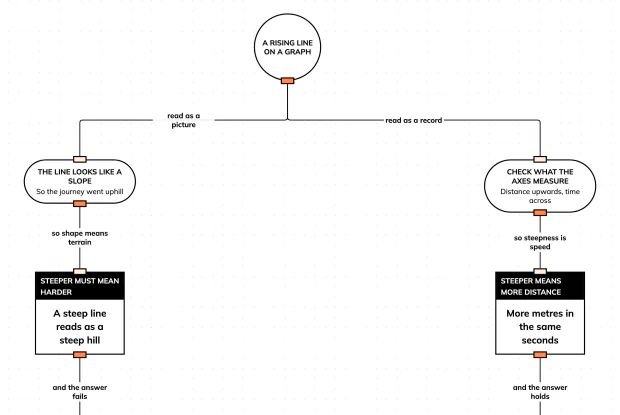
A rising line does not mean a hill and a flat line does not mean level ground. Find out what a distance-time graph actually records, and read one properly in an interactive playground.
Why Slowing Down Is Also Acceleration
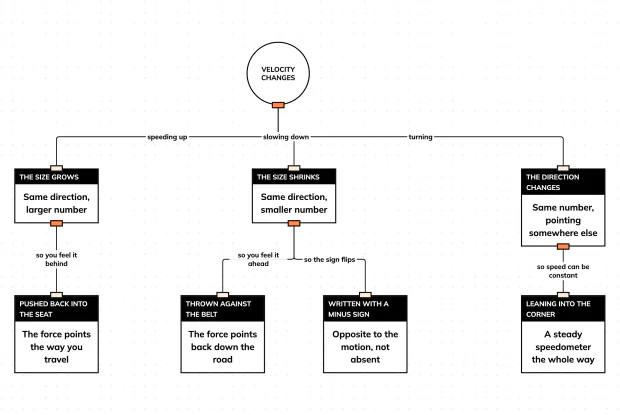
Braking is acceleration. So is turning a corner at a steady speed. Find out why acceleration means change rather than fastness, and build the three cases in an interactive playground.
Why Area on a Velocity-Time Graph Is Distance
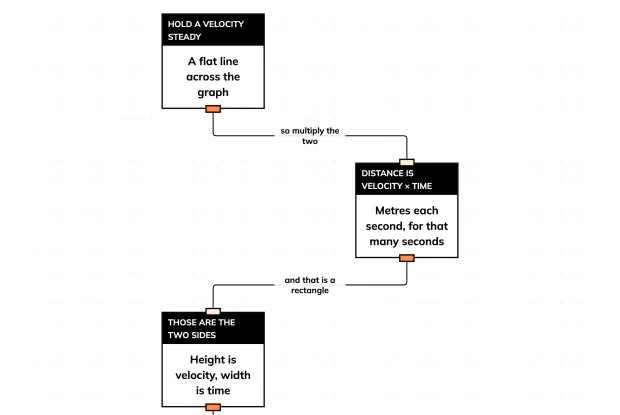
On a velocity-time graph the steepness is acceleration and the area underneath is distance travelled. Follow why that is true rather than a rule to memorise, in an interactive playground.