Why Must a Chemical Equation Balance? Count Atoms
Root Concept
A chemical equation must balance because atoms are rearranged rather than created or destroyed, so each element must appear in equal numbers on both sides; and the only numbers that may be changed are the coefficients, because a subscript states what a substance is and altering one replaces it with a different substance.
CodePLU Goal
Upgrading Human Mental Models
Learn how to think in Workflows

Concept Development By codeplu.com
The fourth step is the one usually left out, and it is the only one that explains why the rules are what they are.
A Word Borrowed From the Wrong Subject
Balancing an equation is usually taught as a procedure: put numbers in front of the formulae until the counts match, starting with whatever element appears in the fewest places. The procedure works. Learned on its own it teaches no chemistry at all, and it leaves two obvious questions unanswered — why the counts have to match, and why you are allowed to change one kind of number but not the other.
There is also a word problem. This site has an algebra tutorial on balancing equations, and there balancing means keeping two sides equal by doing the same thing to each. That is a completely different operation, and importing it here causes real damage: in chemistry you may not do the same thing to both sides, there is no equals sign, and the two sides are not two ways of writing the same value. The shared word is a coincidence of English.
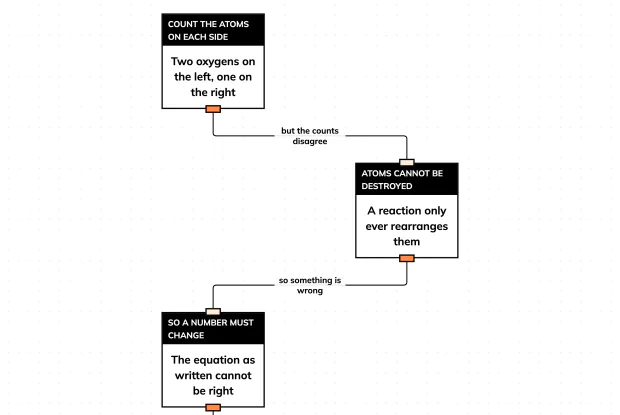
What balancing actually is, is a count of atoms. The previous tutorial established that a reaction rearranges atoms and never creates or destroys them, which is why a sealed flask does not change weight. So every atom on the left must appear somewhere on the right. An equation whose counts disagree is making a claim about the world that is false, and it has to be corrected.
The playground derives the rule rather than stating it, and the step most often left out — why a subscript may never be touched — is a node of its own.
Deriving the Rules
Why must the counts match at all?
Because of conservation of mass, which the previous tutorial derived from what a reaction is. Reactions break and make bonds by moving electrons, and nothing in that touches a nucleus, so every atom present at the start is present at the end. Writing H₂ + O₂ → H₂O therefore claims that an oxygen atom went in and did not come out, which is not something that happens. The equation is not merely untidy or inconvenient to use; it is a false statement about a reaction. Balancing is the act of making the written version agree with what the atoms actually did, and the finished equation is useful precisely because it now reports a real ratio.
Why may you not change a subscript?
Because a subscript is part of the substance’s identity rather than a quantity. H₂O is water. H₂O₂ is hydrogen peroxide, which is used as a bleach and a disinfectant and would not be put in a kettle. Changing the small 2 does not give you more water or less water; it gives you a different substance altogether, and the equation now describes a reaction nobody asked about. The same applies throughout: CO is carbon monoxide and CO₂ is carbon dioxide, one of them lethal in minutes and the other in every exhaled breath. This is the step that is nearly always skipped, and it is the only one that explains why the rules of balancing are what they are.
So what are you allowed to change?
The coefficients — the full-size numbers in front of a formula — and nothing else. A coefficient counts whole units of a substance, so changing it changes how much of that substance is involved without changing what it is. Writing 2H₂O means two water molecules, each still water. That is exactly the freedom balancing needs: the substances are fixed by the chemistry, and the quantities are what you are solving for. Note that a coefficient multiplies everything in the formula after it, so 2H₂O contains four hydrogen atoms and two oxygen atoms, not two and one. Getting that multiplication wrong is the commonest arithmetic slip in balancing. Recounting the whole formula after every change catches it.
How does the counting actually go?
Take hydrogen burning. Start with H₂ + O₂ → H₂O and count: hydrogen is 2 on the left and 2 on the right, which is fine; oxygen is 2 on the left and 1 on the right, which is not. Since the subscripts are fixed, the only move is to put a 2 in front of H₂O, giving two water molecules and therefore 2 oxygen atoms. Now recount, because fixing one element often disturbs another: hydrogen is now 2 on the left and 4 on the right. Put a 2 in front of H₂ and it becomes 4 against 4. The finished equation is 2H₂ + O₂ → 2H₂O, read aloud as two hydrogen plus oxygen gives two water. Recounting after every change is the habit worth forming.
Real World Example
What the Ratio Is Actually Worth
The numbers are not bookkeeping. Once an equation balances, it tells you how much of everything a process needs.
Step 1
The two-to-one ratio was measured before it was explained
When water was first split by an electric current in 1800, the experimenters collected twice the volume of hydrogen as oxygen, every time, from every sample. That reliable two-to-one was a fact about the world long before anybody could say why, and it is exactly what the balanced equation 2H₂O → 2H₂ + O₂ records. The equation is not a convention agreed among chemists; it is a measurement written in symbols, and an unbalanced version of it would contradict what the apparatus plainly showed. The notation had to fit the measurement, not the other way round, which is the right way for a notation to be judged.
Step 2
Ammonia: the ratio that feeds much of the world
Nitrogen and hydrogen combine to give ammonia, the basis of most fertiliser, and the balanced equation is N₂ + 3H₂ → 2NH₃ — read aloud, nitrogen plus three hydrogen gives two ammonia. That 1 to 3 ratio is what a plant is built around: the gases are fed in at those proportions because any excess of one is simply wasted. Getting the coefficients right is the difference between a process that works and one that throws away an expensive reactant, which is why balancing is an industrial concern and not only a classroom one. The same ratio also sets how much hydrogen has to be made first.
Step 3
Why the oxygen in a combustion equation matters
Burning methane is CH₄ + 2O₂ → CO₂ + 2H₂O, and the 2 in front of the oxygen is the whole of the design problem for a gas burner. Supply less oxygen than the equation demands and the reaction cannot complete, producing carbon monoxide instead of carbon dioxide — a gas that is colourless, odourless and lethal, and the reason gas appliances are serviced and ventilated. The balanced equation states the minimum air requirement exactly, which is why it appears on the engineering side of the problem and not only the chemistry side A coefficient on an equation is a safety figure.
FAQs
Final Words
Balancing is a count of atoms, and the reasoning behind it is short. A reaction rearranges atoms and never creates or destroys them, so every atom on the left must appear on the right. An equation whose counts disagree is making a false claim, so something in it has to change — and the only thing that may change is a coefficient.
That last restriction is the step usually left out, and it is the one that makes the rules make sense rather than merely work. A subscript states what a substance is: change the small number in H₂O and you have hydrogen peroxide, not more water, and the equation now describes a reaction nobody asked about. A coefficient states how much of that substance is involved, which is exactly the freedom balancing needs. None of this is algebra: there is no equals sign, nothing is done to both sides, and the two sides may never be swapped.
Continue This Track
This concept is part 4 of What Happens in a Reaction.
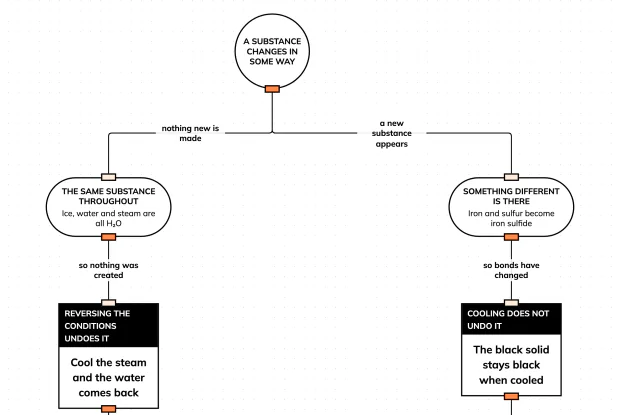
Physical or Chemical Change? Ask What Came Out
Boiling a kettle looks violent and changes nothing; a nail rusting looks like nothing and changes everything. One test separates them. Follow both routes in an interactive playground.
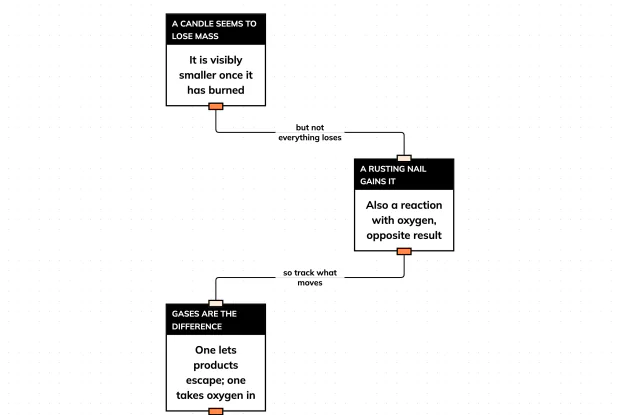
Where Does the Mass Go When Something Burns?
Burning looks like matter disappearing and rusting looks like matter appearing. Neither happens. Follow the reasoning to conservation of mass in an interactive playground.
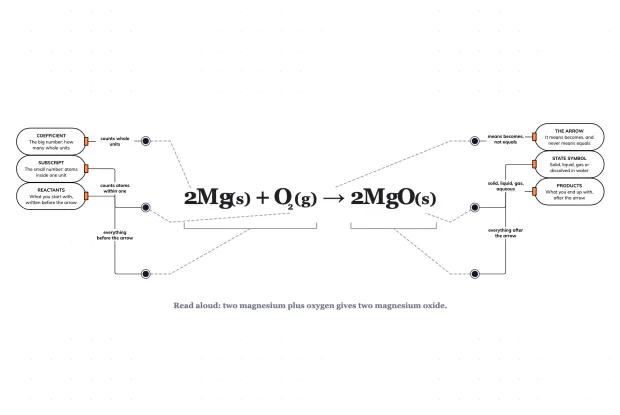
What Does a Chemical Equation Actually Say?
A chemical equation is a sentence with a fixed grammar. Label every part of one — including the two numbers that look alike and mean completely different things — in an interactive playground.
Why Must a Chemical Equation Balance? Count Atoms
Balancing is not algebra and has nothing to do with doing the same to both sides. It is a count of atoms, and only one of the two numbers may be touched. Follow the reasoning in an interactive playground.
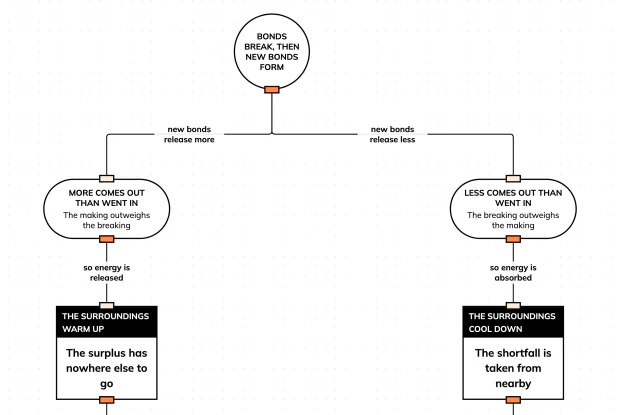
Exothermic or Endothermic? Compare the Two Totals
Every reaction breaks bonds and makes bonds, and which total is larger decides whether the surroundings warm or cool. Follow both outcomes from one starting point in an interactive playground.