What Happens in a Reaction
Five parts on chemical change itself, starting with the test that decides whether one has happened at all — and it is not how dramatic the change looks. A kettle boiling is the noisiest thing in the room and nothing about the water has altered; a nail rusting in a shed is silent and has genuinely become something else. The question is only whether a substance is present at the end that was not there at the start. The second part takes the accounting that follows, through two observations that appear to contradict each other: a candle shrinks as it burns and a rusting nail gets heavier, and neither has created or destroyed anything — seal the container and the balance does not move, because a reaction rearranges atoms and never touches a nucleus. The middle part reads a chemical equation properly, since the parts that look decorative are the ones carrying the information: the arrow means becomes and never equals, the state symbols say where everything is, and the two numbers that look alike mean entirely different things. The fourth part turns that into the rule for balancing, and insists on the step that is nearly always skipped — a coefficient states how much of a substance there is, a subscript states which substance it is, and that asymmetry is the whole reason only one of them may be changed. It is also, despite the shared word, nothing whatever to do with balancing in algebra. The last part asks what a reaction will feel like: every one of them breaks bonds, which costs energy, and makes bonds, which releases it, so whether a flask warms or cools is decided by which total is larger.
CodePLU Goal
Upgrading Human Mental Models
Learn how to think in Workflows
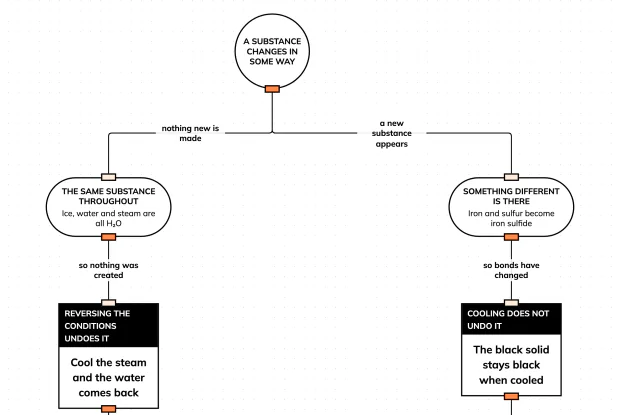
Physical or Chemical Change? Ask What Came Out
Boiling a kettle looks violent and changes nothing; a nail rusting looks like nothing and changes everything. One test separates them. Follow both routes in an interactive playground.
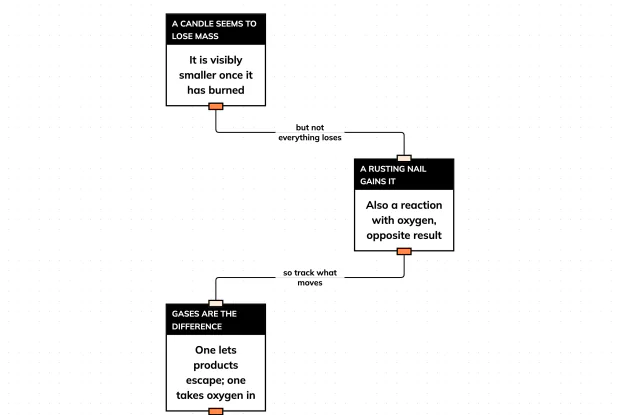
Where Does the Mass Go When Something Burns?
Burning looks like matter disappearing and rusting looks like matter appearing. Neither happens. Follow the reasoning to conservation of mass in an interactive playground.
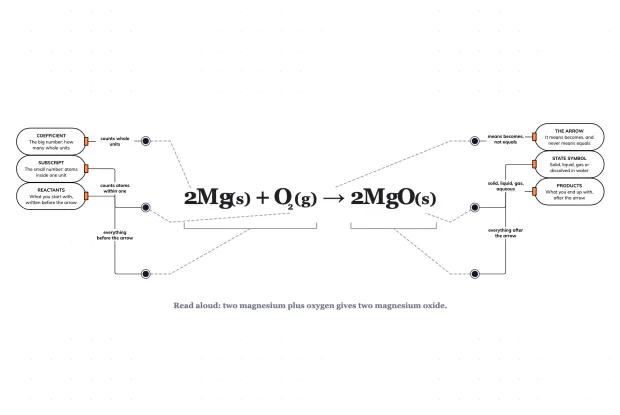
What Does a Chemical Equation Actually Say?
A chemical equation is a sentence with a fixed grammar. Label every part of one — including the two numbers that look alike and mean completely different things — in an interactive playground.
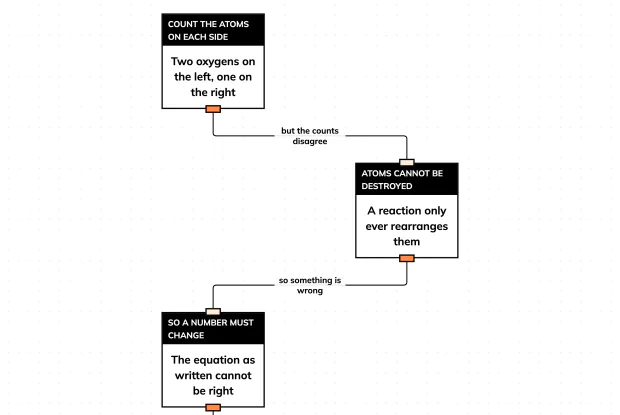
Why Must a Chemical Equation Balance? Count Atoms
Balancing is not algebra and has nothing to do with doing the same to both sides. It is a count of atoms, and only one of the two numbers may be touched. Follow the reasoning in an interactive playground.
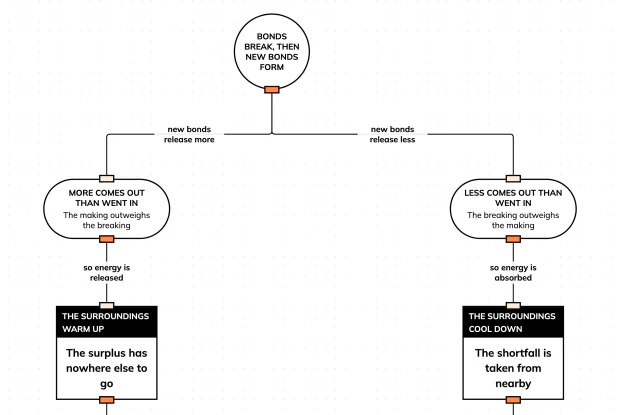
Exothermic or Endothermic? Compare the Two Totals
Every reaction breaks bonds and makes bonds, and which total is larger decides whether the surroundings warm or cool. Follow both outcomes from one starting point in an interactive playground.