Where Does the Mass Go When Something Burns?
Root Concept
Mass is conserved in every chemical reaction because atoms are rearranged rather than created or destroyed, so a burning candle only appears to lose mass because its gaseous products escape, and a rusting nail only appears to gain it because oxygen from the air has been built in — and a sealed container shows no change at all.
CodePLU Goal
Upgrading Human Mental Models
Learn how to think in Workflows

Concept Development By codeplu.com
Two observations that appear to contradict each other, reconciled by asking what crossed the boundary.
Two Observations That Cannot Both Be Right
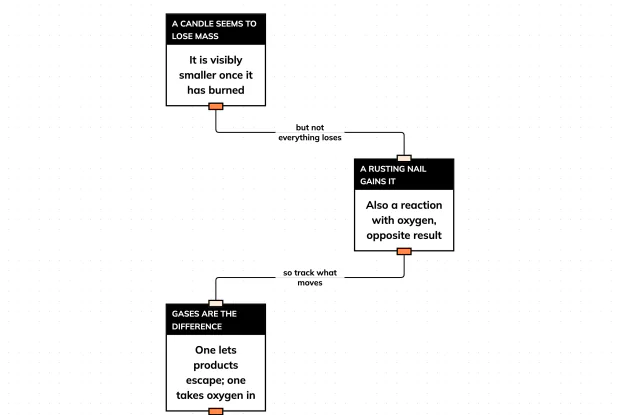
Burn a candle and there is less of it. Leave a nail outside and the rust that forms weighs more than the iron did. Both are reactions with oxygen, and they appear to point in opposite directions — one destroying matter, the other creating it. One of those readings has to be wrong, and in fact both are.
For most of the history of chemistry the first reading was taken seriously. Burning was explained by supposing that a substance escaped from whatever was burning, which accounted neatly for the ash weighing less than the wood. It also failed completely for metals, which gain mass when heated in air, and the fix proposed at the time was that the escaping substance sometimes had negative weight.
What settled it was weighing the surroundings as well as the substance. Carry out a reaction in a sealed container, so nothing can get in or out, and weigh the whole thing before and afterwards: the mass is the same, every time, whatever the reaction. The candle had not destroyed anything — its products were carbon dioxide and water vapour, both gases, and both had simply left. The nail had not created anything either; oxygen from the air had been built into it.
The playground works from those two observations to the rule underneath them, which is the single idea most of this subject rests on.
Following the Accounting
Where does a candle actually go?
Into the air, as two gases. Candle wax is made of carbon and hydrogen, and burning it combines both with oxygen to give carbon dioxide and water vapour. Neither is visible, and both drift away, so what is left behind is less than what was there. Collect them instead of letting them go and the accounting comes out exactly: the carbon dioxide and water together weigh precisely what the wax and the oxygen used weighed. Nothing has been destroyed at any point. The reason this is counter-intuitive is that we treat gases as not quite real, and a litre of air really does weigh something — about 1.2 grams A wheelie bin full of air holds a couple of hundred grams of it.
Where does the extra mass on a nail come from?
From the air, and it can be accounted for down to the gram. Rust is hydrated iron oxide, built from the iron, oxygen from the atmosphere and water. The oxygen and the water had mass before they were part of the rust, and they still have it afterwards; they have simply moved from being part of the surroundings to being part of the solid. The same thing happens dramatically when magnesium is burned, which is a standard school demonstration done behind a screen because of the glare: the white powder left in the crucible weighs more than the ribbon did, and the difference is the oxygen that joined it. The glare is the reason the demonstration is done at a distance and never looked at directly.
What does a sealed container prove?
That the apparent gains and losses are about the boundary rather than about the reaction. If a reaction is run in a sealed flask on a balance, the reading does not move — not when a gas is produced, not when a solid forms out of two clear solutions, not when the mixture gets hot. Open the flask after a gas has formed and the reading drops immediately, because the gas leaves. That one experiment separates two questions people usually run together: whether matter was destroyed, and whether it stayed where you could weigh it. Only the second ever changes, and the first never does It is also why an open dish is the worst possible place to test the question, and why the argument took so long to settle.
Why must this be true at the particle level?
Because a chemical reaction only rearranges atoms, and every atom that goes in comes out. Reactions move electrons about to break and remake bonds, and nothing in that process touches a nucleus — which is exactly why an element cannot be turned into another by chemical means, as the atomic number tutorial showed. So the atoms present at the end are precisely the atoms present at the start, in different company. Since each atom keeps its mass, the total mass cannot change. Conservation of mass is not a separate law bolted on; it follows from what a reactio is. That is worth noticing, because a rule you can derive is one you can rebuild if you forget it, which a rule you merely accepted is not.
Real World Example
How the Argument Was Actually Won
The idea that burning destroys matter held for about a century, and it was not defeated by argument. It was defeated by weighing things carefully enough.
Step 1
The theory that explained burning backwards
Eighteenth-century chemistry explained combustion by supposing that burning substances released something, which was named phlogiston. Wood left ash that weighed less, which fitted perfectly, and the theory was genuinely useful for a time. The difficulty was metals: heating them in air leaves a powder that weighs more than the metal did, which a theory of escape cannot accommodate. The proposed repair was that phlogiston had negative weight, and it is worth noticing that this was a reasonable thing to try rather than an absurd one — it just happened to be wrong A theory that fits most of the evidence and fails on one case is the normal state of science.
Step 2
Weighing the container as well as the contents
Lavoisier, working in the 1770s with balances far better than most of his contemporaries used, heated tin in a sealed vessel and weighed the whole apparatus before and after. The total did not change. Opening the vessel afterwards let air rush in, and the increase in weight then matched the air that entered. That turned burning from a substance escaping into a substance combining, and the gas doing the combining was given the name oxygen. The insight was procedural as much as chemical: weigh the surroundings too. Nothing about the reaction had been hidden; the accounting had simply been incomplete.
Step 3
What the rule buys you afterwards
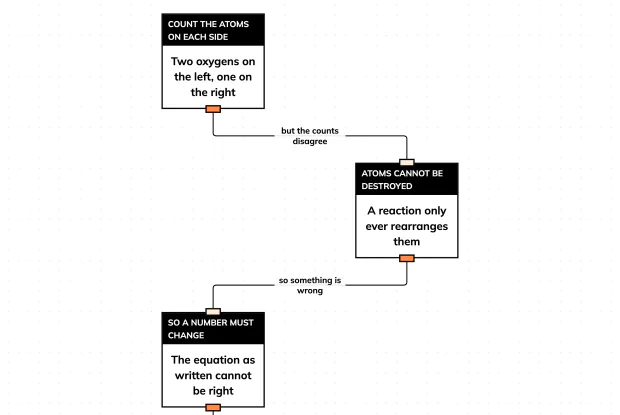
Conservation of mass is not a historical curiosity; it is what makes quantitative chemistry possible at all. If you know the masses going into a reaction you know the total coming out, so an unmeasured product can be found by difference. Industry depends on it to work out how much raw material a given output needs. It is also the reason a chemical equation has to balance, which is the subject of the fourth part of this track — an equation that did not balance would be claiming atoms had appeared or vanished. The rule and the notation are the same idea written twice.
FAQs
Final Words
A candle shrinks and a rusting nail grows, and neither has created or destroyed anything. The candle’s products are carbon dioxide and water vapour, both gases, and both leave; the nail’s extra mass is oxygen taken out of the air and built in. Seal the container so nothing can cross the boundary and the balance does not move at all, whatever the reaction is doing inside it.
Underneath both observations is the rule this subject keeps returning to. A reaction rearranges atoms by moving electrons, and it never touches a nucleus, so every atom that goes in comes out and the total mass cannot change. Conservation of mass is not an extra law; it is a consequence of what a reaction is. It also sets up a requirement for the way reactions are written down: an equation that did not balance would be claiming atoms had appeared from nowhere.
Continue This Track
This concept is part 2 of What Happens in a Reaction.
Physical or Chemical Change? Ask What Came Out
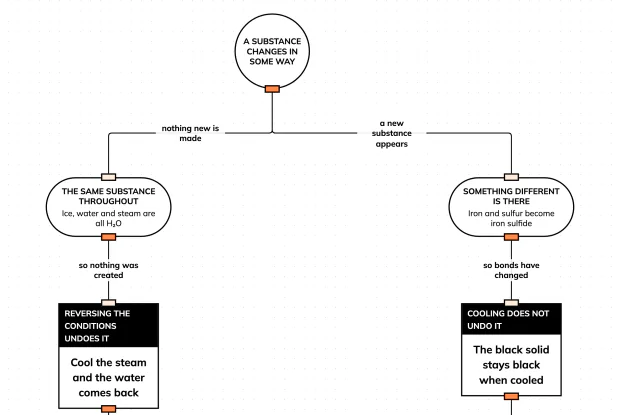
Boiling a kettle looks violent and changes nothing; a nail rusting looks like nothing and changes everything. One test separates them. Follow both routes in an interactive playground.
Where Does the Mass Go When Something Burns?
Burning looks like matter disappearing and rusting looks like matter appearing. Neither happens. Follow the reasoning to conservation of mass in an interactive playground.
What Does a Chemical Equation Actually Say?
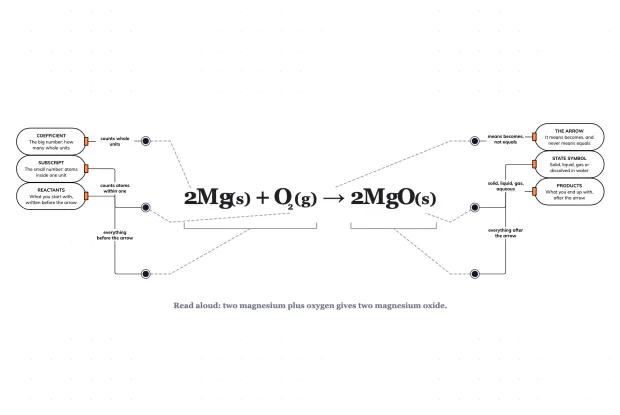
A chemical equation is a sentence with a fixed grammar. Label every part of one — including the two numbers that look alike and mean completely different things — in an interactive playground.
Why Must a Chemical Equation Balance? Count Atoms
Balancing is not algebra and has nothing to do with doing the same to both sides. It is a count of atoms, and only one of the two numbers may be touched. Follow the reasoning in an interactive playground.
Exothermic or Endothermic? Compare the Two Totals
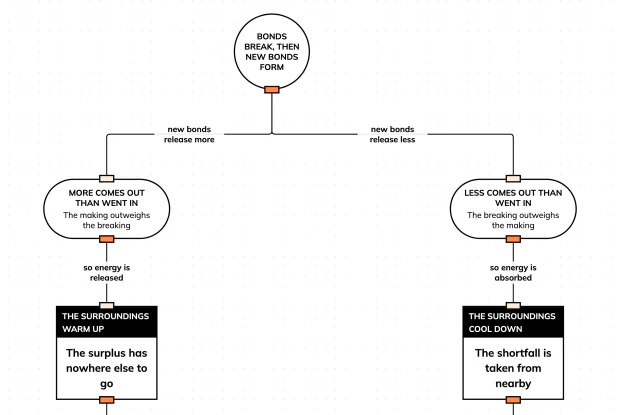
Every reaction breaks bonds and makes bonds, and which total is larger decides whether the surroundings warm or cool. Follow both outcomes from one starting point in an interactive playground.