Exothermic or Endothermic? Compare the Two Totals
Root Concept
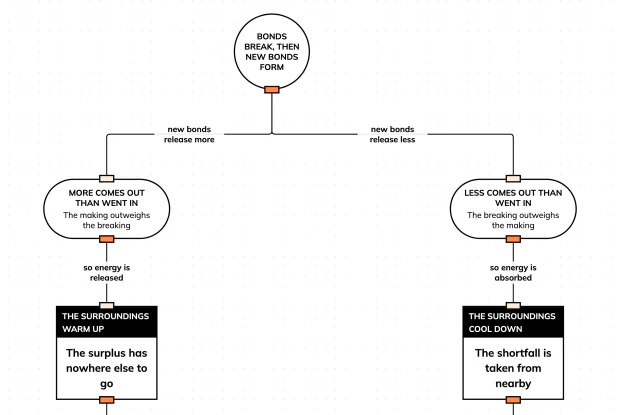
Every reaction breaks bonds, which costs energy, and makes bonds, which releases it, so a reaction is exothermic and warms its surroundings when the bonds made release more than the bonds broken cost, and endothermic and cools them when the reverse is true.
CodePLU Goal
Upgrading Human Mental Models
Learn how to think in Workflows

Concept Development By codeplu.com
Both routes start from the same two events. Only the sizes of the two totals differ.
Both Things Happen in Every Reaction
Some reactions get hot and some get cold, and it is tempting to file them as two different kinds of event. They are not. Every reaction does exactly the same two things: it breaks the bonds in the reactants and it makes new bonds in the products. The only question is which of those two costs or releases more.
The direction is the part that has to be right, and it is the thing most often remembered backwards. **Breaking a bond always costs energy. Making a bond always releases it.** The phrase energy stored in bonds is responsible for most of the confusion, because it suggests that snapping a bond lets something out, like cutting a stretched elastic band. The first tutorial of the bonding track established why the opposite is true: a bond is the lower-energy arrangement, so getting out of one means putting energy in.
Once the direction is right the rest is arithmetic. If the new bonds release more than the old ones cost, there is energy left over, it goes into the surroundings, and the flask gets hot — the reaction is exothermic. If the new bonds release less, the shortfall has to come from somewhere, it is taken from the surroundings, and the flask gets cold — the reaction is endothermic.
What energy itself is, and the fact that it is never created or destroyed, belongs to the physics category and is covered there. This tutorial is about where it goes during a reaction, and the playground runs both outcomes from the same start.
Comparing the Two Totals
Why does breaking a bond cost energy?
Because a bond is the lower-energy arrangement, and leaving a lower arrangement means climbing. Two bonded atoms are held together by electrical attraction — opposite charges in an ionic bond, two nuclei and a shared pair in a covalent one — and pulling them apart works against that attraction, exactly as lifting a ball works against gravity. Nothing is released by the separation. The energy has to be supplied, which is why many reactions need heating before anything happens at all: the first bonds will not break on their own. Making a bond is the same process in reverse, so it gives energy back, which is why the iron and sulfur demonstration kept glowing once it had started.
How do you tell which way a reaction will go?
By adding up the two totals using measured bond energies. Take hydrogen burning: 2H₂ + O₂ → 2H₂O. Breaking two H–H bonds costs 2 × 436 and breaking the O=O costs 498, giving 1370 kilojoules in. Forming four O–H bonds releases 4 × 464, which is 1856 out. More comes out than went in, by 486, so the reaction is strongly exothermic — which is why hydrogen is a fuel. The same sum done on a reaction that needs continuous heating comes out the other way. The numbers are averages taken across many compounds, so the answer is close rather than exact, and the sign is always right even when the size is a little out.
Why does an exothermic reaction often still need a match?
Because the bonds have to be broken before any can be made, and that first step costs energy regardless of how much the reaction will give back afterwards. A mixture of petrol vapour and air sits indefinitely without doing anything; a spark supplies enough to start a small number of molecules reacting, those release energy, and the surplus starts the next lot. The reaction becomes self-sustaining and the match is no longer needed. This is why exothermic does not mean spontaneous, and it is the same pattern as the magnesium and the iron-and-sulfur demonstrations, both of which have to be lit and then carry on by themselves. The energy needed to get a reaction started is a separate quantity from the energy it gives out, and the two are independent.
Is a reaction that feels cold absorbing energy from your hand?
Yes, and that is exactly what feeling cold means. An endothermic reaction needs more energy than it produces, and it takes the difference from whatever is nearest — the solution, the glass, the bench, your skin. Nothing has been created or destroyed anywhere; energy has moved from the surroundings into the chemicals, which is the conservation rule the physics category sets out. The sensation of cold is always energy leaving you rather than cold entering you, and a strongly endothermic reaction in a flask can leave a visible film of frost on the outside of the glass. Cold is never a thing that arrives; it is always warmth going somewhere else, and in this case it is going into breaking bonds.
Real World Example
Three Places the Sum Is Put to Work
The difference between the two totals is not an abstraction. It is what products get designed around.
Step 1
A self-heating can runs an exothermic reaction
Some drinks are sold in cans with a sealed compartment holding calcium oxide and water, kept apart until a button is pressed. Combining them is strongly exothermic, so the surplus energy warms the drink without any external heat. The chemistry is chosen for the size of the surplus and for producing nothing harmful, and the compartment is sealed because the reaction is not meant to touch what you are drinking. It is a reaction packaged purely for the energy it gives out, which is also what a fuel is. The difference is only that a fuel is burned and this is not.
Step 2
An instant cold pack runs the sum in reverse
A cold pack for a sports injury holds a salt and a separate pouch of water, mixed by squeezing. Dissolving the salt is endothermic: more energy is needed to separate the ions than is released when water molecules surround them, so the shortfall comes out of the surroundings and the pack goes cold within seconds. No refrigeration is involved anywhere, which is the whole point — it works in a kit bag on a pitch. It also shows that endothermic changes are genuinely useful rather than merely the other case. Nothing about the pack is refrigerated before use.
Step 3
Photosynthesis is endothermic, and life depends on it
Plants build glucose from carbon dioxide and water, and that reaction needs far more energy than it releases — which is why it cannot happen in the dark. The shortfall is supplied by sunlight. Respiration then runs essentially the reverse reaction and is exothermic, releasing the energy again where an organism needs it, which the biology category covers in detail. Between them they are the largest pair of opposed reactions on the planet, and the accounting is the same sum as in a flask. One supplies the energy and the other spends it, and between the two almost everything alive is paid for.
FAQs
Final Words
Every reaction does both things. Bonds in the reactants are broken, which always costs energy, and bonds in the products are made, which always releases it. Nothing about that differs between a reaction that warms its surroundings and one that cools them — only the sizes of the two totals differ.
If the making releases more than the breaking cost, the surplus goes into the surroundings and the reaction is exothermic: burning, rusting and neutralising all work this way. If it releases less, the shortfall is taken from the surroundings and the reaction is endothermic, which is why a cold pack goes cold and why photosynthesis needs sunlight. Getting the direction right is the whole thing, and it is the thing most often remembered backwards. This track began by asking what makes a change chemical and ends by saying what one will feel like. The next takes a single family of reactions and follows it properly: acids.
Continue This Track
This concept is part 5 of What Happens in a Reaction.
Physical or Chemical Change? Ask What Came Out
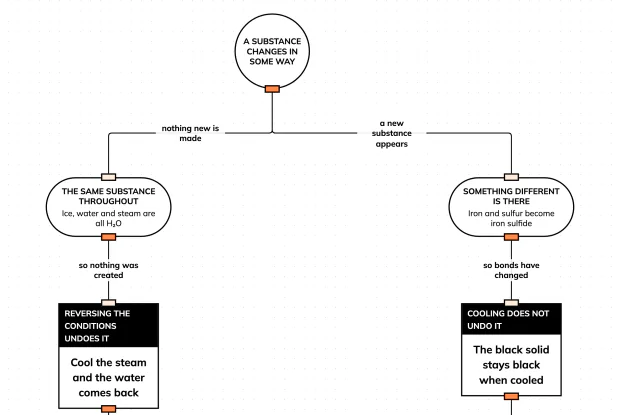
Boiling a kettle looks violent and changes nothing; a nail rusting looks like nothing and changes everything. One test separates them. Follow both routes in an interactive playground.
Where Does the Mass Go When Something Burns?
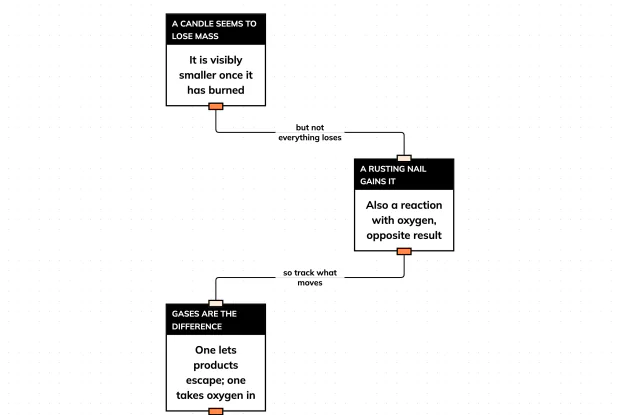
Burning looks like matter disappearing and rusting looks like matter appearing. Neither happens. Follow the reasoning to conservation of mass in an interactive playground.
What Does a Chemical Equation Actually Say?
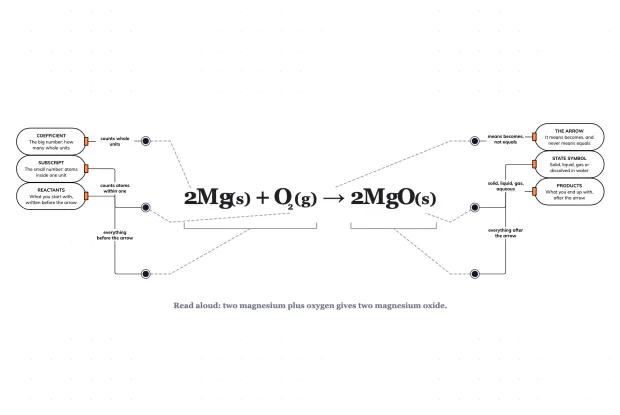
A chemical equation is a sentence with a fixed grammar. Label every part of one — including the two numbers that look alike and mean completely different things — in an interactive playground.
Why Must a Chemical Equation Balance? Count Atoms
Balancing is not algebra and has nothing to do with doing the same to both sides. It is a count of atoms, and only one of the two numbers may be touched. Follow the reasoning in an interactive playground.
Exothermic or Endothermic? Compare the Two Totals
Every reaction breaks bonds and makes bonds, and which total is larger decides whether the surroundings warm or cool. Follow both outcomes from one starting point in an interactive playground.