What Does a Chemical Equation Actually Say?
Root Concept
A chemical equation states which substances react and which are produced, with the arrow meaning becomes rather than equals, and it uses two different numbers — a coefficient counting whole units of a substance and a subscript counting atoms inside one unit — which is why only the coefficient may be changed.
CodePLU Goal
Upgrading Human Mental Models
Learn how to think in Workflows

Concept Development By codeplu.com
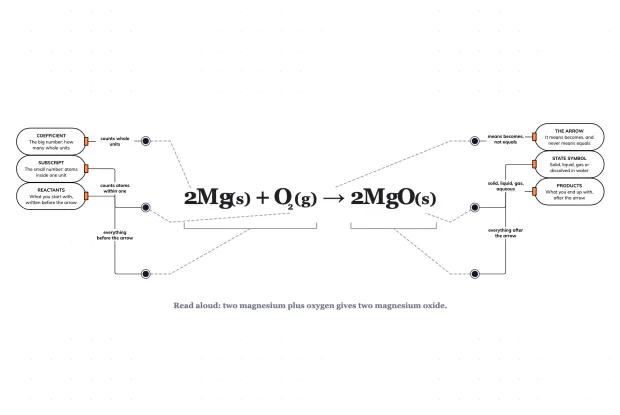
The two numbers are deliberately drawn at different sizes. That size difference is the whole of the distinction.
A Sentence With a Very Strict Grammar
A chemical equation is often met as something to copy down, and copying it is not the same as reading it. Every part of the notation is saying something specific, and the parts that look decorative are usually the ones carrying the information.
Take the one in the playground: 2Mg(s) + O₂(g) → 2MgO(s). Read aloud, that is two magnesium plus oxygen gives two magnesium oxide. It describes magnesium burning, which is the demonstration done behind a screen in school laboratories because the flame is bright enough to hurt your eyes. The substances on the left are the reactants, the ones on the right are the products, and the arrow between them means becomes.
The arrow is the first thing worth being careful about, because it looks like an equals sign and is not one. An equals sign says two things are the same; the arrow says one set of substances turns into another. Magnesium oxide is not the same thing as magnesium and oxygen, and reversing the equation would describe a different reaction entirely.
The second thing is the numbers, of which there are two kinds. The big 2 in front of Mg counts how many whole units of magnesium are involved. The small 2 under the O counts how many oxygen atoms are inside one unit of oxygen gas. They look similar and mean entirely different things, and that distinction is what the next tutorial is built on.
Reading Each Part
Why is the arrow not an equals sign?
Because the two sides are not the same thing. An equals sign in maths asserts that what is written on the left and what is written on the right have the same value, and you may swap them freely — the algebra track on this site covers that. A chemical arrow asserts something weaker and more interesting: that the substances on the left turn into the substances on the right. Magnesium is a metal you can hold and magnesium oxide is a white powder, and nobody would claim they are equal. The two sides do have one thing in common, which is the atoms they contain, and that is what the next tutorial is about. The arrow also records direction: written the other way round it describes extracting magnesium from its oxide, which is a different and much harder process.
What is the difference between the two numbers?
What they count. A coefficient is the full-size number written in front of a formula, and it counts whole units of that substance — the 2 in 2MgO means two units of magnesium oxide. A subscript is the small number written below the line after a symbol, and it counts atoms of that element inside one unit — the 2 in O₂ means each oxygen molecule contains two oxygen atoms. So 2O means two separate oxygen atoms and O₂ means one molecule made of two, which are different things. The consequence is the important part: changing a coefficient changes how much of a substance you have, while changing a subscript changes which substance it is.
What do the state symbols add?
Where the substance actually is, which often matters more than it looks. There are four: (s) for solid, (l) for liquid, (g) for gas, and (aq) for aqueous, meaning dissolved in water. In the magnesium equation they tell you that a solid reacts with a gas to give a solid, which immediately explains why the product weighs more than the metal did — a gas was taken in and nothing left. State symbols are at their most useful when something escapes or appears: a (g) on the product side means mass will seem to vanish from an open container, and an (s) appearing among aqueous substances means a solid has formed out of solution. They are not decoration and should be left out where they carry nothing.
What does an equation not tell you?
A great deal, and knowing the gaps prevents a lot of misreading. It says nothing about how fast the reaction goes, nothing about whether it needs heating to start, nothing about whether it gives out heat or takes it in, and nothing about how much of the reactants actually get used up. The magnesium equation looks identical whether the reaction takes a second or a century. It also says nothing about the mechanism — what happens between the reactants disappearing and the products appearing. An equation is a statement of what goes in and what comes out, in what proportions, and that is both less than people assume and more than enough to be useful.
Real World Example
Three Equations and What Each One Is Telling You
Each of these says something specific that is easy to miss if the equation is treated as a thing to copy rather than a thing to read.
Step 1
CaCO₃(s) → CaO(s) + CO₂(g)
Read aloud: calcium carbonate gives calcium oxide plus carbon dioxide. This is what happens when limestone is heated strongly, and it is the first step in making cement — one of the largest chemical processes on Earth. The state symbols do real work here. One solid becomes another solid plus a gas, so anything heated in an open kiln will appear to lose a great deal of mass as the carbon dioxide leaves. Knowing that before you weigh anything is the difference between a sensible result and apparent magic. The equation warned you before the kiln was lit.
Step 2
2H₂(g) + O₂(g) → 2H₂O(l)
Read aloud: two hydrogen plus oxygen gives two water. Both numbers appear in the same equation and mean different things, which makes it a useful one to read slowly. The big 2 in front of H₂ says two whole hydrogen molecules; the small 2 inside H₂ says each of those molecules is built from two hydrogen atoms. So four hydrogen atoms are involved altogether. Change the big number and you change the quantity; change the small one and H₂O becomes H₂O₂, which is hydrogen peroxide and a completely different substance. One number is a quantity and the other is an identity.
Step 3
Zn(s) + 2HCl(aq) → ZnCl₂(aq) + H₂(g)
Read aloud: zinc plus two hydrochloric acid gives zinc chloride plus hydrogen. This is the standard school method of producing hydrogen, carried out in a laboratory and never improvised, and the state symbols describe exactly what you would see. A solid disappears into a solution, the product stays dissolved and so remains invisible, and a gas bubbles off — which is why the apparatus is set up to collect it. Four substances, four different states, and the equation tells you about all of them before anything is set up. Reading it properly is the difference between following a procedure and knowing what to expect.
FAQs
Final Words
A chemical equation has a fixed grammar and every part of it is saying something. The substances before the arrow are the reactants and the ones after it are the products. The arrow means becomes, not equals, and it records direction — written the other way round it would describe a different and usually much harder process. State symbols say where each substance is, and they earn their place when something escapes as a gas or appears out of solution.
The part worth carrying into the next tutorial is the two numbers. A coefficient is full-size, sits in front of a formula, and counts whole units of a substance. A subscript is small, sits after a symbol, and counts atoms inside one unit. Changing a coefficient changes how much you have; changing a subscript changes what the substance is. That asymmetry is the reason balancing an equation works the way it does.
Continue This Track
This concept is part 3 of What Happens in a Reaction.
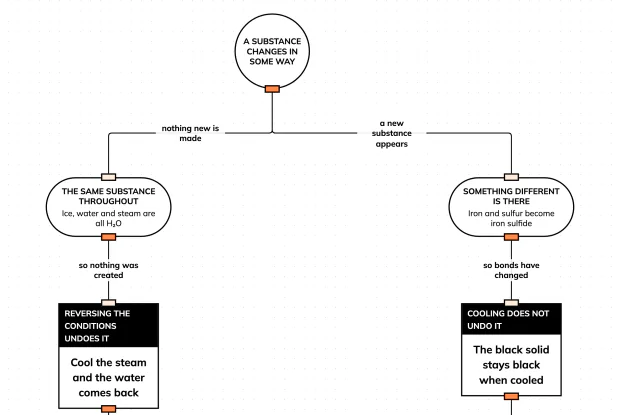
Physical or Chemical Change? Ask What Came Out
Boiling a kettle looks violent and changes nothing; a nail rusting looks like nothing and changes everything. One test separates them. Follow both routes in an interactive playground.
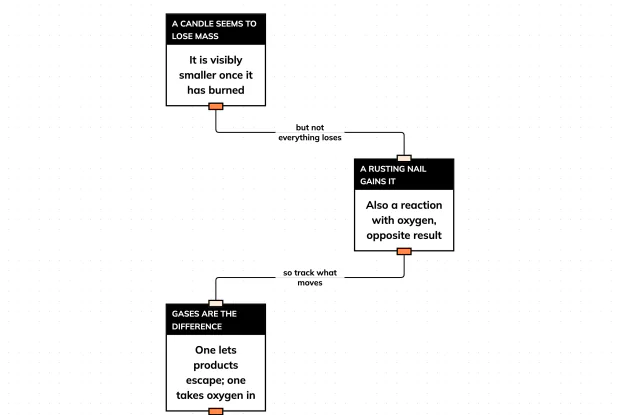
Where Does the Mass Go When Something Burns?
Burning looks like matter disappearing and rusting looks like matter appearing. Neither happens. Follow the reasoning to conservation of mass in an interactive playground.
What Does a Chemical Equation Actually Say?
A chemical equation is a sentence with a fixed grammar. Label every part of one — including the two numbers that look alike and mean completely different things — in an interactive playground.
Why Must a Chemical Equation Balance? Count Atoms
Balancing is not algebra and has nothing to do with doing the same to both sides. It is a count of atoms, and only one of the two numbers may be touched. Follow the reasoning in an interactive playground.
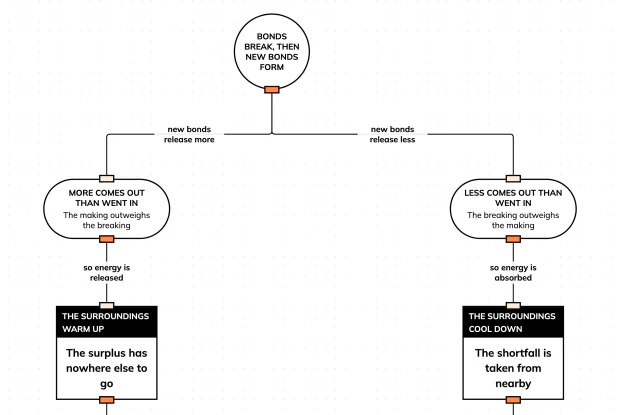
Exothermic or Endothermic? Compare the Two Totals
Every reaction breaks bonds and makes bonds, and which total is larger decides whether the surroundings warm or cool. Follow both outcomes from one starting point in an interactive playground.