Physical or Chemical Change? Ask What Came Out
Root Concept
A change is physical when the substances present afterwards are the same ones that went in, so reversing the conditions reverses the change, and chemical when at least one new substance exists afterwards because bonds have been rearranged — which is why cooling undoes boiling but never undoes burning.
CodePLU Goal
Upgrading Human Mental Models
Learn how to think in Workflows

Concept Development By codeplu.com
Both routes begin with a substance changing. Only one of them ends with something that was not there before.
A Test That Ignores How It Looks
A kettle boiling is noisy, hot and full of movement, and nothing whatever has changed about the water. A nail rusting in a shed over six months is so dull that nobody watches it, and the iron has genuinely become something else. Drama is no guide at all, and neither is speed, heat, colour or sound.
The test that does work is simple to state: is there a new substance afterwards? If the things present at the end are the same things that were present at the start, merely rearranged in space or spread out differently, the change is physical. If at least one substance exists at the end that did not exist at the beginning, the change is chemical.
The first track in this category was entirely about physical change without naming it as such. Melting, boiling, condensing and dissolving all leave every molecule exactly as it was — melted ice is still H₂O, and salt recovered from salt water is the same salt that went in. The third track in the last series showed the other kind: iron and sulfur heated together become iron sulfide, a black solid that no magnet will touch and that nothing physical will separate.
A useful second test follows from the first. A physical change is undone by reversing the conditions, because nothing had to be rebuilt. A chemical change is not, because bonds were broken and new ones made, and cooling does not unmake them.
Applying the Test
Why is boiling physical when it looks so violent?
Because every water molecule survives it. Steam is H₂O, water is H₂O and ice is H₂O, and the only difference between the three is how far apart the molecules are and how freely they move — which the first track covered in detail. Nothing is built and nothing is taken apart, so there is nothing new to find afterwards. Condense the steam and you have the water back, down to the last molecule. The energy going in is considerable and the effect is dramatic, and neither of those is what the test asks about. Energy is involved in physical changes too; what separates the two kinds is whether bonds between atoms were rearranged.
Why is rusting chemical when so little seems to happen?
Because iron, oxygen and water go in and hydrated iron oxide comes out, and that is a substance with its own properties that did not exist before. It is a different colour, it is not magnetic in the way iron is, it flakes instead of bending, and it weighs more than the iron did because oxygen from the air has been built into it. None of that can be reversed by cooling the nail, putting it in the dark, or drying it out. Getting the iron back requires another reaction — the sort used in a blast furnace. Slowness is not evidence of anything: a reaction can take months and still be a reaction.
What are the signs worth looking for?
A colour change that does not reverse, a gas given off when none was being boiled away, a solid appearing when two clear solutions are mixed, a temperature change the surroundings did not cause, and light being produced. Each of these is a hint rather than proof, and every one has a physical impostor. Dissolving a coloured crystal changes the colour of the water, and nothing has reacted. A fizzy drink gives off gas when it is opened, and nothing has reacted. Dissolving some substances cools the water noticeably. So treat the signs as prompts to ask the real question, which is always whether a new substance is present at the end.
Is the line ever genuinely blurred?
In a few places, and they are worth knowing rather than hiding. Dissolving is usually filed as physical, because evaporating the water returns the solid unchanged — but when salt dissolves its ions separate from each other and are surrounded by water molecules, which is more than simple mixing. Dissolving a metal in acid, by contrast, is unambiguously chemical: a gas comes off and the metal cannot be got back by evaporation. The test still decides it in every case. Ask what is present at the end and whether reversing the conditions returns the starting materials, and the awkward cases sort themselves out. The borderline exists because the categories are ours and nature did not agree to them, which is worth saying once rather than pretending the line is sharper than it is.
Real World Example
Three Changes in a Kitchen, Sorted
Cooking is mostly chemistry, which is easy to miss because the most violent-looking step in it usually is not.
Step 1
Water boiling: physical, however dramatic
A pan boiling dry is the noisiest thing in the room and nothing has been changed. Every molecule leaving as steam is the same H₂O that arrived in the tap, and if the kitchen window is cold enough you can watch some of it condense back into liquid water on the glass. That is the second test passing in front of you: reverse the conditions and the change reverses. The bubbles are not a sign of a reaction either — they are water vapour, not a new gas, which is the usual reason people mark this one wrong.
Step 2
Bread browning: chemical, and the smell proves it
The crust of a loaf is a different substance from the dough that went into the oven. Sugars and proteins react at high temperature to produce hundreds of new compounds, which is where both the brown colour and the smell of baking come from — and a smell is a strong hint, because it means molecules are present that were not there before. Nothing about cooling the loaf turns the crust back into dough. This reaction is named after the chemist who described it in 1912 and is responsible for the flavour of roasted and seared food generally.
Step 3
An egg setting: chemical, and famously one-way
A raw egg white is clear and runny; a cooked one is white and firm. Heat changes the shape of the protein molecules and they lock together into a network, which is a rearrangement of bonds and therefore a chemical change. The decisive evidence is the one everybody already knows: no amount of cooling returns a cooked egg to a raw one. Compare that with butter, which melts and resets as often as you like, because melting is physical and nothing in it was rebuilt. The two sit side by side in the same pan, one of them permanently altered and the other not.
FAQs
Final Words
Appearance decides nothing. A kettle boiling is loud, hot and completely unchanged; a nail rusting in a shed is silent and has genuinely become something else. The test that works asks one question: is a substance present at the end that was not present at the start? If not, the change is physical, every particle survived it, and reversing the conditions reverses the change. If so, bonds have been rearranged and the change is chemical.
That puts the first track of this category in its place — melting, boiling and dissolving were all physical change, which is why the salt could always be recovered. And it names what the iron and sulfur demonstration really showed. One thing a chemical change does not do is create or destroy anything: the rusty nail is heavier because oxygen was built into it, not because matter appeared. The next tutorial follows that accounting through a case that looks like the opposite.
Continue This Track
This concept is part 1 of What Happens in a Reaction.
Physical or Chemical Change? Ask What Came Out
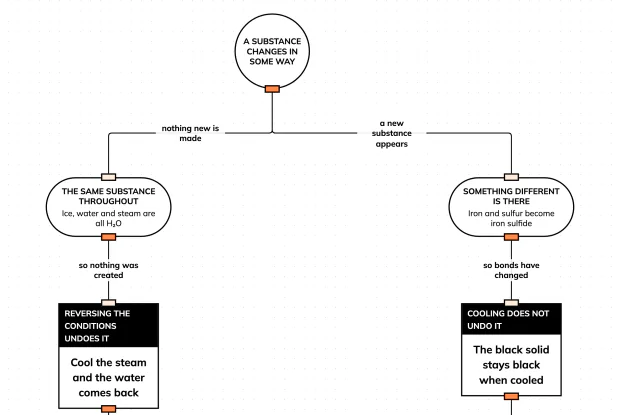
Boiling a kettle looks violent and changes nothing; a nail rusting looks like nothing and changes everything. One test separates them. Follow both routes in an interactive playground.
Where Does the Mass Go When Something Burns?
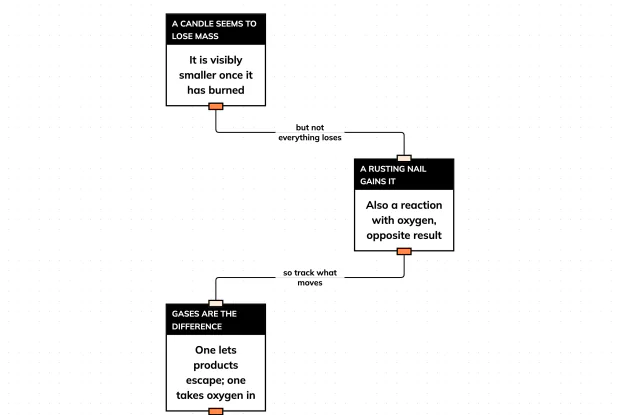
Burning looks like matter disappearing and rusting looks like matter appearing. Neither happens. Follow the reasoning to conservation of mass in an interactive playground.
What Does a Chemical Equation Actually Say?
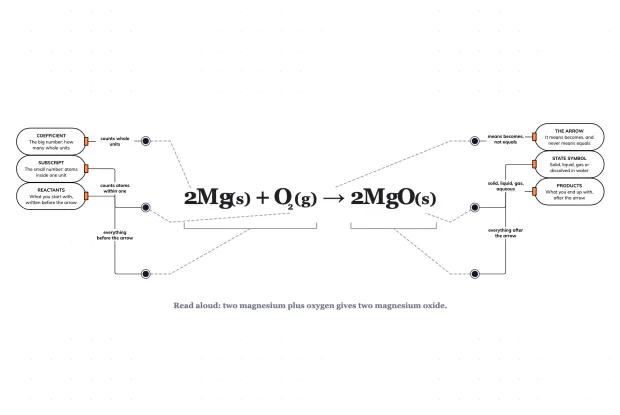
A chemical equation is a sentence with a fixed grammar. Label every part of one — including the two numbers that look alike and mean completely different things — in an interactive playground.
Why Must a Chemical Equation Balance? Count Atoms
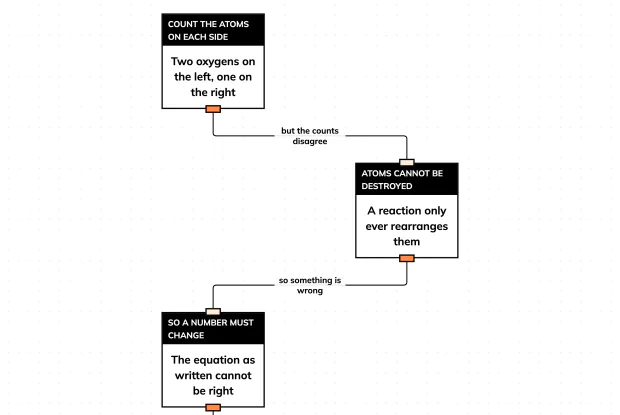
Balancing is not algebra and has nothing to do with doing the same to both sides. It is a count of atoms, and only one of the two numbers may be touched. Follow the reasoning in an interactive playground.
Exothermic or Endothermic? Compare the Two Totals
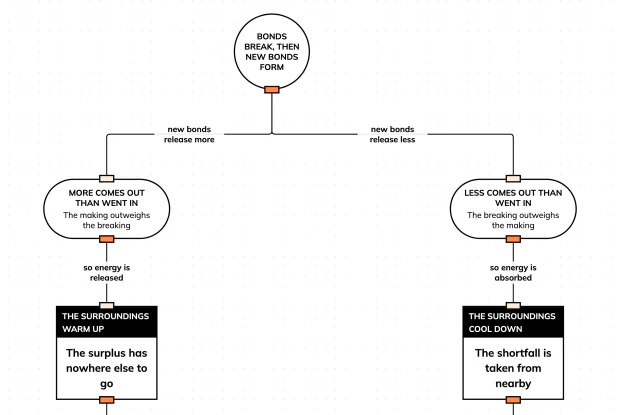
Every reaction breaks bonds and makes bonds, and which total is larger decides whether the surroundings warm or cool. Follow both outcomes from one starting point in an interactive playground.