Why Does Making a Salt Take Several Stages?
Root Concept
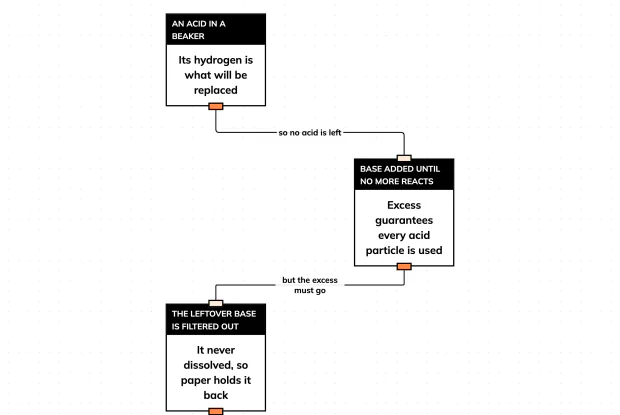
Making a pure sample of a soluble salt takes several stages because each one solves a problem created by the last: excess base guarantees no acid remains, filtering removes the excess that could not dissolve, evaporation removes most of the water, and slow cooling grows crystals instead of leaving a powder.
CodePLU Goal
Upgrading Human Mental Models
Learn how to think in Workflows

Concept Development By codeplu.com
The order is not a convention. Swap any two stages and the sample is contaminated or never forms.
The Reaction Is the Easy Part
An acid and a base react to give a salt and water, and the reaction itself is over in seconds. Yet preparing a clean dry sample of that salt in a laboratory takes several further stages, and it is worth asking why — because every one of them is there to solve a specific problem, and the problems arrive in a fixed order.
The first problem is knowing when to stop. Add too little base and unreacted acid is left in the mixture, which will contaminate the product and make it dangerous to handle. The way round this is to use a base that does not dissolve — a metal oxide or carbonate — and add it until no more will react. Any surplus simply sits at the bottom, which guarantees the acid has all been used up.
That guarantee creates the second problem: there is now undissolved base in the beaker that has no business in the final sample. Because it never dissolved, filtering removes it cleanly and leaves a solution of nothing but salt and water — which is the whole reason an insoluble base was chosen in the first place.
The remaining stages deal with the water. Evaporating most of it concentrates the solution, and letting the rest go slowly as it cools grows crystals rather than leaving a fine powder. Each stage answers the one before it, which is why the sequence cannot be rearranged.
Why Each Stage Is There
Why use a base that will not dissolve?
Because it makes the end of the reaction visible and removable. With a soluble alkali there is no way to tell by looking whether the acid has all been used, and any excess alkali stays dissolved and ends up in the product — so that route needs an indicator and careful measurement instead. An insoluble base avoids the problem entirely: keep adding until solid stops disappearing, and you know the acid has gone. The cost is that you now have solid in the beaker, and the benefit is that solid is exactly the kind of impurity that filtering removes. The method trades a hard problem for an easy one. Choosing the method is itself part of the chemistry.
What does the filtering actually separate?
Undissolved base from a solution of the salt — which is a separation by particle size, the first of the three differences from the mixtures track. The leftover base is present as solid lumps far too big to pass through filter paper, while the salt is dissolved and goes through as easily as the water does. This is the same reason filtering a salt solution achieves nothing: dissolved particles are not held back by paper. Here that is exactly what is wanted, because the salt is supposed to carry on through and only the solid is supposed to stop. The same technique fails in one tutorial and is essential in this one, and the difference is entirely what you are trying to keep.
Why not just boil the solution dry?
Because boiling it to dryness gives a powder rather than crystals, and can damage the salt. Driving off the last of the water quickly leaves the dissolved salt no time to arrange itself, so it comes out as a fine mass rather than as regular shapes. Many salts also hold water within their crystal structure, and heating hard drives that out too and changes the substance — copper sulfate goes from blue to white when it happens, which makes it visible. So most of the water is removed by heating and the last of it is left to go slowly at room temperature, which is the stage that actually produces crystals.
Why does slow cooling give better crystals?
Because crystals grow by particles joining an existing structure, and that takes time. A hot solution holds more dissolved salt than a cold one, so as it cools the excess has to come out of solution. Cooled slowly, particles settle onto a small number of growing crystals and produce large regular ones. Cooled quickly, enormous numbers of tiny crystals start at once and none gets big. The same principle explains why slowly cooled rock has visible grains and quickly cooled lava does not, which the earth-science end of this subject takes up. The crystal size on a bench and the grain size in a rock are the same measurement of how much time the particles were given.
Real World Example
The Same Logic at Three Different Scales
The sequence is not a classroom ritual. The same problems arrive in the same order wherever a solid is recovered from a solution.
Step 1
Copper sulfate, the standard demonstration
Copper oxide is a black insoluble base, and sulfuric acid is colourless. Added together with warming, the mixture turns a deep blue as copper sulfate forms, and the colour change is its own progress indicator — when adding more black powder stops producing more blue, the acid has gone. This is done by a teacher or under supervision in a laboratory, with eye protection, and never improvised at home. What makes it the standard demonstration is that every stage announces itself visually. The black powder, the blue solution and the blue crystals mark the three stages without anything having to be measured.
Step 2
Sea salt is the same process without the reaction
Salt pans take seawater, which is already a solution of salt, and remove the water using sun and wind rather than a burner. The reaction stage is unnecessary because nothing needs to be made, but the rest of the sequence is identical: concentrate the solution, then let crystals form slowly. Flaky sea salt and fine table salt differ mainly in how fast the water went, which is the same relationship between cooling rate and crystal size as on a laboratory bench. Nothing was manufactured; the sequence only concentrated and crystallised what the sea already held.
Step 3
Industry crystallises on purpose, in vessels
Fertiliser, sugar and most pharmaceutical ingredients are purified by crystallisation, because a growing crystal tends to accept its own kind of particle and exclude everything else — so the crystals come out purer than the solution they grew in. That makes controlling the rate a serious engineering problem: too fast and the crystals are small and trap impurities, too slow and the plant is uneconomic. The last stage of a school preparation is an entire industry at scale. The purity comes from the growing itself rather than from any later cleaning step, which is what makes it worth engineering.
FAQs
Final Words
The reaction takes seconds and the preparation takes several stages, and nothing about that is ceremony. Using a base that will not dissolve means the acid can be used up completely without measuring anything — you simply add solid until solid stops disappearing. That guarantee leaves undissolved base in the beaker, which is precisely the kind of impurity filtering removes, because the salt is dissolved and goes through while lumps do not.
The last two stages deal with the water. Most of it is driven off by heating, and the rest is left to go slowly, because crystals grow by particles joining an existing structure and that takes time — boiling to dryness gives a powder and can drive water out of the crystals themselves. Every stage answers a problem created by the one before it, which is why the order is load-bearing: filter too early and unreacted acid comes through with the salt.
Continue This Track
This concept is part 4 of Acids, Bases and Salts.
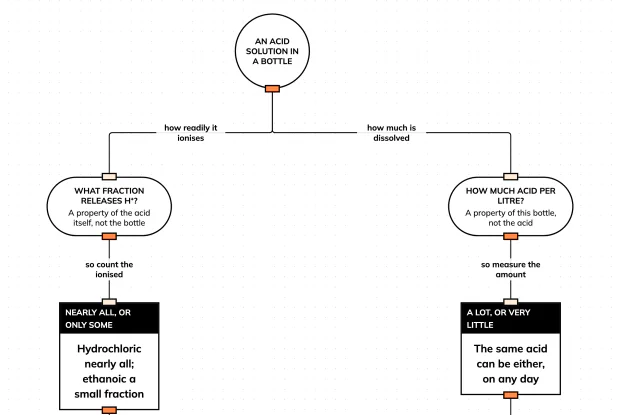
What Makes Something an Acid? Follow What They Share
Lemon juice, vinegar and car battery acid behave the same way despite having nothing else in common. Work back to the particle they all release, in an interactive playground.
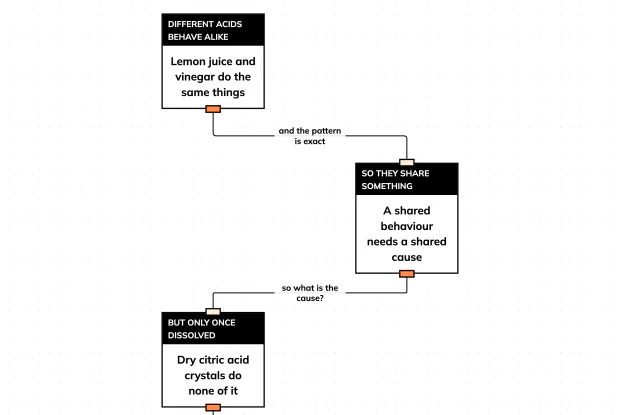
What Does the pH Scale Actually Measure?
pH is one number reporting how many hydrogen ions a solution contains, and each step is a factor of ten. Place six regions on the scale in an interactive playground.
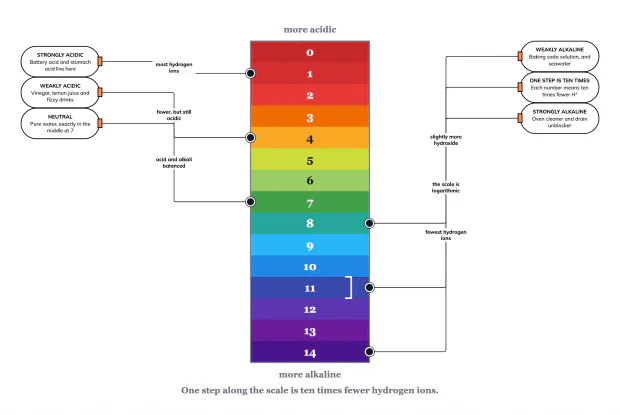
What Do Acids React With? Three Partners, One Pattern
Acids react with metals, with bases and with carbonates, and every one of those produces a salt. What differs is what comes out alongside it. Sort the three in an interactive playground.
Why Does Making a Salt Take Several Stages?
Mixing an acid and a base gives a salt in seconds, so why does getting a dry sample of it take four more stages? Each one answers a problem the last created.
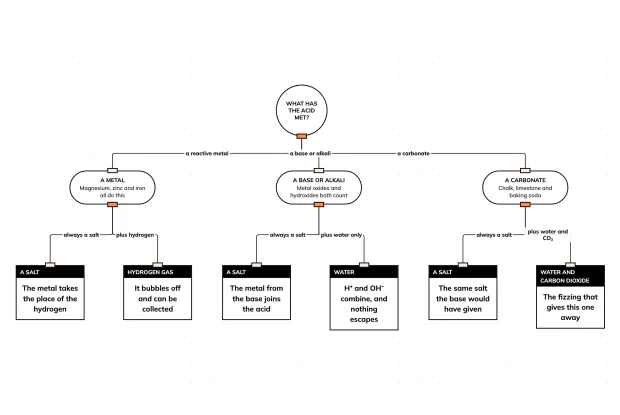
Strong or Concentrated? They Are Not the Same
A dilute strong acid and a concentrated weak acid are completely different things, and the words are not interchangeable. Follow both questions from one bottle in an interactive playground.