Acids, Bases and Salts
Five parts on a family of substances that behave far more predictably than their reputation suggests. It opens by refusing to define an acid by taste or by danger, and works instead from the puzzle that lemon juice, vinegar, fizzy drinks and battery acid all do the same things despite having nothing else in common — with the decisive clue being that none of them does any of it while dry. Water is not a bystander: dissolving releases hydrogen ions, and those ions are the whole family resemblance. The second part puts a number on how many, and spends its time on the feature of the pH scale that is easiest to miss — each whole step is a factor of ten, so the difference between ordinary rain and damaging acid rain is one number on a chart. The third sorts the three things an acid reacts with and finds a salt under all of them, so the information is in the second product: hydrogen from a metal, water alone from a base, and the fizz of carbon dioxide from a carbonate. The fourth asks why getting a clean sample of that salt takes several stages when the reaction itself takes seconds, and the answer is that each stage solves a problem the one before it created — which is why the order cannot be rearranged. The last part separates two words that are routinely used as synonyms and are not: strong is about what fraction of an acid releases its hydrogen ions and cannot be changed, while concentrated is about how much is dissolved and changes the moment water is added.
CodePLU Goal
Upgrading Human Mental Models
Learn how to think in Workflows
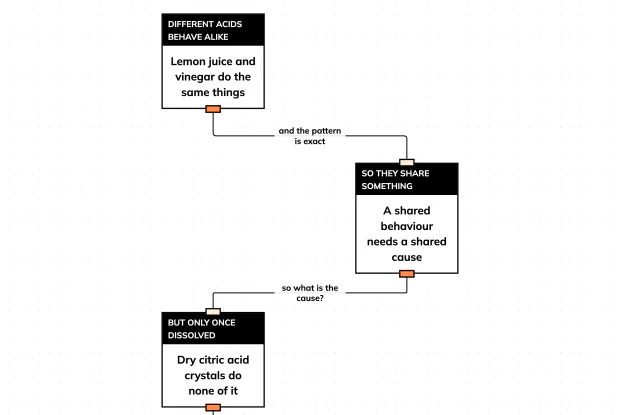
What Makes Something an Acid? Follow What They Share
Lemon juice, vinegar and car battery acid behave the same way despite having nothing else in common. Work back to the particle they all release, in an interactive playground.
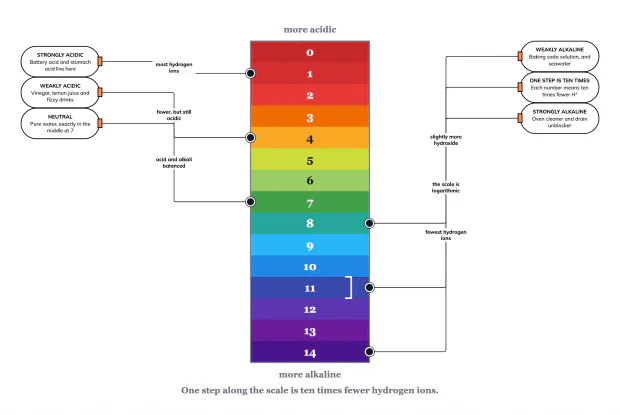
What Does the pH Scale Actually Measure?
pH is one number reporting how many hydrogen ions a solution contains, and each step is a factor of ten. Place six regions on the scale in an interactive playground.
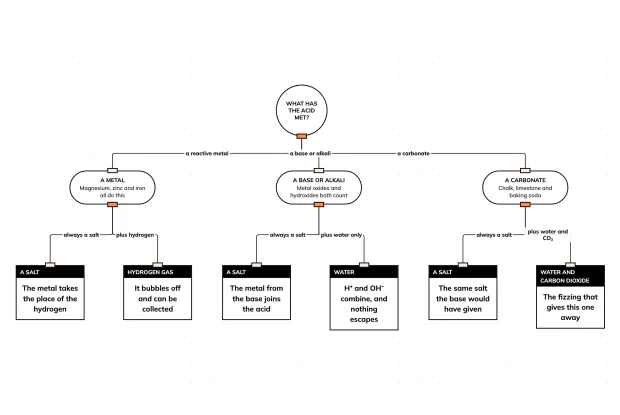
What Do Acids React With? Three Partners, One Pattern
Acids react with metals, with bases and with carbonates, and every one of those produces a salt. What differs is what comes out alongside it. Sort the three in an interactive playground.
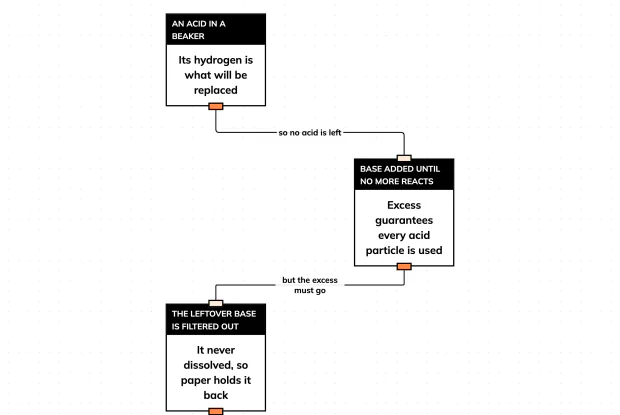
Why Does Making a Salt Take Several Stages?
Mixing an acid and a base gives a salt in seconds, so why does getting a dry sample of it take four more stages? Each one answers a problem the last created.
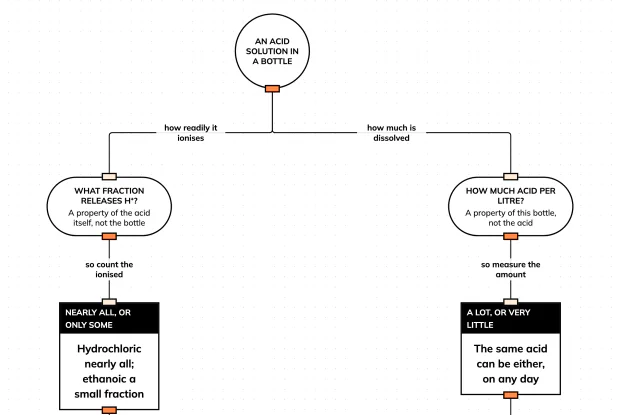
Strong or Concentrated? They Are Not the Same
A dilute strong acid and a concentrated weak acid are completely different things, and the words are not interchangeable. Follow both questions from one bottle in an interactive playground.