What Makes Something an Acid? Follow What They Share
Root Concept
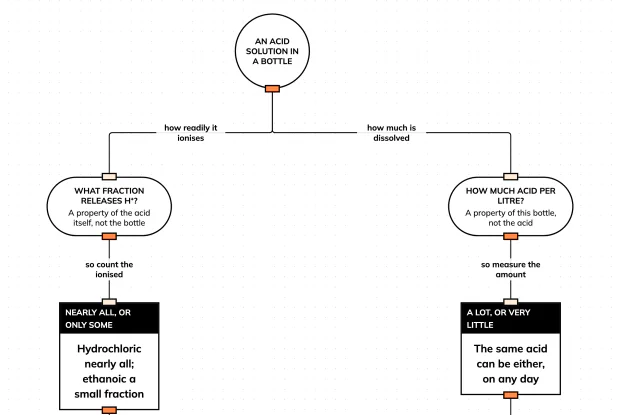
An acid is a substance that releases hydrogen ions into solution when it dissolves in water, which is why acids that otherwise have nothing in common all behave the same way, and why an acid shows none of that behaviour while it is dry.
CodePLU Goal
Upgrading Human Mental Models
Learn how to think in Workflows

Concept Development By codeplu.com
The definition arrives at the end. The third step is the one that rules out everything except the water.
A Family With Nothing Obvious in Common
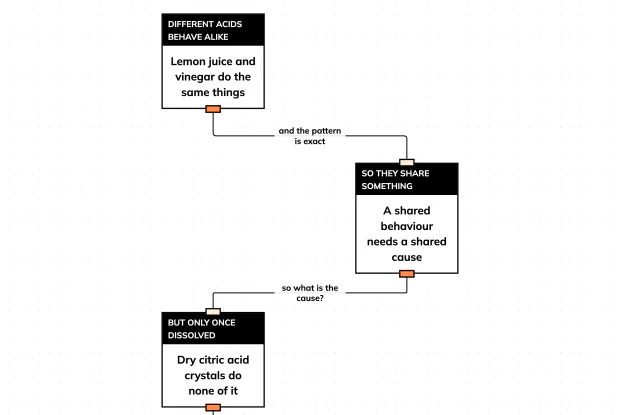
Lemon juice, vinegar, fizzy drinks and the acid in a car battery have almost nothing in common. They are made of different elements, they come from different places, and one of them is sold in bottles for cooking while another will destroy your clothes. Yet all four behave the same way: all taste sour where tasting them is safe, all turn blue litmus paper red, all react with certain metals to give off hydrogen, and all can be cancelled out by the same sorts of substance.
That shared behaviour is the thing to explain. A pattern that exact does not come from a coincidence, so there must be something these substances have in common, and the question is what.
The clue that narrows it down is the one most often overlooked. Citric acid in its dry crystalline form is a white powder that does none of this. It does not turn litmus red, it does not react with magnesium, and it is not notably dangerous. Add water and every one of those behaviours appears at once. So whatever an acid is, it is something that only happens in solution — the water is not a bystander.
What happens on dissolving is that the acid releases hydrogen ions, written H⁺, into the water, and it is those ions that do everything on the list. The playground works from the shared behaviour back to the shared particle.
Working Back to the Cause
What is a hydrogen ion, exactly?
A hydrogen atom that has lost its only electron, which leaves something unusual: a bare proton. A hydrogen atom is one proton with one electron around it, so removing the electron removes everything except the nucleus. That is why H⁺ is so much smaller than any other ion and why it behaves so distinctively — it is a single positive charge with almost no size at all. In water it never travels alone but attaches itself to water molecules, which is a refinement worth knowing about and not worth worrying about at this level. Writing H⁺ and calling it a hydrogen ion is accurate enough for everything in this track.
Why does an acid do nothing while it is dry?
Because the hydrogen is still bonded into the molecule and has not been released. In solid citric acid the hydrogen atoms are held covalently within the molecules, and a bonded hydrogen is not a hydrogen ion. Water is what separates them: its molecules surround the acid, the bonds holding those particular hydrogens give way, and H⁺ ions are released into the solution. This is why the bottle of citric acid in a kitchen cupboard is a harmless powder and a strong solution of the same substance is not. It also explains a practical point worth knowing — that an acid concentrated enough to be hazardous is dangerous largely because of how much H⁺ it can supply.
What is the opposite of an acid?
A base, and the mirror image is exact. Where an acid releases hydrogen ions, a base either releases hydroxide ions, written OH⁻, or accepts hydrogen ions from somewhere else. A base that dissolves in water is given its own name, alkali, so every alkali is a base but not every base is an alkali — copper oxide is a base and does not dissolve. Sodium hydroxide, the alkali used in drain cleaner, releases Na⁺ and OH⁻ when it dissolves. Because H⁺ and OH⁻ combine readily to give water, an acid and an alkali cancel each other out, which is what the third tutorial in this track is about. The two families are defined by opposite particles, which is why they cancel rather than merely diluting each other.
Are acids dangerous?
Some are, many are not, and treating the word as a synonym for corrosive gets the chemistry wrong. There is citric acid in a lemon, carbonic acid in every fizzy drink, acetic acid in vinegar, and hydrochloric acid in your own stomach doing useful work on your lunch. What makes a particular acid hazardous is how readily it releases hydrogen ions and how concentrated the solution is — two separate things that the last tutorial in this track separates properly. A dilute solution of a reactive acid can be far safer than a concentrated solution of a mild one. Laboratory acids are handled with eye protection and are never improvised with at home.
Real World Example
Three Acids Doing Entirely Different Jobs
The definition is worth having because it covers cases that look unrelated. These three share the H⁺ ion and almost nothing else.
Step 1
Your stomach runs on hydrochloric acid
The stomach lining produces hydrochloric acid continuously, keeping the contents strongly acidic. That does two jobs: it starts breaking proteins down, and it kills most of the microorganisms arriving with food. The stomach survives it because of a mucus layer that is replaced constantly, and the human-body category covers how the duodenum neutralises the mixture once it leaves. It is the clearest possible answer to whether acids are inherently harmful: one of the most reactive common acids is being made inside you right now, on purpose. The question is never whether something is an acid but which acid, how concentrated, and where it is.
Step 2
Carbonic acid is why a fizzy drink is sharp
Carbon dioxide dissolved under pressure reacts with water to form carbonic acid, and that is what gives a fizzy drink its sharpness — the sweetness is masking an acid rather than sitting beside plain bubbles. Open the bottle and the pressure drops, the carbon dioxide comes out of solution, and the drink goes both flat and noticeably less sharp as the acid breaks back down. The same reaction happens in rain, which is why unpolluted rainwater is already slightly acidic before anything else is added to the air. The sharpness and the fizz are two effects of the same dissolved gas, which is why they fade together.
Step 3
Sulfuric acid, and why a car battery is heavy
A lead-acid car battery holds plates of lead in sulfuric acid, and the reactions between them are what produce the current. This is genuinely the dangerous end of the family: the solution is concentrated, it reacts readily with skin and fabric, and batteries carry warnings for that reason. Sulfuric acid is also the single most produced industrial chemical in the world, used in fertiliser manufacture more than anything else. Note the spelling — sulfur and sulfuric with an f, which is the international convention every exam board now follows. The traditional British spelling now reads as dated in a way that colour and centre do not.
FAQs
Final Words
Four substances with nothing obvious in common behave identically, and a pattern that exact has a cause. The clue that finds it is that none of them does any of it while dry: citric acid crystals turn no litmus red and react with no metal until water is added. So whatever makes an acid an acid only happens in solution.
What happens is that the acid releases hydrogen ions, H⁺, into the water, and those ions cause every behaviour on the list. That makes the definition one about what a substance releases rather than how it tastes or how dangerous it is — and the family is far wider than the word suggests, taking in lemons, fizzy drinks and the contents of your own stomach. The next tutorial puts a number on how much H⁺ a solution actually contains.
Continue This Track
This concept is part 1 of Acids, Bases and Salts.
What Makes Something an Acid? Follow What They Share
Lemon juice, vinegar and car battery acid behave the same way despite having nothing else in common. Work back to the particle they all release, in an interactive playground.
What Does the pH Scale Actually Measure?
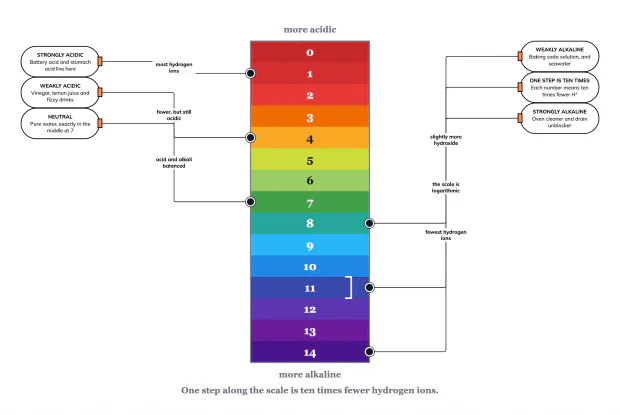
pH is one number reporting how many hydrogen ions a solution contains, and each step is a factor of ten. Place six regions on the scale in an interactive playground.
What Do Acids React With? Three Partners, One Pattern
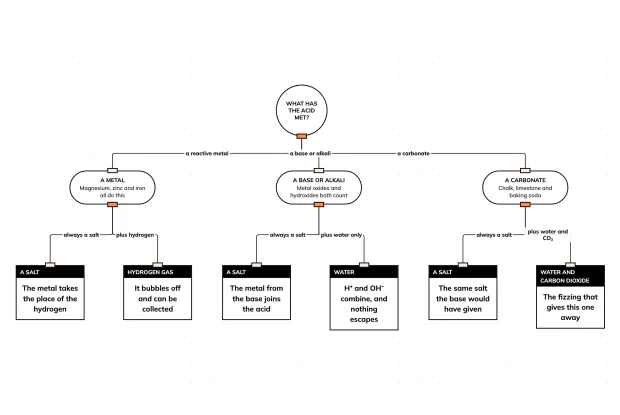
Acids react with metals, with bases and with carbonates, and every one of those produces a salt. What differs is what comes out alongside it. Sort the three in an interactive playground.
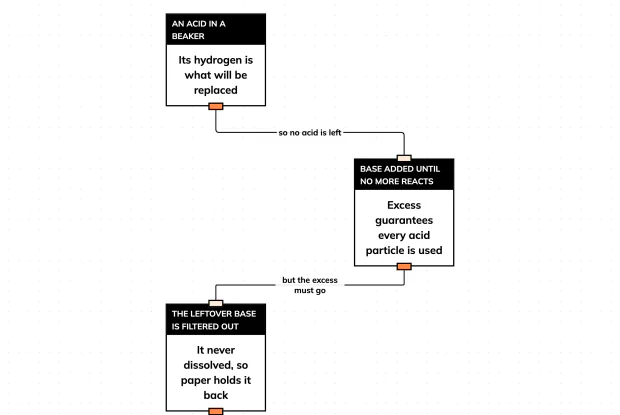
Why Does Making a Salt Take Several Stages?
Mixing an acid and a base gives a salt in seconds, so why does getting a dry sample of it take four more stages? Each one answers a problem the last created.
Strong or Concentrated? They Are Not the Same
A dilute strong acid and a concentrated weak acid are completely different things, and the words are not interchangeable. Follow both questions from one bottle in an interactive playground.