Strong or Concentrated? They Are Not the Same
Root Concept
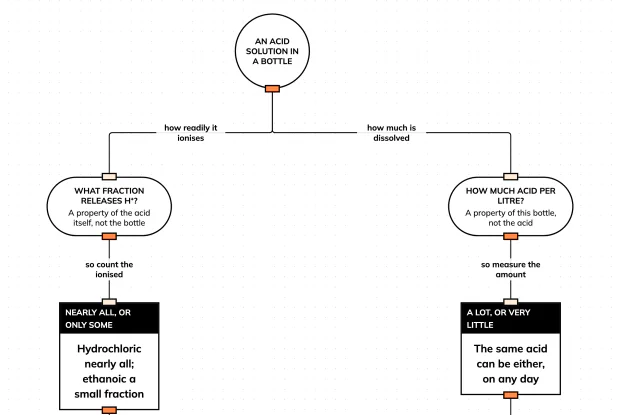
Strong and concentrated answer different questions about an acid: strong describes what fraction of the acid releases its hydrogen ions, which is a fixed property of that acid, while concentrated describes how much acid is dissolved in a given volume, which changes the moment water is added.
CodePLU Goal
Upgrading Human Mental Models
Learn how to think in Workflows

Concept Development By codeplu.com
Both branches start from the same bottle. Only one of the two answers can be changed by adding water.
Two Words That Are Not Interchangeable
Strong and concentrated get used as though they mean the same thing, and they do not. They answer two separate questions about the same bottle, and confusing them makes a surprising amount of chemistry stop working — including why two acids at the same concentration can have quite different pH values.
The first question is about the acid itself. When an acid dissolves it releases hydrogen ions, as the first tutorial in this track established — but not every acid releases all of them. In hydrochloric acid essentially every molecule gives up its hydrogen, so it is called a strong acid. In ethanoic acid, which is what vinegar is, only a small fraction do at any moment and the rest stay intact. That makes it a weak acid, and no amount of anything you do to the bottle changes it.
The second question is about this particular bottle. Concentrated means a lot of acid dissolved in a given volume of water; dilute means not much. That has nothing to do with which acid it is, and it is changed the instant you add water.
So the two words are independent, and all four combinations exist. A dilute solution of a strong acid is ordinary laboratory hydrochloric acid. A concentrated solution of a weak acid is the vinegar used for pickling. Treating the words as synonyms collapses four situations into two.
Keeping the Two Apart
What does strong actually mean?
That nearly every molecule of the acid releases its hydrogen ion when it dissolves. Hydrochloric, sulfuric and nitric acids are the three strong acids usually met at this level, and in solution they exist almost entirely as separated ions — there are essentially no intact HCl molecules in hydrochloric acid. A weak acid is one where only a small proportion ionises at any moment, so most of it remains as whole molecules with their hydrogens still attached. Ethanoic, citric and carbonic acids are all weak. This is a property of the substance, fixed by its own bonding, and it is why strength is never something you can adjust A bottle of a weak acid left for a century is still a weak acid.
What does concentrated actually mean?
How much acid is dissolved in a given volume of solution, and nothing else. It is a property of the mixture rather than of the acid, which is why the same acid can be sold concentrated and used dilute. Adding water makes a solution more dilute immediately and changes no chemistry at all — the acid is the same acid, there is simply less of it per litre. This is the one of the two that an experimenter controls, and it is why laboratory bottles are labelled with a concentration rather than with the word strong. The mixtures track covers the underlying idea: a solution’s proportions can be anything, which is what makes it a mixture.
So which one decides the pH?
Both, which is exactly why they have to be kept apart. pH counts the hydrogen ions actually present, and that depends on how much acid is there and on what fraction of it has ionised. A dilute strong acid and a concentrated weak acid can land on the same pH by completely different routes — one has few molecules all ionised, the other has many molecules barely ionised. Knowing the pH therefore does not tell you which acid you have, and knowing the acid does not tell you the pH. You need both answers, which is the practical reason this distinction is worth the trouble. Two numbers are needed, and each answers a different question.
Which one decides how hazardous it is?
Mostly concentration, which is not the intuitive answer. A very dilute solution of a strong acid is routinely handled in school laboratories with eye protection and causes no particular alarm; a concentrated solution of the same acid is treated very differently. Meanwhile a weak acid can be dangerous if concentrated enough — concentrated ethanoic acid burns skin despite being chemically the same substance as vinegar. The word strong on a label would tell you almost nothing useful about handling, which is part of why labels carry concentrations and hazard symbols instead. Laboratory acids are used under supervision and never improvised with. The useful question before handling anything is how much, not how strong.
Real World Example
All Four Combinations, in Ordinary Settings
The clearest way to see that the words are independent is to find a real example of each combination, which is not difficult.
Step 1
Dilute strong: the acid on a school bench
The hydrochloric acid used in school experiments is a strong acid at a low concentration. Essentially all of it is ionised, so it behaves as an acid reliably and reacts briskly with magnesium — but there is not much of it per litre, so it is manageable with ordinary precautions. This is the combination most students meet first, which is part of why the two words get tangled: the bottle says dilute and the acid is strong, and both statements are on the same label at the same time. Reading one word and ignoring the other is how the confusion starts.
Step 2
Concentrated weak: pickling vinegar
Vinegar is a solution of ethanoic acid, which is a weak acid — at any moment only a small proportion of its molecules have released a hydrogen ion. Pickling vinegar is noticeably more concentrated than the table kind, strong enough in smell to make your eyes water, and it is still exactly as weak an acid as it ever was. Concentrating it changed how much acid is present and changed nothing whatever about what fraction of it ionises. The smell is the undissociated molecules leaving the liquid, which is itself a reminder that most of them are still intact.
Step 3
The two extremes, and why labels avoid the word
Concentrated sulfuric acid is both strong and concentrated, and is handled with serious precautions in laboratories and industry. Rainwater is both weak and dilute: it contains carbonic acid at a very low concentration, which is why it sits at about pH 5.6 and nobody thinks twice about standing in it. Because the four cases differ so much, a hazard label quotes a concentration and a symbol rather than calling anything strong — the word simply does not carry the information a handler needs A number and a pictogram say something precise; an adjective does not.
FAQs
Final Words
Strong and concentrated answer different questions about the same bottle. Strong is about the acid: what fraction of it releases its hydrogen ions when it dissolves. Hydrochloric acid ionises almost completely and is strong; ethanoic acid ionises only slightly and is weak, and nothing you do to the bottle will change that. Concentrated is about the mixture: how much acid is dissolved in a given volume, which changes the instant water is added.
Because the two are independent, all four combinations exist — dilute strong acid on a school bench, concentrated weak acid in pickling vinegar, and both extremes besides. Keeping them apart matters because pH depends on both, so a pH value never identifies an acid on its own, and because hazard depends far more on concentration than on the word strong. One claim this track made is still unpaid: that only metals above hydrogen react with acid. The next track builds that order.
Continue This Track
This concept is part 5 of Acids, Bases and Salts.
What Makes Something an Acid? Follow What They Share
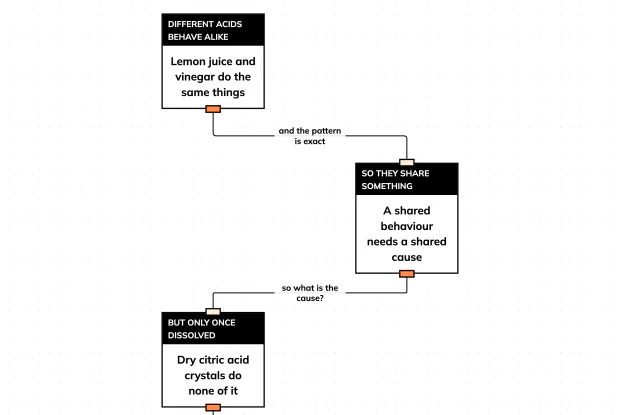
Lemon juice, vinegar and car battery acid behave the same way despite having nothing else in common. Work back to the particle they all release, in an interactive playground.
What Does the pH Scale Actually Measure?
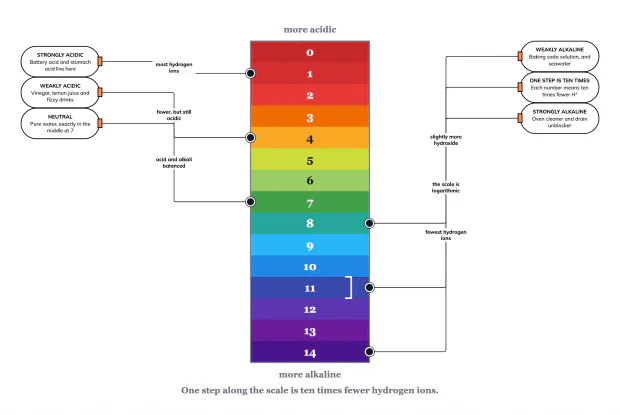
pH is one number reporting how many hydrogen ions a solution contains, and each step is a factor of ten. Place six regions on the scale in an interactive playground.
What Do Acids React With? Three Partners, One Pattern
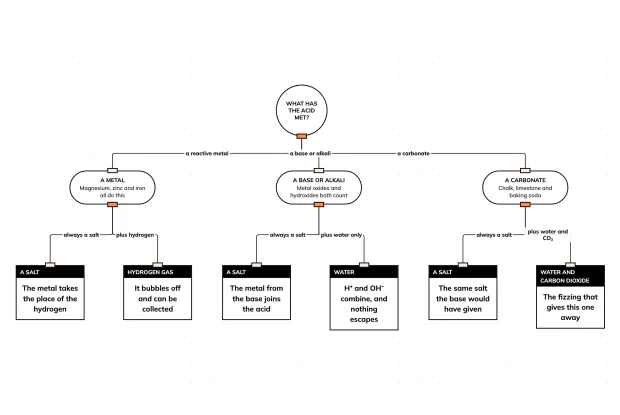
Acids react with metals, with bases and with carbonates, and every one of those produces a salt. What differs is what comes out alongside it. Sort the three in an interactive playground.
Why Does Making a Salt Take Several Stages?
Mixing an acid and a base gives a salt in seconds, so why does getting a dry sample of it take four more stages? Each one answers a problem the last created.
Strong or Concentrated? They Are Not the Same
A dilute strong acid and a concentrated weak acid are completely different things, and the words are not interchangeable. Follow both questions from one bottle in an interactive playground.