What Do Acids React With? Three Partners, One Pattern
Root Concept
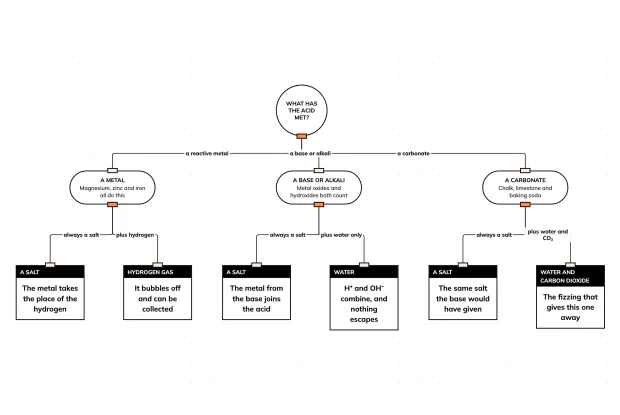
An acid reacts with a metal, a base or a carbonate, and every one of those reactions produces a salt because the metal takes the place of the acid’s hydrogen; what differs is the second product — hydrogen from a metal, water from a base, and water plus carbon dioxide from a carbonate.
CodePLU Goal
Upgrading Human Mental Models
Learn how to think in Workflows

Concept Development By codeplu.com
A salt appears under all three. The useful part of the board is the row underneath it.
Three Reactions With One Thing in Common
Acids are predictable, which is unusual and useful. They react with three sorts of substance, and all three reactions produce a salt. The word salt here does not mean the stuff on a table — that is one particular salt, sodium chloride. In chemistry a salt is any compound formed when the hydrogen of an acid is replaced by a metal, so magnesium sulfate, copper nitrate and calcium chloride are all salts.
That single pattern is the thing to hold on to. An acid supplies hydrogen ions, and what it meets supplies a metal; the metal takes the hydrogen’s place and a salt is the result. The name of the salt comes from both parents — the metal from one side and the acid from the other — so hydrochloric acid always gives a chloride, sulfuric acid gives a sulfate, and nitric acid gives a nitrate.
What distinguishes the three reactions is the other product. A metal leaves hydrogen gas, which bubbles off. A base leaves water and nothing else, which is why a neutralisation looks so undramatic. A carbonate leaves water and carbon dioxide, and the fizzing is the giveaway — it is also the standard test for a carbonate.
The playground sorts the three partners by what comes out. A salt appears under all of them, so the row that actually carries information is the second one.
The Three Reactions
Acid plus metal: where does the hydrogen come from?
Out of the acid, which is the whole point. The acid has released hydrogen ions into solution; a reactive metal gives up electrons to those ions, turning them back into hydrogen atoms that pair up and leave as H₂ gas. The metal, having lost electrons, is now a positive ion in solution — and that is the salt. Magnesium with hydrochloric acid gives magnesium chloride and hydrogen: Mg + 2HCl → MgCl₂ + H₂. Not every metal does this. Copper, silver and gold are unreactive enough to be left alone by dilute acids, which is part of why copper has been used for pipes and gold for coinage. The fizzing of a reactive metal in acid is the hydrogen leaving.
Acid plus base: why is nothing given off?
Because the two things that meet combine into water, which stays in the mixture. The acid supplies H⁺ and the base supplies OH⁻, and those join to make H₂O. Meanwhile the metal from the base pairs with what is left of the acid, which is the salt. Sodium hydroxide with hydrochloric acid gives sodium chloride and water: NaOH + HCl → NaCl + H₂O — ordinary table salt, made from an alkali used in drain cleaner and an acid found in your stomach. Nothing escapes and usually nothing changes colour, so the reaction can be running hard with almost no sign of it except the temperature rising. Neutralisation is strongly exothermic.
Acid plus carbonate: what is the fizzing?
Carbon dioxide, and it is the most recognisable of the three. A carbonate contains the carbonate group, CO₃, and when an acid meets it the products are a salt, water and carbon dioxide gas. Calcium carbonate with hydrochloric acid gives calcium chloride, water and carbon dioxide: CaCO₃ + 2HCl → CaCl₂ + H₂O + CO₂. This is why vinegar fizzes on limescale, why baking soda froths in lemon juice, and why acid rain eats limestone buildings and leaves sandstone ones alone. It is also the standard test for a carbonate: add dilute acid, collect the gas, and if it turns limewater cloudy it was carbon dioxide. The fizz tells you something is being released; the limewater tells you what.
How do you name the salt?
Take the metal from one reactant and the ending from the acid. The metal gives the first word: magnesium, copper, sodium. The acid gives the second: hydrochloric acid gives chloride, sulfuric acid gives sulfate, nitric acid gives nitrate, and carbonic acid gives carbonate. So zinc with sulfuric acid gives zinc sulfate, and copper oxide with nitric acid gives copper nitrate. The naming is completely mechanical once the two parents are identified, which means a salt you have never met can be named on sight — and the formula worked out as well, using the charges from the bonding track. The one thing the name does not tell you is the ratio, which comes from the charges rather than from the words.
Real World Example
Three Everyday Versions of These Reactions
None of these needs apparatus to observe. They are the same three reactions happening in kitchens, stomachs and on the outsides of buildings.
Step 1
Limescale in a kettle is a carbonate reaction
The chalky deposit in a kettle in a hard-water area is largely calcium carbonate, left behind as water boils away. Descaler is an acid, and what it does is exactly the third reaction on the board: the carbonate is converted to a soluble salt, water and carbon dioxide, and the fizzing while it works is the gas leaving. The insoluble deposit becomes a dissolved salt that rinses away. It is also why descaling instructions tell you to rinse thoroughly — the salt is still there until you do An insoluble problem has been turned into a soluble one, which is the general shape of a lot of cleaning chemistry.
Step 2
Indigestion remedies are neutralisation in a packet
An antacid works by neutralising some of the hydrochloric acid in the stomach, raising the pH and relieving the burning sensation. Different products use different bases, and which one is chosen changes what else happens: a hydroxide gives only a salt and water, while a carbonate also produces carbon dioxide, which is why some remedies cause belching and others do not. The human-body category covers what the stomach acid is doing in the first place. This is the second reaction and the third, sold on a shelf. The pH is being raised rather than the acid being removed entirely, since the stomach needs to keep working.
Step 3
Acid rain is picky about building stone
Limestone and marble are both calcium carbonate, so acidic rain reacts with them and slowly dissolves the surface away — which is why old statues lose their faces and cathedral carvings blur. Sandstone and granite contain no carbonate and are left largely alone in the same weather. The damage is not weathering in general but one specific reaction picking out one specific material, and a conservator can predict which parts of a building are at risk from what they are made of. Replacement stone is chosen the same way, which is why some repairs are in a different material from the original.
FAQs
Final Words
An acid has three sorts of partner and every one of them gives a salt, because the metal takes the place of the acid’s hydrogen. That is the pattern, and the name of the salt follows mechanically from the two parents: the metal supplies the first word and the acid the second, so sulfuric acid always gives a sulfate and nitric acid always gives a nitrate.
The information is in the second product. A reactive metal releases hydrogen, which bubbles off and can be collected. A base gives water and nothing else, which is why neutralisation can be running hard with no visible sign except the temperature rising. A carbonate gives water and carbon dioxide, and the fizzing is both the giveaway and the standard test. The next tutorial takes one of these reactions and asks why turning it into a usable sample of a salt takes three separate stages.
Continue This Track
This concept is part 3 of Acids, Bases and Salts.
What Makes Something an Acid? Follow What They Share
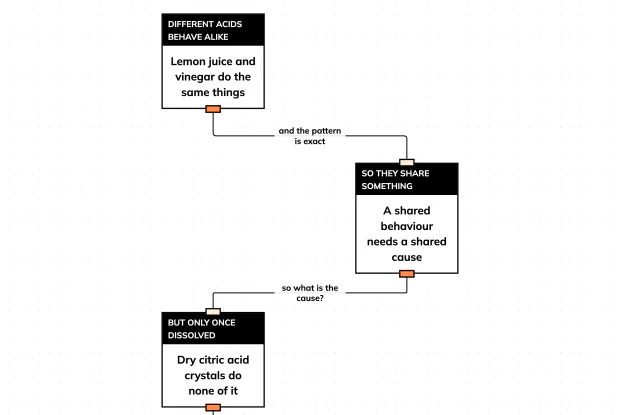
Lemon juice, vinegar and car battery acid behave the same way despite having nothing else in common. Work back to the particle they all release, in an interactive playground.
What Does the pH Scale Actually Measure?
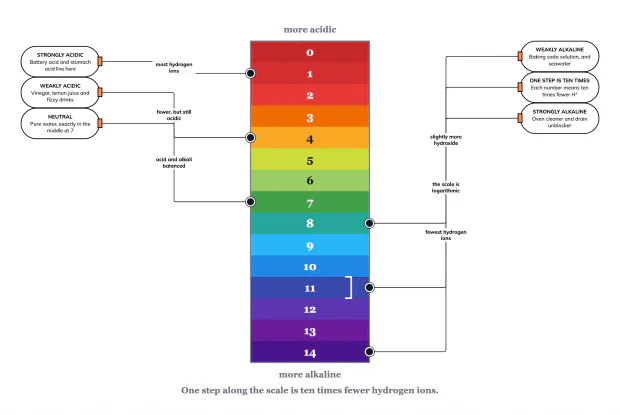
pH is one number reporting how many hydrogen ions a solution contains, and each step is a factor of ten. Place six regions on the scale in an interactive playground.
What Do Acids React With? Three Partners, One Pattern
Acids react with metals, with bases and with carbonates, and every one of those produces a salt. What differs is what comes out alongside it. Sort the three in an interactive playground.
Why Does Making a Salt Take Several Stages?
Mixing an acid and a base gives a salt in seconds, so why does getting a dry sample of it take four more stages? Each one answers a problem the last created.
Strong or Concentrated? They Are Not the Same
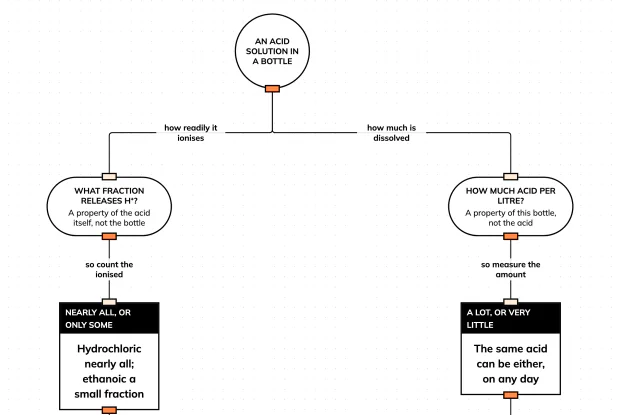
A dilute strong acid and a concentrated weak acid are completely different things, and the words are not interchangeable. Follow both questions from one bottle in an interactive playground.