What Does the pH Scale Actually Measure?
Root Concept
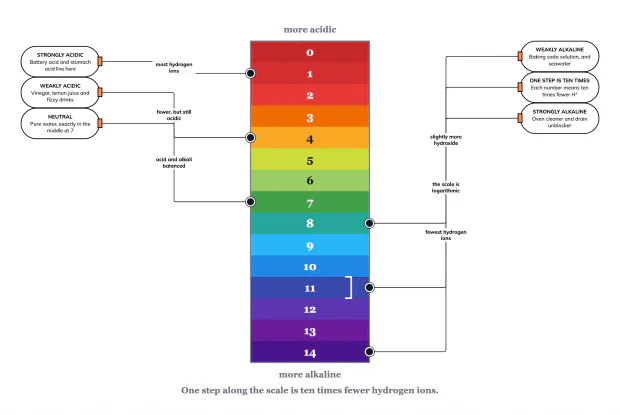
The pH scale puts a number on how many hydrogen ions a solution contains, with 7 as neutral, lower numbers meaning more hydrogen ions and higher numbers meaning fewer; and because the scale is logarithmic, each whole step represents a tenfold change rather than a fixed amount.
CodePLU Goal
Upgrading Human Mental Models
Learn how to think in Workflows

Concept Development By codeplu.com
The bracket spans one whole number, which is a factor of ten. The scale is not evenly spaced in hydrogen ions.
One Number for the Whole Family
The previous tutorial established that every acid releases hydrogen ions into solution, and that alkalis release hydroxide ions instead. That raises an obvious practical question: how many? Lemon juice and battery acid are both acids, and nobody would treat them the same way. What is needed is a measurement rather than a label.
pH is that measurement. It reports how many hydrogen ions a solution holds, on a scale that normally runs from 0 to 14. Below 7 means more hydrogen ions than pure water has, and the solution is acidic. Above 7 means fewer, with hydroxide ions in the majority instead, and the solution is alkaline. Exactly 7 means the two are in balance, which is where pure water sits.
The feature that catches people out is that the scale is logarithmic. Each whole number is not a fixed amount further along but a factor of ten: a solution at pH 3 holds ten times as many hydrogen ions as one at pH 4, and a hundred times as many as one at pH 5. So the gap between a fizzy drink at pH 3 and black coffee at pH 5 is much larger than the two numbers suggest, and the gap between stomach acid at pH 1 and pure water is ten million.
The playground places six regions on the scale. The examples are on the pills rather than printed on the column, so the exercise is matching a substance to a region rather than reading an answer off.
Reading the Scale Properly
Why is 7 the neutral point?
Because that is where pure water sits, and pure water is the reference. Water molecules break apart very slightly on their own, producing equal numbers of hydrogen ions and hydroxide ions — a tiny proportion of them, but exactly equal. That balance is what neutral means, and the number 7 is simply where it lands on the scale as it is defined. Adding an acid tips the balance towards hydrogen ions and the number falls; adding an alkali tips it the other way and the number rises. Neutral is therefore not an absence of ions, which is the usual misreading. It is an equal count of the two kinds. Pure water is quietly doing both things at once.
What does logarithmic actually mean here?
That each step is a multiplication rather than an addition. Going from pH 5 to pH 4 means ten times more hydrogen ions, and from pH 5 to pH 3 means a hundred times more. This is why small-looking differences matter: rain at pH 5.6 is normal, and rain at pH 4.6 has ten times the hydrogen ions and is damaging acid rain. It is also why pH is used at all rather than quoting the concentration directly — the range from battery acid to oven cleaner spans a factor of about a hundred thousand billion, which is unwieldy as a number and perfectly manageable as a scale from 0 to 14.
How is pH actually measured?
With an indicator or with a meter, depending on how precise you need to be. An indicator is a substance that changes colour depending on how many hydrogen ions are around: litmus does one job, turning red in acid and blue in alkali, while universal indicator is a mixture giving the full range of colours shown on the column. That is where the red to purple sequence comes from. An indicator gives you a region rather than a figure, which is often enough. A pH meter measures an electrical property of the solution and reports a number to a decimal place, which is what is used where precision matters — in a brewery, a swimming pool or a soil laboratory.
Does a low pH mean dangerous?
Not on its own, and this is worth separating carefully. pH tells you how many hydrogen ions a solution currently holds, which is related to hazard but is not the same thing. Stomach acid sits around pH 1 to 2 and is doing useful work inside you. Pure lemon juice is about pH 2 and is sold for cooking. What makes a particular solution dangerous depends on the acid itself, how concentrated it is, how much of it there is, and what it is touching. The last tutorial in this track separates the two ideas that get tangled here — how readily an acid releases its hydrogen ions, and how much acid is dissolved.
Real World Example
Three Places a Number on This Scale Decides Something
The scale earns its place because a single number carries enough information to act on, in settings that have nothing to do with a laboratory.
Step 1
Soil pH decides what will grow
Most garden plants do best between about pH 6 and 7, but rhododendrons, blueberries and camellias need distinctly acidic soil and will go yellow and fail in chalky ground. The reason is not that the plants dislike the number: pH changes which minerals dissolve and so which ones roots can take up, and iron becomes unavailable in alkaline soil. Gardeners test with an indicator kit and adjust — lime raises pH, and composted bark lowers it. One measurement explains an entire row of plants that will not thrive. The soil has not changed what it contains; it has changed what is available to a root.
Step 2
Swimming pools are held near 7.4
Pool water is kept slightly alkaline, around pH 7.2 to 7.6, and it is checked daily. Too low and the water begins to corrode metal fittings and irritates eyes; too high and the chlorine becomes much less effective at killing bacteria, so the pool can be fully dosed and still unsafe. The target range is narrow because the scale is logarithmic — a drift of half a unit is a threefold change in hydrogen ions. It is a good illustration of a measurement being useful precisely because it is quick. The daily test takes a minute and prevents both problems at once.
Step 3
Acid rain, and a difference of one unit
Rain is naturally slightly acidic at about pH 5.6, because carbon dioxide dissolves in it to make carbonic acid. Sulfur and nitrogen oxides from burning fuels make it far more so, and rainfall below about pH 4.5 damages trees, strips nutrients from soil and dissolves limestone buildings. The difference between normal and damaging looks like one number on a chart and is more than a tenfold change in hydrogen ions, which is exactly the thing a linear reading of the scale hides It is also why a limit is quoted as a pH rather than a concentration: the number is something a monitoring station can report daily and compare across years.
FAQs
Final Words
pH turns the question how acidic into a number. It reports how many hydrogen ions a solution holds: below 7 there are more than pure water has and the solution is acidic, above 7 there are fewer and hydroxide ions are in the majority, and at exactly 7 the two are in balance, which is what neutral means. Neutral is an equal count rather than an absence, which is the misreading worth avoiding.
The feature that does the most work is the one that is easiest to miss. Each whole step is a factor of ten, not a fixed amount, so pH 3 holds a hundred times the hydrogen ions of pH 5 and the difference between normal rain and damaging acid rain is a single number on a chart. The scale compresses an enormous range into fourteen units, which is exactly what makes it useful and exactly what makes subtracting two pH values misleading.
Continue This Track
This concept is part 2 of Acids, Bases and Salts.
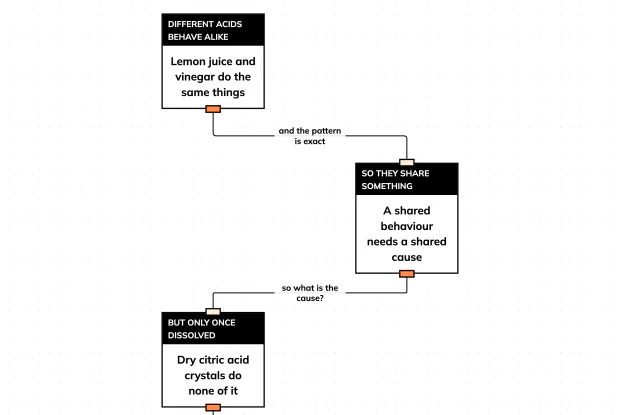
What Makes Something an Acid? Follow What They Share
Lemon juice, vinegar and car battery acid behave the same way despite having nothing else in common. Work back to the particle they all release, in an interactive playground.
What Does the pH Scale Actually Measure?
pH is one number reporting how many hydrogen ions a solution contains, and each step is a factor of ten. Place six regions on the scale in an interactive playground.
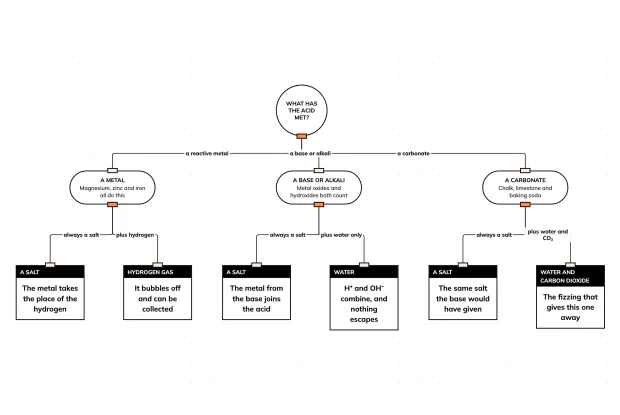
What Do Acids React With? Three Partners, One Pattern
Acids react with metals, with bases and with carbonates, and every one of those produces a salt. What differs is what comes out alongside it. Sort the three in an interactive playground.
Why Does Making a Salt Take Several Stages?
Mixing an acid and a base gives a salt in seconds, so why does getting a dry sample of it take four more stages? Each one answers a problem the last created.
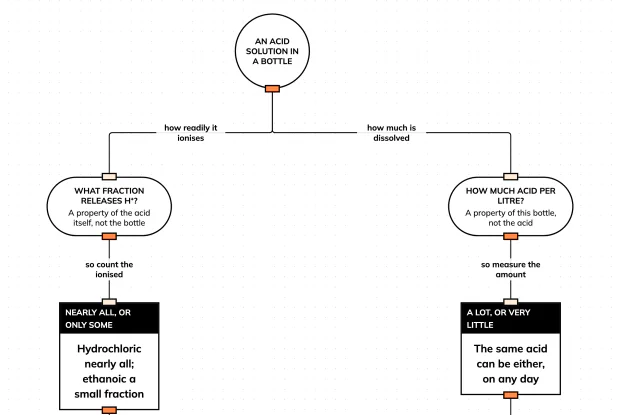
Strong or Concentrated? They Are Not the Same
A dilute strong acid and a concentrated weak acid are completely different things, and the words are not interchangeable. Follow both questions from one bottle in an interactive playground.