Why Are Long Chains Cracked? Fixing the Proportions
Root Concept
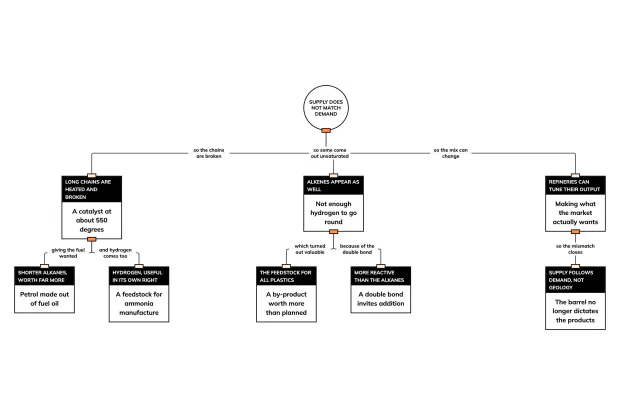
Crude oil contains more long-chain hydrocarbons than the market wants and fewer short ones, so long molecules are broken by heat and a catalyst into shorter alkanes plus alkenes — the alkenes being unavoidable, because there is not enough hydrogen for two saturated molecules.
CodePLU Goal
Upgrading Human Mental Models
Learn how to think in Workflows

Concept Development By codeplu.com
The cause here is economic rather than chemical. Everything below it is the chemistry invented to answer an awkward arithmetic problem.
A Problem Distillation Cannot Solve
The previous tutorial ended on a mismatch. A barrel of crude oil yields far more long heavy fractions than anybody wants to buy, and far less petrol than the world is trying to use. Distillation cannot help, because it is a physical separation: it divides up what is already there and makes nothing new. Whatever proportions came out of the ground are the proportions you are stuck with.
Unless the molecules themselves are changed. Cracking is the chemical process that does it — long hydrocarbon chains are heated, usually with a catalyst, until they break into shorter ones. A twenty-carbon molecule nobody wants becomes an eight-carbon molecule somebody will pay well for, plus whatever is left over.
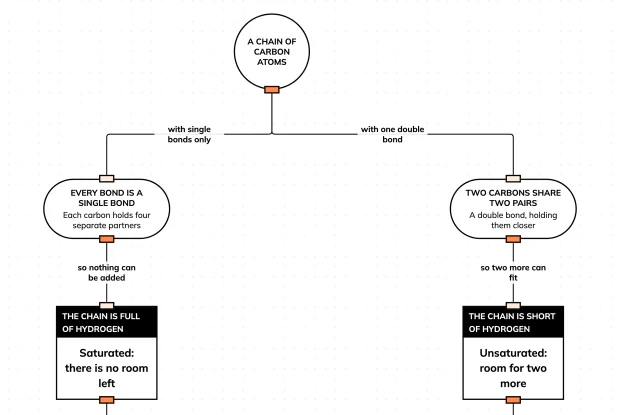
That leftover is where it gets interesting, and it comes down to counting hydrogen. A saturated chain carries about as much hydrogen as it can hold. Split it into two pieces and each piece now has a loose end that would need another hydrogen atom to be saturated too — but no hydrogen was added, so there is not enough to go round. One of the fragments has to manage without.
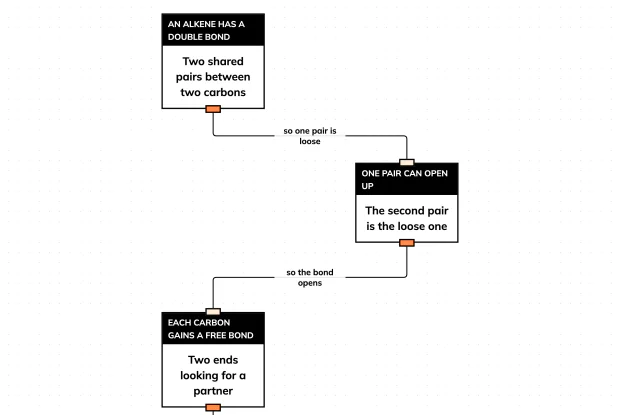
What it does instead is form a double bond between two of its carbon atoms, using a second shared pair where a hydrogen would have been. That is an alkene — far more reactive than the alkanes it came from, an unavoidable by-product of a process designed to make petrol, and the starting point for every plastic in the world.
How Cracking Works
What actually happens to the molecule?
A carbon-to-carbon bond somewhere along the chain is broken by heat, and the chain comes apart into two shorter molecules. This is thermal decomposition, which the reactions track described: one substance becoming more than one, driven by heat. The temperatures involved are high — around 550 °C for catalytic cracking, higher still without a catalyst — because carbon-to-carbon bonds are strong, which is the property that let the chains be long in the first place. The catalyst is usually a zeolite, a porous aluminosilicate that lowers the temperature required and therefore the cost, which is exactly the job a catalyst did in the rates track. The same trade appears here as there: speed bought at a lower temperature, with the products left untouched.
Why must an alkene be produced?
Because of a shortage of hydrogen, and the arithmetic is worth doing. A ten-carbon alkane is C₁₀H₂₂. If it split into two five-carbon alkanes you would need C₅H₁₂ twice over, which is twenty-four hydrogen atoms — and only twenty-two are available. Nothing was added, so two hydrogens cannot appear from nowhere. The conservation rule from the reactions track settles it: the atoms on the right must be exactly the atoms on the left. So one fragment forms a double bond instead of taking the hydrogen it lacks, and becomes an alkene. The by-product is not an accident of the method — it is forced by counting. No choice of catalyst or temperature can avoid it, because the shortage is arithmetic rather than chemistry.
Why is cracking worth the energy it costs?
Because the products are worth so much more than what went in. Heavy fuel oil sells cheaply because almost nothing can burn it; petrol sells at several times the price because everything can. Converting one into the other adds enormous value for the cost of heat and a catalyst, which is why every large refinery has a cracking unit and why the process was one of the most commercially important inventions of the twentieth century. The alkenes make the arithmetic better still, since they feed an entire plastics industry that would otherwise have no raw material at all. A process justified by petrol turned out to pay for itself twice over, on a product nobody asked for.
How is this different from distillation?
Distillation is physical and cracking is chemical, and the first track made that distinction with ice and water. In distillation every molecule that goes in comes out unchanged, merely sorted into company it boils with; nothing is made or destroyed and the process could in principle be undone by mixing everything back together. In cracking, bonds are broken and new substances exist at the end that did not exist at the start, and no amount of mixing puts them back. That is why one can change the proportions and the other cannot. A refinery needs both, and they are doing genuinely different jobs: one sorts the barrel, the other rewrites it.
Real World Example
One Reaction, Read Three Ways
A single cracking reaction, examined for what it makes, what it must make, and what that turned out to be worth.
Step 1
The intended product: petrol from something heavier
Decane has ten carbons and is too heavy to be much use as a motor fuel. Cracked, it gives octane — eight carbons, squarely in the petrol range and worth several times as much per litre. This is the reason the process exists, and from a refinery’s point of view everything else in the equation is incidental. Ten carbons in, eight carbons out, and the value of the barrel has gone up without a drop more oil being pumped out of the ground. The same carbon atoms are being sold at a far higher price, purely because of how they are now arranged.
Step 2
The forced by-product: ethene, because of two missing hydrogens
The two carbons left over cannot form ethane, C₂H₆, because that would need six hydrogen atoms and only four remain once octane has taken eighteen of the original twenty-two. So they form ethene, C₂H₄, with a double bond between the two carbons standing in for the hydrogens that are not there. Check the totals: ten carbons and twenty-two hydrogens on each side. The equation balances, which is what forced the alkene in the first place. Balancing is not a check carried out afterwards here; it is the thing that decides what the products can be.
Step 3
The accident that became an industry
Ethene is the single most produced organic chemical in the world, and essentially all of it comes from cracking. It is the starting material for polythene, and the route to ethanol, antifreeze and a long list of other products. None of that was the point of cracking, which was invented to make petrol. The by-product that the hydrogen shortage forced into existence now supports a larger industry than some of the fuels the process was designed around. Few industrial accidents have paid better. It is also a reminder that a by-product is only worthless until somebody finds out what it does.
FAQs
Final Words
A barrel of crude oil comes out of the ground in the wrong proportions, and no physical separation can fix that, because separating molecules leaves every one of them unchanged. Cracking fixes it chemically: long chains are heated with a catalyst until carbon-to-carbon bonds break, and a heavy molecule nobody wants becomes a light one that sells for several times as much.
The by-product is forced rather than chosen. Split a saturated chain in two and the fragments between them would need more hydrogen than the original molecule contained, so one of them forms a double bond in place of the hydrogen it cannot have. That makes it an alkene — more reactive than anything it came from, because a double bond is somewhere things can be added. It was an unwanted remainder from a process designed to make petrol, and it now feeds the entire plastics industry.
The next tutorial takes those two families side by side and asks how you tell them apart.
Continue This Track
This concept is part 3 of The Chemistry of Carbon.
Why Does Carbon Make So Many Compounds?
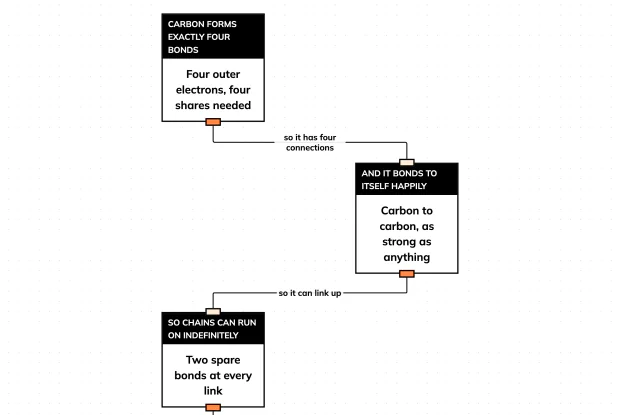
There are around a hundred and twenty elements, and one of them is responsible for most known compounds. Follow the argument that explains why, in an interactive playground.
What Comes Out of Crude Oil? Six Useful Fractions
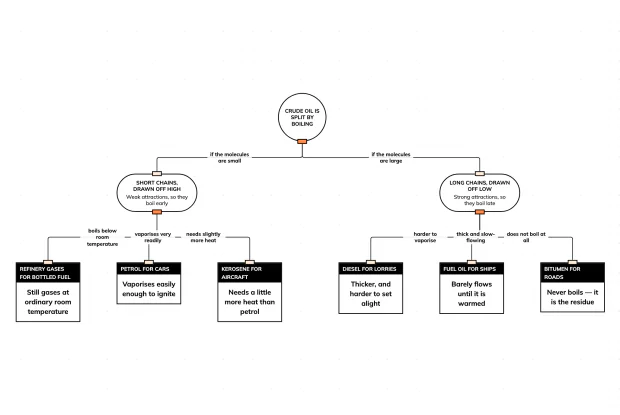
Crude oil is a mixture of hydrocarbons of every length, and sorting them by length sorts them by use as well. Work out why, in an interactive playground.
Why Are Long Chains Cracked? Fixing the Proportions
A barrel of crude oil gives far more heavy oil than anyone wants and far less petrol. Follow how breaking long molecules fixes that — and what it produces by accident — in an interactive playground.
Alkane or Alkene? One Bond Makes the Difference
Two hydrocarbon families differ by a single bond, and that one difference decides how they react and how you tell them apart. Test both in an interactive playground.
How Is a Polymer Made? One Bond, Thousands of Times
Every plastic starts as a small molecule with a double bond. Follow how thousands of them join into one chain — and why the result lasts for centuries — in an interactive playground.