What Comes Out of Crude Oil? Six Useful Fractions
Root Concept
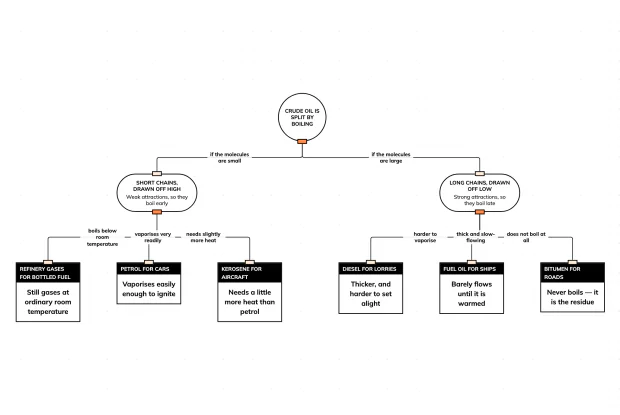
Crude oil is a mixture of hydrocarbon chains of many lengths, and because longer chains attract each other more strongly they boil at higher temperatures — so separating the mixture by boiling point sorts it by chain length, and chain length is what decides what each fraction is good for.
CodePLU Goal
Upgrading Human Mental Models
Learn how to think in Workflows

Concept Development By codeplu.com
The two columns are not two kinds of substance. They are the same kind of molecule at two ends of one scale, and every difference between them follows from length.
A Mixture Sorted by Length
Crude oil is a thick dark liquid that is almost useless as it comes out of the ground. It is a mixture, and the separation track established what that means: the substances in it are not chemically joined, so they keep their own properties and can be separated by a physical method. Crude oil is separated by fractional distillation, which that track described, and this tutorial is about what the separation produces rather than how it is done.
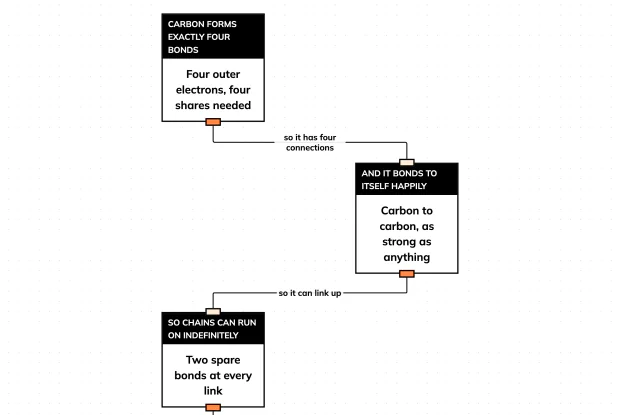
Almost everything in crude oil is a hydrocarbon — a molecule of carbon and hydrogen only. What differs between them is how many carbon atoms are in the chain, which ranges from one to well over fifty, and the previous tutorial explained why chains of any length are possible in the first place.
The useful fact is that chain length and boiling point go together. A longer molecule has more surface in contact with its neighbours, so the attractions between molecules are stronger and more energy is needed to pull them apart into a gas. Short chains boil early, long chains boil late, and nothing boils out of order.
That makes a single physical separation do two jobs at once. Sorting the mixture by boiling point sorts it by chain length — and chain length is what decides whether something makes a good fuel for an engine, a good fuel for a ship, or a good road surface. The products come out already graded by what they are good for.
Why Length Decides Everything
Why does a longer chain boil at a higher temperature?
Because of the attractions between separate molecules, which are not the same thing as the bonds inside them. The bonds holding a hydrocarbon together are strong covalent bonds and boiling does not break a single one of them — a molecule of petrol is exactly the same molecule as a liquid and as a vapour. What boiling has to overcome is the much weaker attraction between neighbouring molecules, and that attraction grows with the size of the molecule, because a longer chain has more of itself lying alongside its neighbours. So a twenty-carbon chain needs far more heat to separate from its neighbours than a five-carbon chain, even though the bonds within each are identical in kind.
Why are short chains the better fuels?
Because burning requires the fuel to be a vapour mixed with air, and a short chain vaporises readily. Petrol evaporates at ordinary temperatures, which is why it can be ignited by a spark in a cold engine and why its fumes are dangerous in a confined space. A long chain stays stubbornly liquid, so it has to be heated, sprayed into fine droplets, or both before it will burn at all. Short chains also flow more easily and burn more cleanly, leaving less soot behind. That combination is why the shortest usable fractions command the highest prices and the longest ones are sold cheaply or used where nothing else will do.
What is the problem with what comes out?
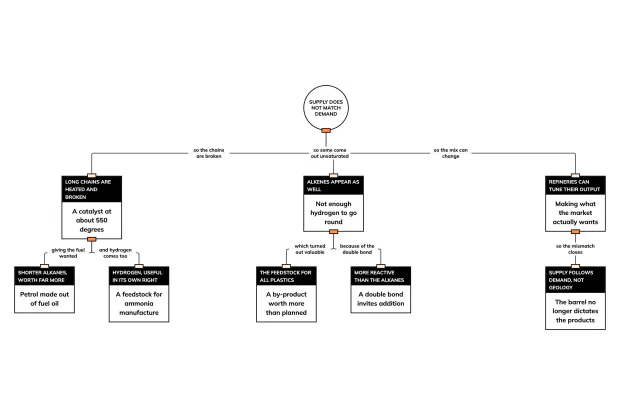
The proportions are wrong. A barrel of crude oil yields far more of the long heavy fractions than anybody wants and far less petrol than the world is trying to buy, and the mismatch is not small — demand for short chains runs well ahead of what the ground provides, while heavy oil sits in tanks with no buyer. Distillation cannot fix this, because it only separates what is already present and makes nothing new. Fixing it needs a chemical change that takes long molecules and turns them into short ones, which is exactly what the next tutorial is about. A physical separation can only ever hand you the proportions the ground supplied.
Is bitumen a failure of the process?
No, although it is tempting to read it that way. Bitumen is what never boils at all — the residue left at the bottom when everything else has been driven off — and it is genuinely useful precisely because of the property that makes it useless as a fuel. A material that will not vaporise, will not run away in the rain and barely flows at summer temperatures is exactly what a road surface needs. The same chain length that disqualifies it from an engine qualifies it for a motorway, which is a reasonable reminder that there is no such thing as a bad fraction, only a wrongly matched one.
Real World Example
Three Fractions and the Jobs They Were Matched To
These are not arbitrary assignments. In each case the chain length produces a property, and the property dictates the use.
Step 1
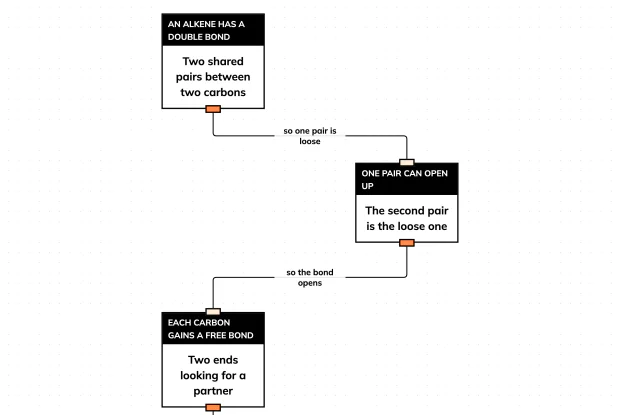
Petrol: short enough to vaporise in a cold engine
Petrol is a mixture of chains around five to ten carbons long, and it evaporates freely at ordinary temperatures. That is exactly what a spark-ignition engine needs, because the fuel has to be a vapour mixed with air before the spark arrives. The same volatility is why petrol has to be stored in sealed containers, why its vapour is a fire risk around a filling station, and why a spilled puddle of it disappears while a spilled puddle of oil does not. Every one of those facts, useful and dangerous alike, is the same short chain length seen from a different angle.
Step 2
Ship fuel oil: so thick it has to be heated to pump
The heavy fuel oil burned by large ships is so viscous at ordinary temperatures that it will barely move along a pipe, and the vessel has to heat it before the engines can use it. No car could run on it, and it is cheap for exactly that reason. A ship can afford the heating equipment and the space it takes, so it buys the fraction nobody else can use and burns it by the tonne. The economics follow from the chain length as directly as the chemistry does. The cheapest fuel in the world is cheap because almost nothing else can burn it.
Step 3
Bitumen: the fraction that is valuable for not burning
Bitumen never boils during distillation and is drawn off as the residue, a black solid that softens in heat and is mixed with stone to make roads. Everything that makes it a hopeless fuel makes it a good surface: it will not evaporate in the sun, will not wash away in rain and is stiff enough to carry traffic. It is the clearest case of a fraction being matched to the one job its properties suit, rather than being a leftover nobody wanted. The property that disqualifies it everywhere else is the one the job requires.
FAQs
Final Words
Crude oil is a mixture of hydrocarbon chains of every length, and separating it by boiling point separates it by length, because a longer molecule has more of itself lying against its neighbours and needs more energy to be pulled free. No covalent bond is broken anywhere in that process; the attractions being overcome are between molecules rather than within them.
That one scale decides the rest. Short chains vaporise readily, so they ignite in a cold engine and are the fuels worth most. Longer chains stay liquid and have to be heated before they will burn, so they go to ships and furnaces that can afford the equipment. And the residue that never boils at all becomes road surface, because not evaporating is exactly what a road needs. There is no bad fraction, only a wrongly matched one.
What distillation cannot do is change the proportions, and they are badly wrong. The next tutorial is about the process invented to fix that.
Continue This Track
This concept is part 2 of The Chemistry of Carbon.
Why Does Carbon Make So Many Compounds?
There are around a hundred and twenty elements, and one of them is responsible for most known compounds. Follow the argument that explains why, in an interactive playground.
What Comes Out of Crude Oil? Six Useful Fractions
Crude oil is a mixture of hydrocarbons of every length, and sorting them by length sorts them by use as well. Work out why, in an interactive playground.
Why Are Long Chains Cracked? Fixing the Proportions
A barrel of crude oil gives far more heavy oil than anyone wants and far less petrol. Follow how breaking long molecules fixes that — and what it produces by accident — in an interactive playground.
Alkane or Alkene? One Bond Makes the Difference
Two hydrocarbon families differ by a single bond, and that one difference decides how they react and how you tell them apart. Test both in an interactive playground.
How Is a Polymer Made? One Bond, Thousands of Times
Every plastic starts as a small molecule with a double bond. Follow how thousands of them join into one chain — and why the result lasts for centuries — in an interactive playground.