Why Does Carbon Make So Many Compounds?
Root Concept
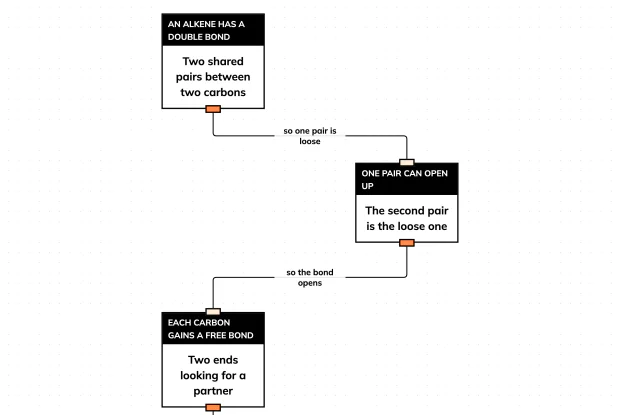
Carbon has four outer electrons so it forms four bonds, and it bonds to other carbon atoms as strongly as to anything else, so its atoms can build chains, branches and rings of unlimited length — which is why carbon compounds outnumber those of every other element combined.
CodePLU Goal
Upgrading Human Mental Models
Learn how to think in Workflows

Concept Development By codeplu.com
Neither of the top two facts is remarkable on its own. It is the combination that does the work, and the third step is where the counting runs away.
One Element, Most of the Compounds
There are around a hundred and twenty elements. Something like ten million compounds have been catalogued, and the great majority of them contain carbon. Chemistry splits itself in half along that line: organic chemistry is the study of carbon compounds, and inorganic chemistry is everything else — every compound of the other hundred and nineteen elements put together.
That is a strange state of affairs and it demands an explanation. Carbon is not rare, not especially reactive, and not in any obvious way a special element. It sits in the middle of the second row of the periodic table, between boron and nitrogen, and nothing about its position announces that it is about to dominate the subject.
The explanation is two ordinary facts that happen to combine badly for anyone trying to count. The first comes straight from the periodic table: carbon has four electrons in its outer shell, so it needs four more to complete it, so it forms four bonds. The second is that carbon-to-carbon bonds are strong and stable — a carbon atom is perfectly happy bonded to other carbon atoms, which is not true of most elements.
Put those together and a carbon atom in a chain still has two bonds spare, so the chain can be extended at either end, branch sideways, or curl round and join itself into a ring. There is no natural stopping point, and every different arrangement is a different compound.
Building the Argument
Why exactly four bonds?
Because carbon has four electrons in its outer shell and that shell holds eight. The bonding track established the pattern: an atom with a nearly full outer shell takes electrons in and becomes a negative ion, and an atom with one or two spare gives them away and becomes positive. Carbon is the awkward middle case. Losing four electrons or gaining four would both take an impractical amount of energy, so it does neither and shares instead, forming four covalent bonds in which each shared pair counts towards completing both atoms’ shells. Four is also the most useful number it could have had: two would give only chains, and three or four open up branching and rings as well.
Why does bonding to itself matter so much?
Because it is the difference between a handful of compounds and an unlimited number. Plenty of elements form four bonds, silicon among them, but a bond between two carbon atoms is unusually strong and stable, while silicon-to-silicon bonds are comparatively weak and are readily attacked. The result is that long silicon chains fall apart and long carbon chains do not. A carbon chain built of twenty atoms is a perfectly ordinary substance that can sit in a bottle for years, and that stability is what allows the chain length to be a free choice rather than a limit. The property has a name worth knowing — catenation — and carbon is better at it than any other element.
How does that produce so many compounds?
By making the arrangement matter as much as the ingredients. A carbon atom in the middle of a chain uses two of its four bonds to hold the chain together, leaving two for hydrogen or anything else. So the chain can be any length, and at any point along it a branch can grow sideways, and the two ends can meet to close a ring. Take just five carbon atoms and twelve hydrogens: they can be arranged as a straight chain, or with one branch, or with two, and those are three genuinely different substances with different boiling points. Add more atoms and the number of possible arrangements grows faster than almost any other quantity in chemistry.
Is this why life is built from carbon?
It is the main reason, yes. Living things need molecules that are large enough to carry information and perform specific jobs, stable enough not to fall apart at body temperature, and varied enough that a cell can build thousands of different ones. Carbon chains satisfy all three at once and nothing else comes close. Proteins, fats, sugars and DNA are all carbon frameworks with other atoms attached, and the variety that makes them capable of so much is exactly the variety this tutorial has been counting. Silicon has been proposed as an alternative in science fiction, and the weakness of silicon-to-silicon bonds is why it stays fiction. The chemistry that makes life possible is the same chemistry counted in the step above.
Real World Example
The Same Atoms, Different Substances
In each of these nothing changes about which atoms are present or how many — only how they are joined — and the results are not alike.
Step 1
Two ways to arrange four carbons and ten hydrogens
Butane is a straight chain of four carbon atoms. Rearrange it so that three sit in a row and the fourth branches off the middle one, and you have a different substance with the same formula entirely: it boils about ten degrees lower and is used as a propellant where butane would not do. Nothing was added or removed. Compounds related this way are called isomers, and the number of them grows ferociously with chain length — a twenty-carbon chain has over three hundred thousand. Nobody has ever made most of them, and they are all perfectly real possibilities.
Step 2
Diamond and graphite are both pure carbon
Both are carbon and nothing else, with no other element involved at all. In diamond each atom uses all four bonds to hold neighbours in a rigid three-dimensional framework, which is why it is the hardest natural substance there is. In graphite each atom bonds to only three others in flat sheets, with the sheets held together weakly enough to slide, which is why it works as a pencil and a lubricant. One element, two arrangements, opposite properties. This is the cleanest demonstration in chemistry that structure is a property in its own right, not a detail about a substance.
Step 3
A ring instead of a chain changes everything
Six carbons in a straight chain give hexane, a runny solvent that behaves like petrol. Join the two ends of a six-carbon chain into a ring with a particular pattern of bonding and you get benzene, which behaves so differently that an entire branch of organic chemistry is devoted to ring compounds. The ring is unusually stable and resists reactions that a chain would undergo readily, and most dyes, many drugs and a great deal of industrial chemistry start from it. Closing a chain into a ring is not a small change to a molecule; it produces a different kind of chemistry.
FAQs
Final Words
Carbon dominates chemistry because of two facts that are unremarkable separately. It has four outer electrons in a shell that holds eight, so gaining or losing them is impractical and it shares instead, forming four bonds. And a bond between two carbon atoms is strong and stable, which most elements cannot say of bonds to themselves.
Together those mean a carbon atom in the middle of a chain still has two bonds free, so the chain can grow at either end, branch sideways at any point, or close into a ring — and every different arrangement is a different substance. Five carbons and twelve hydrogens give three different compounds; twenty carbons give hundreds of thousands. That is why carbon compounds outnumber those of every other element combined, why chemistry divides itself into organic and inorganic along that line, and why living things are built from carbon rather than anything else.
The next tutorial meets carbon compounds in the quantity the world uses them: crude oil.
Continue This Track
This concept is part 1 of The Chemistry of Carbon.
Why Does Carbon Make So Many Compounds?
There are around a hundred and twenty elements, and one of them is responsible for most known compounds. Follow the argument that explains why, in an interactive playground.
What Comes Out of Crude Oil? Six Useful Fractions
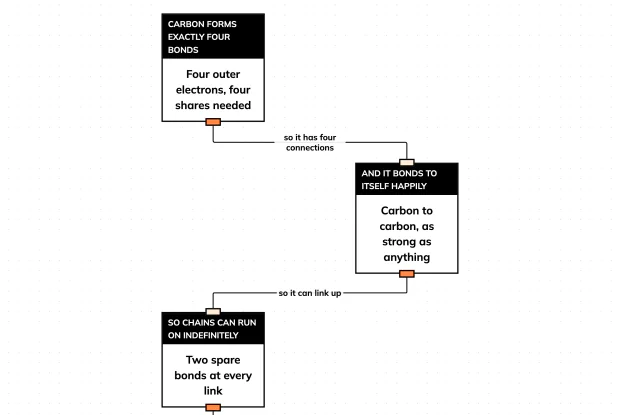
Crude oil is a mixture of hydrocarbons of every length, and sorting them by length sorts them by use as well. Work out why, in an interactive playground.
Why Are Long Chains Cracked? Fixing the Proportions
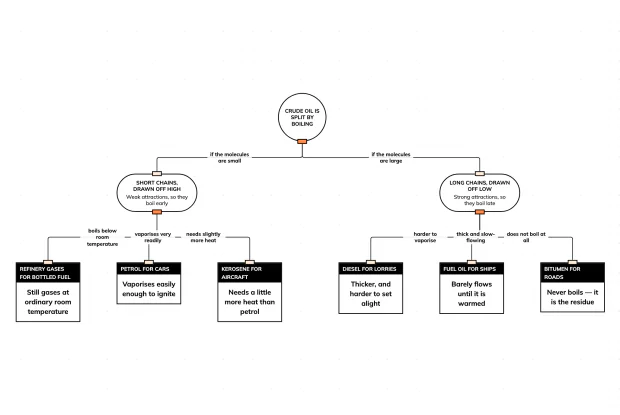
A barrel of crude oil gives far more heavy oil than anyone wants and far less petrol. Follow how breaking long molecules fixes that — and what it produces by accident — in an interactive playground.
Alkane or Alkene? One Bond Makes the Difference
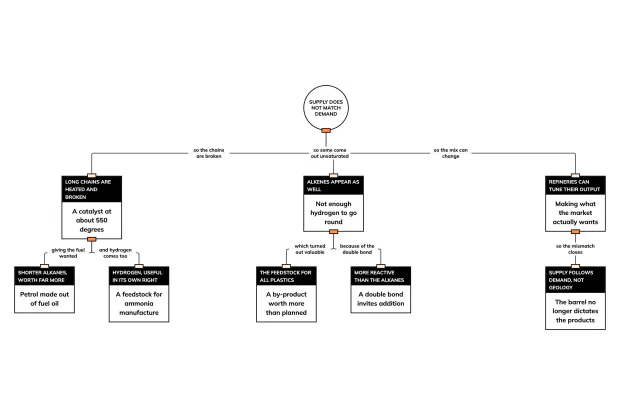
Two hydrocarbon families differ by a single bond, and that one difference decides how they react and how you tell them apart. Test both in an interactive playground.
How Is a Polymer Made? One Bond, Thousands of Times
Every plastic starts as a small molecule with a double bond. Follow how thousands of them join into one chain — and why the result lasts for centuries — in an interactive playground.