The Chemistry of Carbon
Five parts on the element that accounts for most of the compounds there are. It opens on why that should be true of one ordinary element in the middle of the second row: carbon has four outer electrons so it forms four bonds, and a bond between two carbon atoms is unusually strong, so chains can run on indefinitely, branch, and close into rings. Neither fact is remarkable alone; together they make the arrangement matter as much as the ingredients, which is why five carbons and twelve hydrogens give three different substances. The second part meets those chains in the quantity the world uses them, where separating crude oil by boiling point separates it by chain length — and chain length decides whether something fuels a car, a ship, or surfaces a road. The third is the process invented because the ground supplies the wrong proportions: long molecules broken into short ones, with an alkene forced out as a by-product because there is not enough hydrogen for two saturated fragments. The fourth takes the two families side by side, where one bond decides whether bromine water keeps its colour. And the last uses that same double bond on another alkene instead of on bromine, which is every plastic ever made — and the reason none of them rot.
CodePLU Goal
Upgrading Human Mental Models
Learn how to think in Workflows
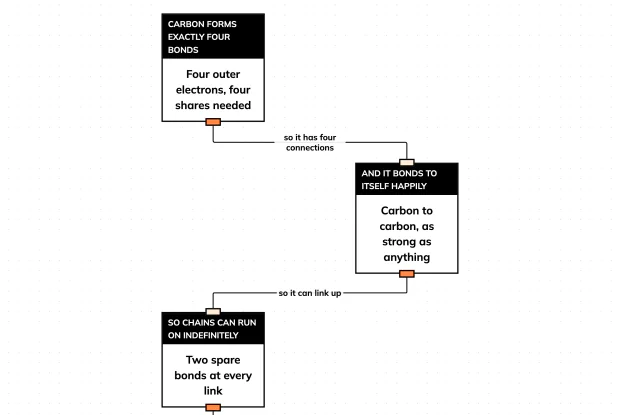
Why Does Carbon Make So Many Compounds?
There are around a hundred and twenty elements, and one of them is responsible for most known compounds. Follow the argument that explains why, in an interactive playground.
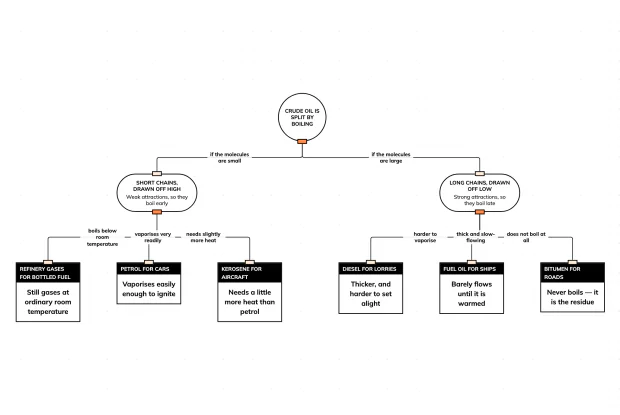
What Comes Out of Crude Oil? Six Useful Fractions
Crude oil is a mixture of hydrocarbons of every length, and sorting them by length sorts them by use as well. Work out why, in an interactive playground.
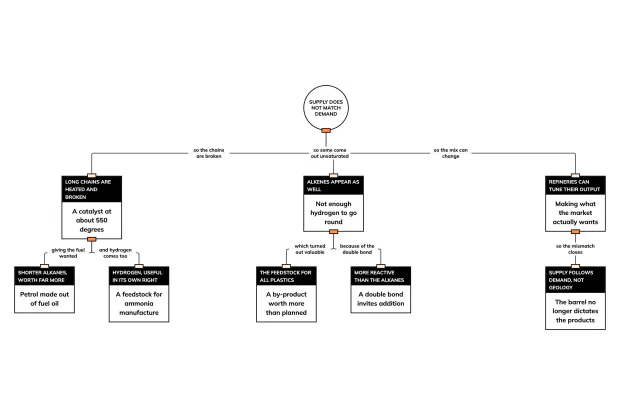
Why Are Long Chains Cracked? Fixing the Proportions
A barrel of crude oil gives far more heavy oil than anyone wants and far less petrol. Follow how breaking long molecules fixes that — and what it produces by accident — in an interactive playground.
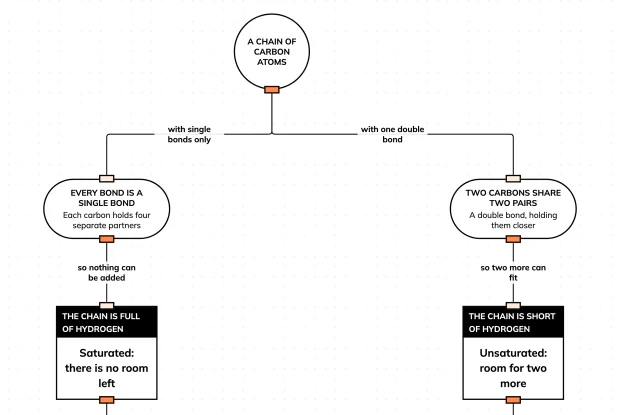
Alkane or Alkene? One Bond Makes the Difference
Two hydrocarbon families differ by a single bond, and that one difference decides how they react and how you tell them apart. Test both in an interactive playground.
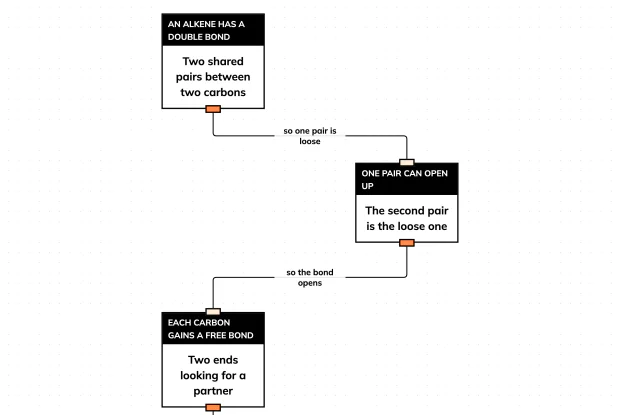
How Is a Polymer Made? One Bond, Thousands of Times
Every plastic starts as a small molecule with a double bond. Follow how thousands of them join into one chain — and why the result lasts for centuries — in an interactive playground.