How Is a Polymer Made? One Bond, Thousands of Times
Root Concept
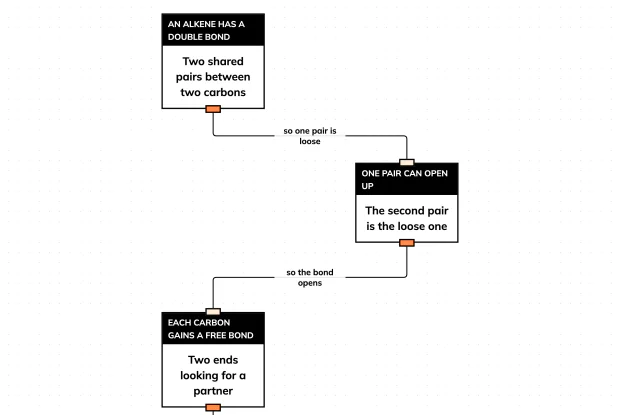
A polymer forms when the double bond in each of thousands of alkene molecules opens up, leaving two free bonds per molecule so they join end to end into one long chain — which contains only strong carbon bonds and therefore resists almost everything.
CodePLU Goal
Upgrading Human Mental Models
Learn how to think in Workflows

Concept Development By codeplu.com
The last two steps are the same fact stated twice: once as an advantage and once as a problem. Nothing in the chemistry distinguishes them.
The Same Double Bond, Used on Itself
The previous tutorial showed an alkene opening its double bond to take on two bromine atoms. Everything about that reaction works just as well if the thing being added is another alkene — and that single change turns a laboratory test into the foundation of the plastics industry.
Start with ethene, the by-product cracking forced into existence. Its double bond opens, leaving each of its two carbons with a free bond. Those free bonds find the nearest ethene molecules, whose double bonds open in turn, and the process runs on. Thousands of molecules end up joined end to end as a single chain, with no double bonds left anywhere in it.
The small repeating molecule is called the monomer and the long chain is the polymer, which simply means "many parts". Ethene gives poly(ethene), the plastic in carrier bags and bottles. Propene gives poly(propene), which is stiffer. Change the monomer and you change the plastic, and the whole range of materials comes from varying one small molecule.
Nothing else is produced. Every atom in the monomers ends up in the chain, which makes this an addition reaction of exactly the kind the last tutorial described, carried out several thousand times over. And the chain that results is made entirely of strong carbon bonds, with nothing weak anywhere along it for water, air or a bacterium to attack — which is both why plastic is so useful and why it is still here centuries later.
Following the Chain
What does the double bond actually do?
It provides the two free bonds that let one molecule attach to the next. A double bond is two shared pairs of electrons between the same two carbon atoms, and the second pair is held less firmly than the first. When it opens, the two carbons stay joined by the remaining single bond but each now has a bond going spare, pointing outwards. Those are the hooks. Every monomer contributes two of them, one at each end, which is exactly what is needed to build a chain rather than a pair — one hook would give molecules joining up two at a time and stopping, and the chain depends on there being another at the far end.
Why does nothing else come out?
Because nothing is removed. Every atom that was in the monomers is still there in the polymer, just arranged into one long molecule instead of thousands of small ones, which is why this is called addition polymerisation. You can see it in the formula: n molecules of C₂H₄ give one molecule of (C₂H₄)ₙ, and the two sides balance without a by-product appearing. That is worth contrasting with the other way polymers can be made, in which a small molecule such as water is squeezed out at every join — nylon and polyester are made that way, and so are proteins inside a living cell. Knowing which kind you are looking at tells you immediately whether to expect a second product.
Why does plastic last so long?
Because there is nothing in the chain for anything to attack. A polymer chain is carbon joined to carbon joined to carbon, with hydrogen along the sides, and both of those bonds are strong and non-polar. Water cannot get a grip because there is no charged or partly charged site to pull on. No bacterium or fungus has an enzyme for it, because these materials have existed for less than a century and nothing has had the time or the reason to evolve one. The chain is also long and tangled, so even where an attack begins it does not easily spread. The result is a material that keeps its shape and strength for a very long time, which is the entire point of it.
Is the durability a flaw?
It is the property that was wanted, which is what makes the problem hard. A bag that dissolved in rain or a pipe that rotted in soil would be useless, and plastics were adopted precisely because they resist everything cheap materials used to fail against. The same resistance then applies in a landfill or an ocean, where it is not wanted at all, and the chain does not know the difference. So the answer cannot be to make plastic weaker in general — it has to be either collecting and reusing it, or designing specific materials with a deliberate weak point built into the chain for the cases where that is acceptable.
Real World Example
Three Monomers, Three Materials
Each of these is the same opening of a double bond, repeated thousands of times, and the differences come entirely from what was attached to the monomer.
Step 1
Ethene gives poly(ethene): bags and bottles
Ethene is the simplest alkene — two carbons, four hydrogens, one double bond — and polymerising it gives the commonest plastic there is. The chains are flexible and slide past one another easily, which gives a soft, bendable material that can be blown into film for carrier bags or moulded into bottles. It is cheap because ethene is cheap, and ethene is cheap because cracking produces it whether anybody wants it or not. A material that wraps most of what you buy exists because a refinery could not avoid making its ingredient. Thinner grades go to film and thicker ones to mouldings, from the same chemistry.
Step 2
Propene gives poly(propene): rope and crates
Propene is ethene with a methyl group on the side, and that side group hangs off the finished chain at regular intervals. It stops the chains packing and sliding as freely, so the material is stiffer, stronger and survives higher temperatures — which is why poly(propene) is used for rope, crates, car bumpers and anything that goes in a dishwasher. One extra carbon on the monomer, and a noticeably different material comes out. The side group is not part of the chain and takes no part in the reaction; it simply gets in the way afterwards, which turns out to be the useful bit.
Step 3
Chloroethene gives PVC: pipes and window frames
Replace one of ethene’s hydrogens with a chlorine atom and the polymer that results is rigid, weather-resistant and self-extinguishing, which is why it is used for drainpipes, guttering and window frames. Adding a plasticiser makes the same polymer soft enough for cable insulation and flooring. The chain is built by the identical reaction in all three cases; only the passenger atoms on the monomer have changed. That is the pattern of the whole industry: one reaction, and a catalogue of materials made by altering what rides along on the monomer. The backbone is identical every time.
FAQs
Final Words
A polymer is built by using an alkene’s double bond on another alkene instead of on bromine. The second shared pair opens, leaving each carbon with a free bond, and because every monomer offers one at each end the molecules join into a chain rather than stopping at pairs. Thousands of them end up as one molecule, with no double bonds left and nothing else produced.
What comes out is a chain of strong, non-polar carbon bonds with no weak point anywhere along it. Water cannot grip it, and no organism has had the time or reason to evolve an enzyme that attacks it. That is exactly why plastics were adopted, and the same sentence explains why they are still in the ground and the sea decades later — the chain cannot tell a drainpipe from a landfill.
This track has spent five tutorials burning hydrocarbons or burying them. The next asks what that does to the air.
Continue This Track
This concept is part 5 of The Chemistry of Carbon.
Why Does Carbon Make So Many Compounds?
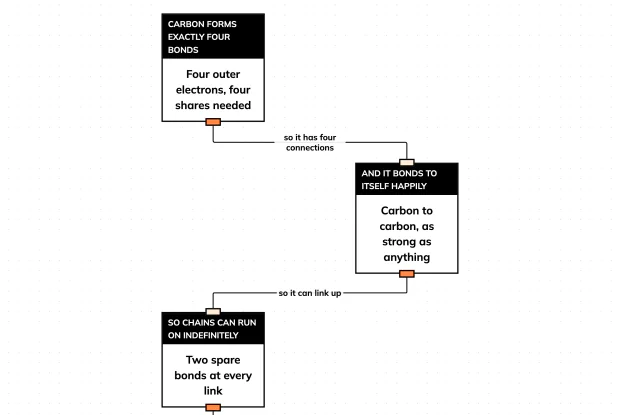
There are around a hundred and twenty elements, and one of them is responsible for most known compounds. Follow the argument that explains why, in an interactive playground.
What Comes Out of Crude Oil? Six Useful Fractions
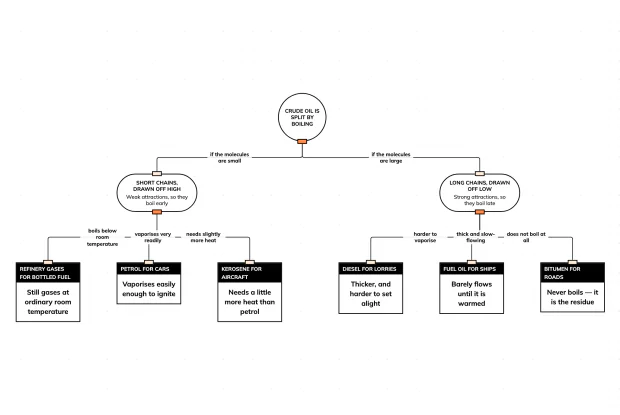
Crude oil is a mixture of hydrocarbons of every length, and sorting them by length sorts them by use as well. Work out why, in an interactive playground.
Why Are Long Chains Cracked? Fixing the Proportions
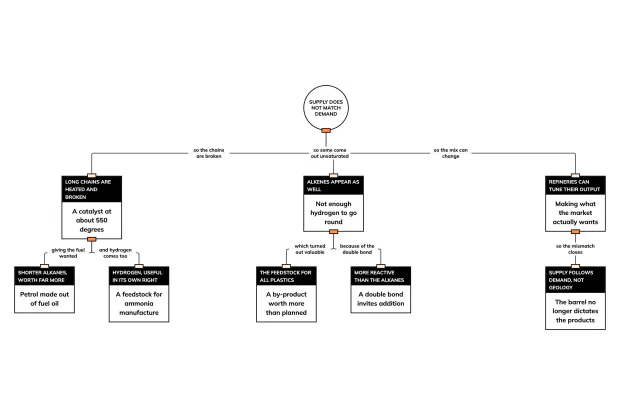
A barrel of crude oil gives far more heavy oil than anyone wants and far less petrol. Follow how breaking long molecules fixes that — and what it produces by accident — in an interactive playground.
Alkane or Alkene? One Bond Makes the Difference
Two hydrocarbon families differ by a single bond, and that one difference decides how they react and how you tell them apart. Test both in an interactive playground.
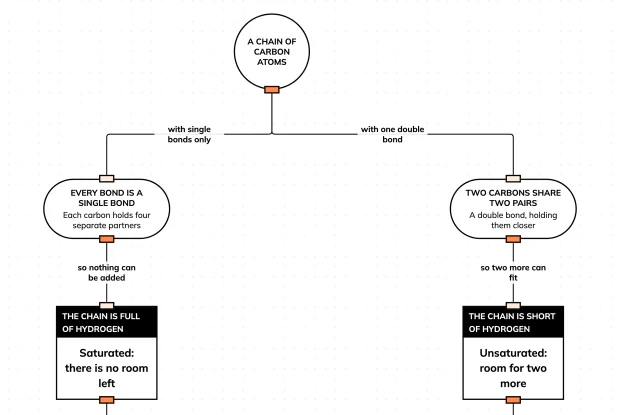
How Is a Polymer Made? One Bond, Thousands of Times
Every plastic starts as a small molecule with a double bond. Follow how thousands of them join into one chain — and why the result lasts for centuries — in an interactive playground.