Alkane or Alkene? One Bond Makes the Difference
Root Concept
An alkane has only single bonds and carries as much hydrogen as it can hold, so it is saturated and unreactive, while an alkene has a carbon-to-carbon double bond that can open to accept two more atoms — which is why it decolourises bromine water and an alkane does not.
CodePLU Goal
Upgrading Human Mental Models
Learn how to think in Workflows

Concept Development By codeplu.com
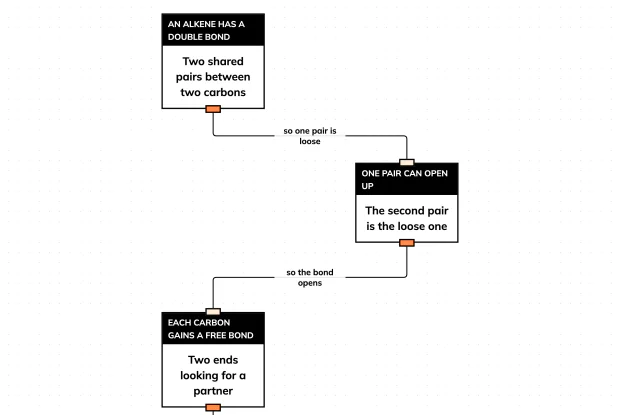
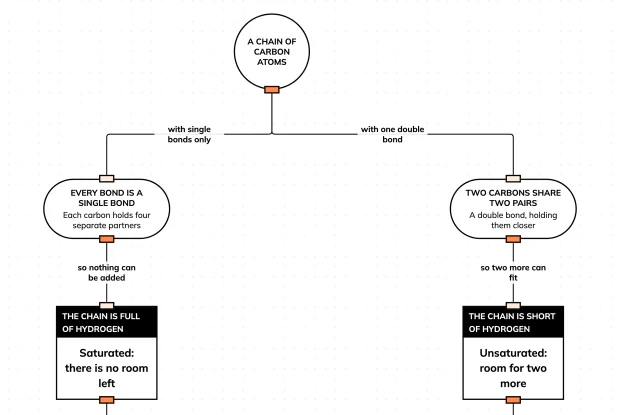
Both branches start from the same thing: a chain of carbon atoms. Only one bond in that chain is different, and every row below it diverges because of that.
Two Families, One Bond Apart
Cracking produced two kinds of molecule, and they are worth telling apart properly because they behave nothing like each other. Both are hydrocarbons — carbon and hydrogen only — and both are chains. The difference is a single bond somewhere along that chain.
In an alkane, every bond is a single bond: each carbon atom is joined to four separate neighbours, using its four bonds on four different partners. There is nowhere for anything else to attach without something being removed first, and a molecule in that state is called saturated. Methane, ethane, propane and butane are the first four, and the names run on from there.
In an alkene, two of the carbon atoms share two pairs of electrons rather than one — a double bond. Those two carbons are using two of their bonds on each other, so between them they are holding two fewer hydrogen atoms than they could. The molecule is short of hydrogen, which is exactly what the cracking arithmetic forced, and a molecule in that state is called unsaturated.
Saturated and unsaturated are not just labels. An alkane has no room for anything new and consequently does very little except burn. An alkene has a double bond that can open up and take two more atoms in, which makes it reactive, useful, and easy to identify with a test that takes about three seconds.
Telling Them Apart
What does saturated actually mean?
That the molecule is holding as much hydrogen as its carbon skeleton allows. Count the bonds on any carbon in an alkane and you find four, all going to different atoms, with every position occupied. Nothing can be added without first taking something away, which is why alkanes are so unreactive: there is no vacancy. The general formula captures it — an alkane with n carbons has 2n+2 hydrogens, so three carbons means eight hydrogens and propane is C₃H₈. The word is the same one used on food packaging about fats, and it means exactly the same thing there: a saturated fat is one whose carbon chains have no double bonds left in them.
What does the double bond change?
It creates somewhere for a reaction to happen. Two carbons sharing two pairs of electrons are held more tightly together, but the second pair is held less securely than the first and can be persuaded to break while the first stays intact. When it does, each of those two carbons has a free bond, and two new atoms can attach without anything being displaced. That is an addition reaction, and alkanes simply cannot do it. The general formula shifts accordingly: an alkene with n carbons has 2n hydrogens, so ethene is C₂H₄ against ethane’s C₂H₆ — the two missing hydrogens being precisely what the double bond stands in for. The formula alone therefore tells you which family a molecule belongs to, before any test is run.
How does the bromine water test work?
By letting the alkene use its double bond on the bromine. Bromine water is orange because of the bromine dissolved in it, and when an alkene is shaken with it the double bond opens and a bromine atom attaches to each of the two carbons. The bromine is consumed, so the orange colour disappears and the mixture goes clear within seconds. An alkane shaken with bromine water does nothing at all, because it has no vacancy to offer and bromine is not energetic enough to force one. So a colour that vanishes means unsaturated and a colour that stays means saturated, which is about as clean as a chemical test gets.
Do they burn differently?
Both burn, and this is the one thing alkanes do readily, but alkenes burn with a smokier flame. The reason is the proportion of carbon: an alkene carries less hydrogen for the same number of carbons, so there is relatively more carbon to oxidise and more of it tends to escape as soot rather than reaching carbon dioxide. That is why alkanes are the fuels and alkenes are generally not — an alkene is far too valuable as a chemical feedstock to burn anyway, which the next tutorial explains. Burning is a poor test for either, since both do it. A test has to tell two things apart, and a flame tells you only that you have a hydrocarbon.
Real World Example
Three Places the Difference Shows
Saturated and unsaturated turn up far outside organic chemistry lessons, and in each case it is the same double bond doing the work.
Step 1
Saturated and unsaturated fat are the same distinction
A fat is built on long carbon chains, and the label on a bottle of cooking oil is reporting whether those chains contain double bonds. Saturated fats have none, pack together neatly and tend to be solid at room temperature, which is butter and lard. Unsaturated fats have double bonds that kink the chain so the molecules cannot stack as closely, which lowers the melting point and gives a liquid oil. The chemistry on the label is exactly the chemistry on this board. Saturated and unsaturated mean the same thing in a supermarket as in a laboratory.
Step 2
Margarine is made by removing the double bonds
Hardening a vegetable oil into a spread means adding hydrogen across some of its double bonds, turning unsaturated chains into saturated ones so the fat sets at room temperature. It is run at about 60 °C over a nickel catalyst, and it is an addition reaction of exactly the kind an alkane could never undergo. The process has a name people recognise — hydrogenation — and it is the single most common industrial use of a double bond opening up. Leaving some double bonds unreacted is how the firmness of the finished spread is controlled.
Step 3
Bromine water as a three-second test
Shake a sample with orange bromine water and watch. If the colour drains away the sample is unsaturated; if it sits there orange, the sample is saturated. The test needs no heating, no apparatus and no waiting, and it works because the double bond consumes the bromine that was providing the colour. Very few chemical tests are this direct, and it is the standard way of distinguishing the two families in any school laboratory. The absence of a result is as informative as the result, which is what makes it a test rather than an observation.
FAQs
Final Words
Alkanes and alkenes are both chains of carbon and hydrogen, and they differ by one bond. In an alkane every bond is single and every position on every carbon is occupied, so the molecule is saturated, has no vacancy, and does very little beyond burning. In an alkene two carbons share a second pair of electrons, which means two fewer hydrogens than the chain could hold.
That shortage is the whole difference. The second pair of a double bond can open while the first stays intact, leaving two free bonds for new atoms to join without anything being displaced — an addition reaction, which an alkane cannot perform at all. It is why bromine water decolourises with one and not the other, why hardening vegetable oil into margarine works, and why the labels on cooking fat are reporting organic chemistry. The last tutorial of this track takes the same double bond and uses it on another alkene instead of on bromine.
Continue This Track
This concept is part 4 of The Chemistry of Carbon.
Why Does Carbon Make So Many Compounds?
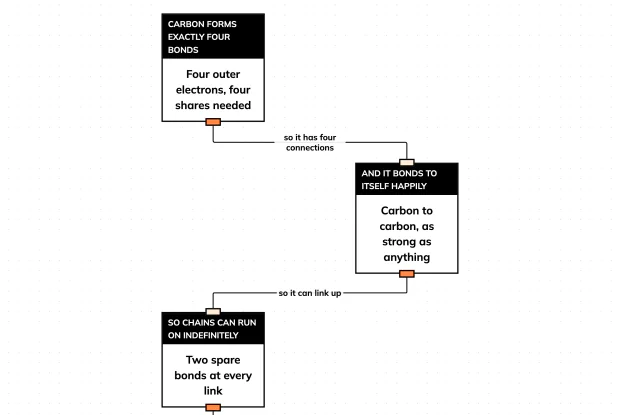
There are around a hundred and twenty elements, and one of them is responsible for most known compounds. Follow the argument that explains why, in an interactive playground.
What Comes Out of Crude Oil? Six Useful Fractions
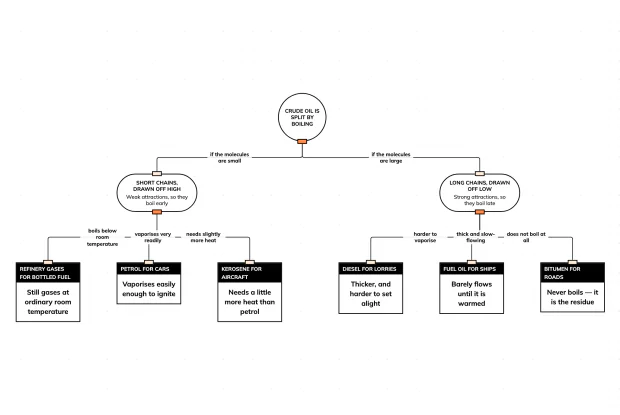
Crude oil is a mixture of hydrocarbons of every length, and sorting them by length sorts them by use as well. Work out why, in an interactive playground.
Why Are Long Chains Cracked? Fixing the Proportions
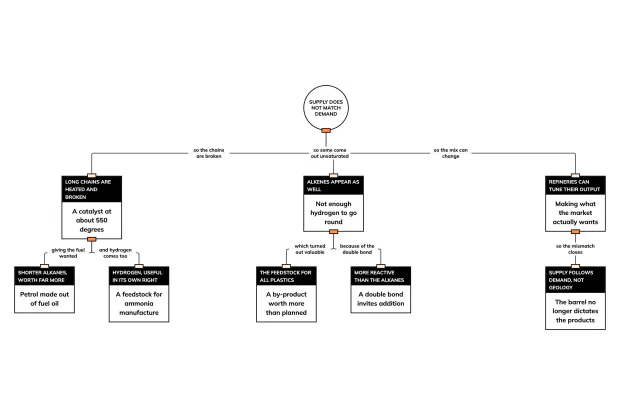
A barrel of crude oil gives far more heavy oil than anyone wants and far less petrol. Follow how breaking long molecules fixes that — and what it produces by accident — in an interactive playground.
Alkane or Alkene? One Bond Makes the Difference
Two hydrocarbon families differ by a single bond, and that one difference decides how they react and how you tell them apart. Test both in an interactive playground.
How Is a Polymer Made? One Bond, Thousands of Times
Every plastic starts as a small molecule with a double bond. Follow how thousands of them join into one chain — and why the result lasts for centuries — in an interactive playground.