Why Have Two Parents At All? Variation Is Why
Root Concept
Sexual reproduction produces offspring that differ from one another, so when conditions change some individuals in a varied population are likely to cope while a genetically uniform population has no such individuals, which is why the cost of needing two parents is worth paying.
CodePLU Goal
Upgrading Human Mental Models
Learn how to think in Workflows

Concept Development By codeplu.com
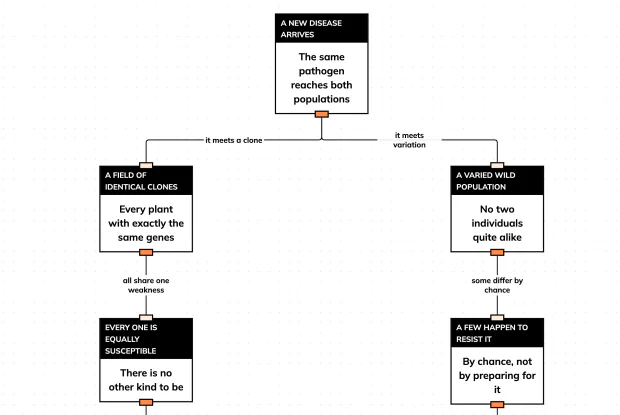
The resistance was already there before the disease arrived. Nothing adapted — the population was simply varied.
Paying for Something You May Never Need
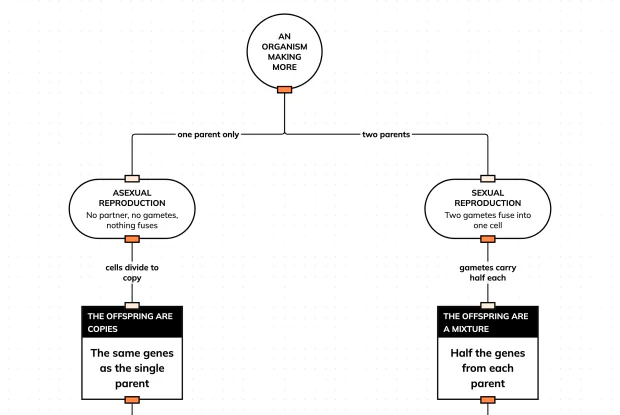
By every obvious measure, sexual reproduction is the worse option. It needs a partner, who may not be found. It costs resources to produce gametes and to attract a mate. It is slower than simply dividing. And an individual that reproduces sexually passes on only half its genes to each offspring, where an asexual one passes on all of them. On those terms the asexual branch wins comfortably, and the question is why sexual reproduction exists at all, let alone why nearly every large organism uses it.
The answer is not about any individual. It is about what happens to a population when the conditions it is suited to stop holding — a new disease, a change in climate, a new predator, a different food supply. A population in which every individual is identical meets that change as one individual: if the change is fatal to one of them it is fatal to all of them, because there is no other kind to be. A population in which everyone differs meets it as thousands of slightly different attempts, and some of those are likely to cope.
The crucial point is about timing. The individuals that cope were not made resistant by the disease arriving — they happened to be resistant already, for reasons having nothing to do with it. The variation was there first, which is why it works as insurance and why it cannot be arranged afterwards.
Working Through the Two Branches
Why is a uniform population so vulnerable?
Because susceptibility is in the genes, and every member of a clone has the same ones. If a pathogen can overcome the defences of one plant in a field of clones, it can overcome the defences of every plant in that field, because there is nothing different for it to run into. The disease does not have to work its way through a range of resistances; there is only one resistance and it has already failed. This is why the banana example from the first tutorial in this track is not bad luck but a structural consequence, and why it happened twice to two different varieties grown the same way.
Where does the resistance in a varied population come from?
From the ordinary working of meiosis and fertilisation, running for generations before anything happened. The previous tutorial counted over eight million possible chromosome combinations from a single individual, and that was before crossing over was included. Every generation of a sexually reproducing population therefore contains individuals with combinations that have never existed before, most of which make no particular difference to anything. Occasionally one of them happens to make its owner harder for some pathogen to infect. Nobody designed that and nothing selected for it in advance — it was simply one of the millions of combinations being produced anyway, most of which do nothing at all. Variation is generated blindly and only afterwards turns out to have been useful, which is an uncomfortable idea and an accurate one.
What actually happens to the population afterwards?
It becomes more resistant, because the individuals that survived are the ones that reproduce. The susceptible individuals contributed nothing to the next generation, and the resistant ones contributed everything, so the proportion carrying resistance rises sharply. The population that comes out of the episode is genuinely different from the one that went in. Notice what did and did not change: no individual changed at all, and the ones that survived were the same organisms they always were. What changed was which individuals the population was made of. That distinction is the whole of how populations adapt, and getting it the wrong way round — imagining that organisms change to suit their circumstances — is the single most persistent error in this part of biology.
Does this mean asexual reproduction is a mistake?
No, and treating it as one gets the comparison backwards. In stable conditions a clone population reproducing quickly will out-compete a sexual one handsomely, because it pays none of the costs and produces more individuals faster. The asexual strategy is not a failure waiting to happen; it is the better strategy whenever conditions hold. The problem is only that conditions do not hold indefinitely. That is why so many organisms switch between the two, as the greenfly in the first tutorial do — asexual while things are good, sexual before things get difficult. An organism that could only do one of them has committed itself to a bet about the future.
Real World Example
The Irish Potato Blight
The potato arrived in Europe as a very narrow selection of varieties, propagated vegetatively. When a pathogen capable of attacking them arrived in 1845, the structural situation was exactly the left-hand branch.
Step 1
A whole country on very few varieties
Potatoes grow well in poor soil and a small plot can feed a family, which made them the staple crop for a large part of the Irish rural population by the 1840s. Because potatoes are propagated from tubers, as the previous tutorial described, each variety was a clone, and only a handful of varieties were grown — the Irish Lumper most of all. The genetic diversity of the entire national crop was therefore roughly that of a few individual plants, however many million were in the ground. Nobody had designed that situation; it followed from propagating a useful crop the easy way.
Step 2
The pathogen met no resistance anywhere
Phytophthora infestans, an organism resembling a fungus, reached Europe in 1845 and spread through the crop. Because every plant of a variety was genetically identical, there were no individuals that happened to cope, and the disease moved through fields without meeting anything that slowed it. Crops failed across successive years. The resulting famine killed around a million people and drove a comparable number to emigrate, permanently changing the population of the island. Policy failures made the catastrophe far worse than the crop failure alone needed to be, and that is a matter for a history lesson rather than this one; the biology in the playground is why the crop failed at all.
Step 3
Where the resistance eventually came from
It came from the wild relatives of the potato in South America, which had never stopped reproducing sexually and had enormous variation accumulated across thousands of wild populations. Breeders crossed resistant wild plants with cultivated ones and then propagated the results vegetatively, which is exactly the two-branch arrangement from the previous tutorial. Collections of wild crop relatives are maintained today for precisely this reason: they are a store of variation that uniform crops cannot generate for themselves. The seed banks holding them are, in effect, an attempt to keep the right-hand branch of the playground available to crops that have been moved onto the left-hand one.
FAQs
Final Words
One disease, two populations, two endings. The uniform population met it as a single individual, because that is effectively what it was, and nothing in it happened to cope. The varied population contained a few individuals that did, entirely by chance, and those were the ones that reproduced — so the population that came through was more resistant than the one that went in.
That is what the cost of sexual reproduction buys, and it explains the timing problem that makes it worth paying in advance. The resistance has to already exist when the change arrives, because nothing can generate it to order afterwards. This track has separated the two strategies, taken apart the cell divisions behind each, sorted the ways of managing alone, and ended on why the expensive option survives. The last track in this subject follows the genes themselves, and asks why you look like your parents but not exactly like either.
Continue This Track
This concept is part 5 of How Living Things Make More of Themselves.
One Parent or Two? The Two Ways to Reproduce
One parent gives copies, quickly. Two parents give offspring that all differ, slowly. Follow both routes from the same starting point in an interactive playground and see what each one buys.
How Does One Cell Become Two? Mitosis in Order
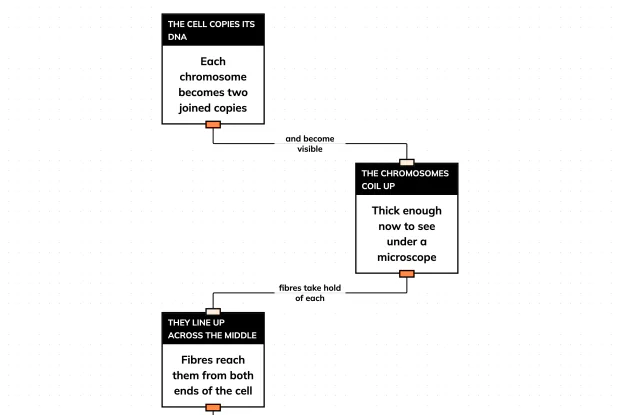
Mitosis makes two cells with identical sets of chromosomes. Follow the six stages in order in an interactive playground, and see why the lining-up step is what makes it accurate.
Why Do Gametes Carry Half? Follow the Arithmetic
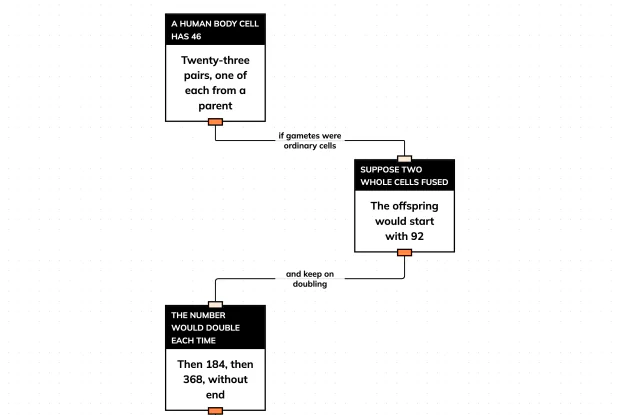
If a sperm and an egg each carried a full set of chromosomes, every generation would have twice as many as the last. Reason to meiosis step by step in an interactive playground.
Making More Without a Partner — Four Methods
Asexual reproduction is not one process. Sort binary fission, budding, spores and vegetative propagation by how the new organism actually gets started, in an interactive playground.
Why Have Two Parents At All? Variation Is Why
Sexual reproduction is slow, expensive and needs a partner. Trace what happens when one disease meets a clone population and a varied one, in an interactive playground, and see what the cost buys.