Making More Without a Partner — Four Methods
Root Concept
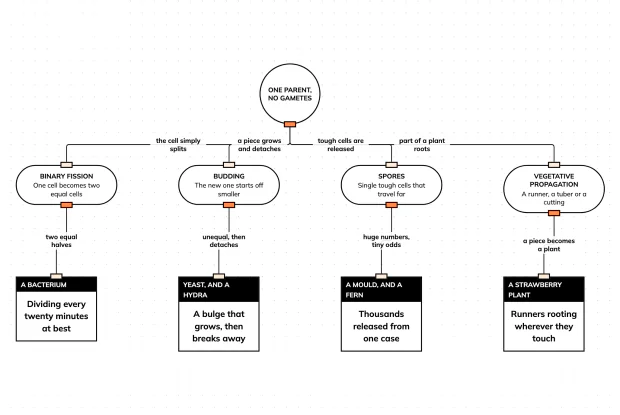
Asexual reproduction takes several forms distinguished by how the new individual begins: binary fission splits a cell into two equal cells, budding grows a smaller outgrowth that detaches, spores are tough single cells released in large numbers, and vegetative propagation grows a new plant from part of an existing one.
CodePLU Goal
Upgrading Human Mental Models
Learn how to think in Workflows

Concept Development By codeplu.com
All four give identical offspring. What differs is how the new individual starts out.
The Same Result, Four Different Routes
The first tutorial in this track put asexual reproduction on one branch and left it there, as though it were a single thing. It is not. Organisms that reproduce without a partner do so in several quite different ways, and the differences are worth sorting out because they are not merely mechanical — each suits a different kind of organism and a different problem.
What they have in common is the outcome. In every case there is one parent, no gametes, nothing fuses, and the new individual carries the parent's genes exactly. That part is settled and the playground does not revisit it. What the sorting asks about is the beginning: how does the new organism get started, and what does it start as?
In binary fission there is no new individual in any meaningful sense — one cell becomes two equal cells and the original is gone, having become both of them. In budding a recognisable parent remains and the offspring begins as a small outgrowth that enlarges and breaks away. Spores are different again: a single tough cell is released, often in enormous numbers, and most of them die, with the few that land somewhere suitable growing into a complete organism. And vegetative propagation is a plant growing a new plant from part of itself — a runner, an underground stem, or a piece cut off and planted.
Those four answers are the categories, and sorting an organism into one of them says something real about how it lives.
What Separates the Four
Why is binary fission different from the others?
Because nothing is left over. In every other method there is a parent that continues to exist and an offspring that is clearly a new individual. In binary fission the cell copies its DNA, pulls the two copies to opposite ends, and pinches into two cells of roughly equal size — and there is no sense in which either is the parent and either is the child. The original has become both. An earlier track used this to explain why bacteria are sometimes said not to die of old age, and the same tutorial made the point that this is not mitosis: there is no nucleus, no spindle and no lining-up stage, which is part of why it is so much faster.
What does budding do that fission does not?
It leaves a parent behind, and it starts the offspring smaller. A bulge grows out of the parent organism, receives a copy of the genetic material, enlarges, and eventually separates. Yeast does this as a single cell, which is why a yeast population under a microscope shows cells with smaller cells attached to them. Hydra, a small freshwater animal, does it with a whole body: a miniature hydra grows out of the side of an adult, develops tentacles, and detaches as a complete animal. The asymmetry is the defining feature — unlike fission, the two products are not equivalent, and one of them is recognisably the original. In a hydra you can watch the whole thing happen over a few days with nothing more than a hand lens.
Why do spores exist in such numbers?
Because almost all of them fail, and the strategy only works if enough are produced to make that acceptable. A spore is a single cell with a tough protective wall and almost no food reserve, which makes it light enough to travel on air currents and durable enough to survive drying. An earlier track followed exactly this in bread mould, where the stalk exists to lift the spore case clear of the food so the spores leave on moving air. The trade is straightforward: a spore is cheap, so an organism can make millions, and the few that land somewhere damp and suitable are enough. Ferns and mosses use the same approach.
What counts as vegetative propagation?
Any case where a new plant grows from part of an existing plant rather than from a seed. Strawberries send out horizontal stems called runners that root where they touch soil. Potatoes are swollen underground stems, and each eye on one is a bud that can grow into a new plant. Daffodils and onions spread by bulbs dividing. Many plants will grow from a cutting — a piece of stem placed in water or soil, which produces roots and becomes an independent plant. All of these are possible because plants keep dividing meristem tissue in places an animal has no equivalent of, which is why no animal can be propagated from a cutting.
Real World Example
A Potato Field and a Packet of Seeds
Potatoes can be grown from tubers or from true seed, and almost nobody does the second — which turns out to be a precise illustration of what each branch of the first tutorial is for.
Step 1
Seed potatoes are not seeds
What a grower plants is a small tuber, which is a swollen section of underground stem with buds on it. Each bud grows into a shoot and then into a complete plant, genetically identical to the plant the tuber came from. Calling it a seed potato is a piece of ordinary language that gets the biology exactly backwards: nothing about it is a seed, no fertilisation was involved, and the plant that results is a clone rather than an offspring in the usual sense. The whole field will therefore be one plant, repeated, which is exactly the situation the banana example in the first tutorial described.
Step 2
Potato plants do make real seeds
A potato plant flowers and, if pollinated, produces small green fruits containing true seeds, which are the product of sexual reproduction with all the variation that implies. Those seeds will grow, and what comes up will not be the variety the grower planted. Every seedling will be different, most will produce poor tubers, and the uniform crop a buyer expects will be gone — different sizes, different cooking qualities, different resistance to disease. The variation that protects a wild population is precisely what a commercial grower cannot have, because a supermarket contract specifies a potato rather than a range of them.
Step 3
Which is why breeders use the seeds anyway
New potato varieties can only come from true seed, because that is the only route by which anything new appears. A breeder grows thousands of seedlings, selects the handful with useful combinations of qualities, and then propagates those vegetatively for ever after — a process that takes upwards of a decade. Both branches of the first tutorial are doing their proper job: sexual reproduction generating variation to choose from, and asexual reproduction preserving a chosen result unchanged once it has been found. The field is a clone and the breeding programme is not, and neither could do the other's job.
FAQs
Final Words
Four routes, one outcome. Binary fission splits a cell into two equal cells with nothing left over that could be called the parent. Budding grows a smaller outgrowth that enlarges and detaches, leaving the original behind. Spores are tough single cells released in enormous numbers against very poor odds. Vegetative propagation grows a new plant from a runner, a tuber or a cutting.
In every case there is one parent, nothing fuses, and the offspring carries the parent's genes exactly — so the sorting is about how the new individual starts rather than about what it ends up with. A potato field shows both branches of this track doing their proper work at once: seed to generate something new, tubers to keep it unchanged. The last tutorial asks why any organism goes to the trouble of the other branch at all.
Continue This Track
This concept is part 4 of How Living Things Make More of Themselves.
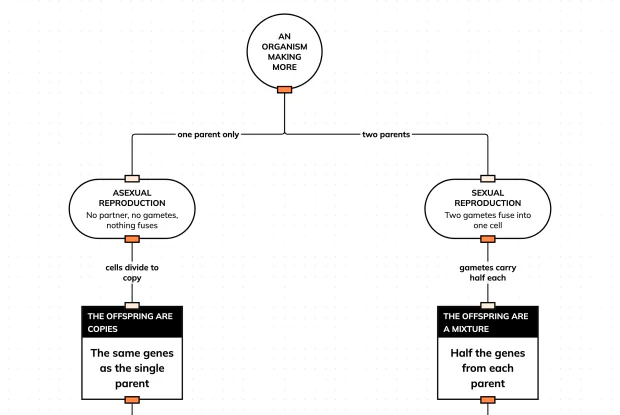
One Parent or Two? The Two Ways to Reproduce
One parent gives copies, quickly. Two parents give offspring that all differ, slowly. Follow both routes from the same starting point in an interactive playground and see what each one buys.
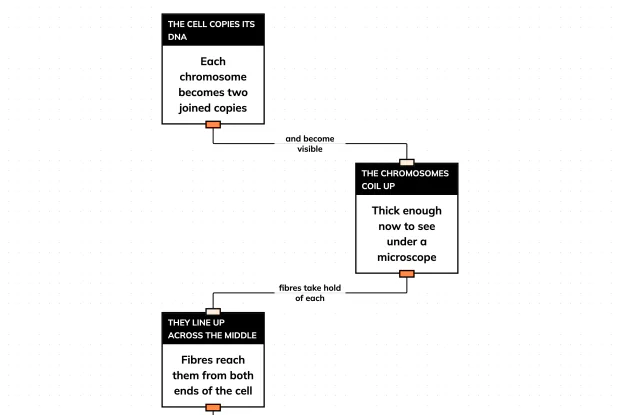
How Does One Cell Become Two? Mitosis in Order
Mitosis makes two cells with identical sets of chromosomes. Follow the six stages in order in an interactive playground, and see why the lining-up step is what makes it accurate.
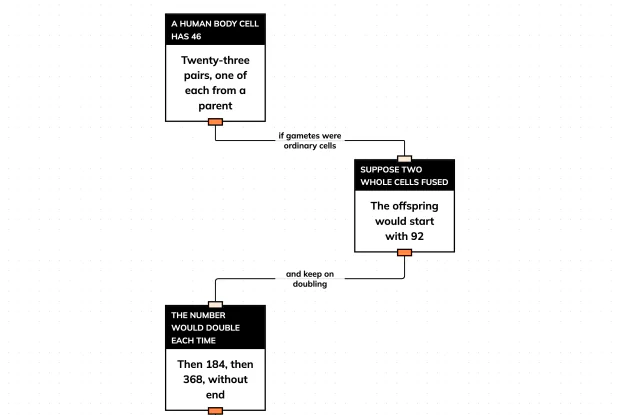
Why Do Gametes Carry Half? Follow the Arithmetic
If a sperm and an egg each carried a full set of chromosomes, every generation would have twice as many as the last. Reason to meiosis step by step in an interactive playground.
Making More Without a Partner — Four Methods
Asexual reproduction is not one process. Sort binary fission, budding, spores and vegetative propagation by how the new organism actually gets started, in an interactive playground.
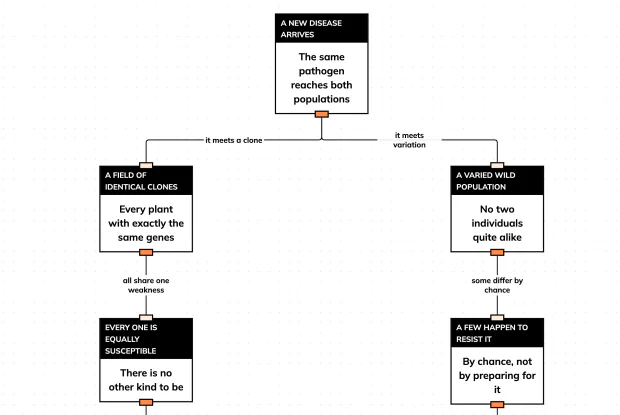
Why Have Two Parents At All? Variation Is Why
Sexual reproduction is slow, expensive and needs a partner. Trace what happens when one disease meets a clone population and a varied one, in an interactive playground, and see what the cost buys.