How Living Things Make More of Themselves
There are exactly two ways of making more of your kind, and the choice between them decides whether the next generation is identical to this one or different from it. The track opens on that contrast — one parent, ordinary cell division and offspring carrying the parent's genes exactly, against two gametes fusing and offspring that are new combinations — and then takes apart the machinery behind each. Mitosis is read as a solution to one problem, which is that each new cell needs a complete set of chromosomes rather than roughly half the material, and the lining-up step nobody remembers turns out to be where the accuracy comes from. Meiosis is not announced but arrived at: a body cell has forty-six chromosomes, two whole cells fusing would give ninety-two and the generation after that one hundred and eighty-four, so gametes cannot be ordinary cells and some other division has to exist. The fourth tutorial sorts the ways of managing without a partner, which are four quite different beginnings to the same outcome. And the track closes on the question the first one raised: why any organism pays for the expensive option, traced through one disease meeting a clone population and a varied one, where the decisive point is that the resistance had to already be there before the disease arrived.
CodePLU Goal
Upgrading Human Mental Models
Learn how to think in Workflows
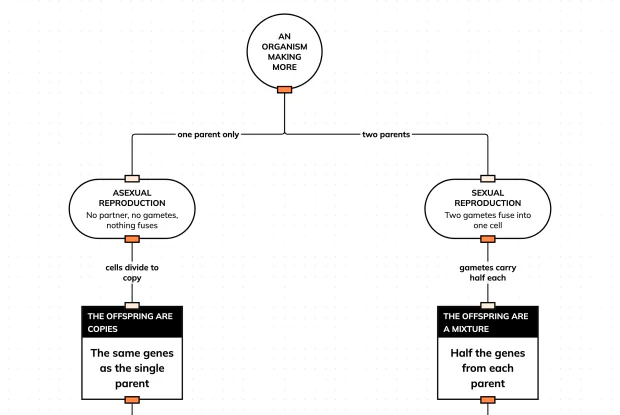
One Parent or Two? The Two Ways to Reproduce
One parent gives copies, quickly. Two parents give offspring that all differ, slowly. Follow both routes from the same starting point in an interactive playground and see what each one buys.
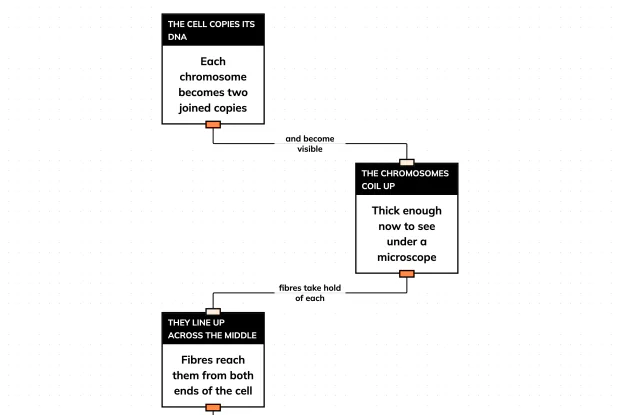
How Does One Cell Become Two? Mitosis in Order
Mitosis makes two cells with identical sets of chromosomes. Follow the six stages in order in an interactive playground, and see why the lining-up step is what makes it accurate.
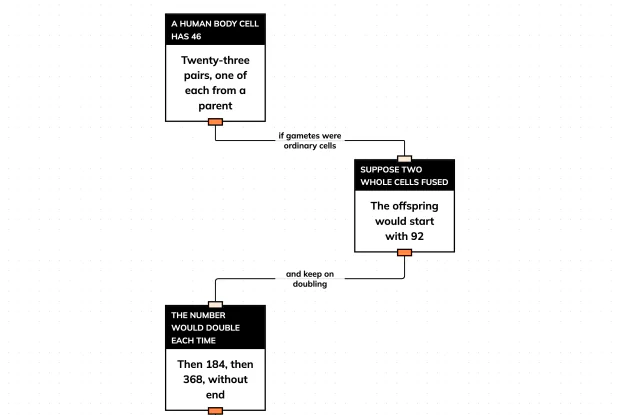
Why Do Gametes Carry Half? Follow the Arithmetic
If a sperm and an egg each carried a full set of chromosomes, every generation would have twice as many as the last. Reason to meiosis step by step in an interactive playground.
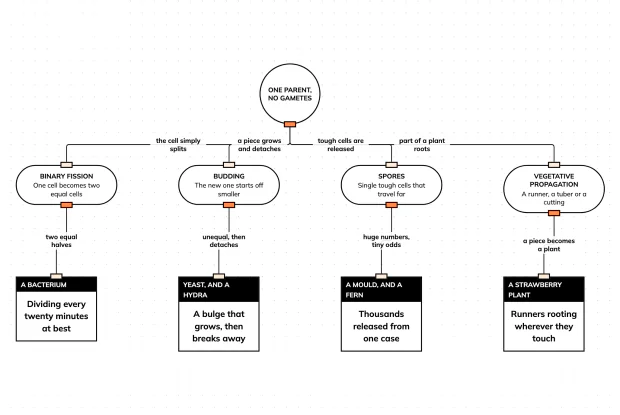
Making More Without a Partner — Four Methods
Asexual reproduction is not one process. Sort binary fission, budding, spores and vegetative propagation by how the new organism actually gets started, in an interactive playground.
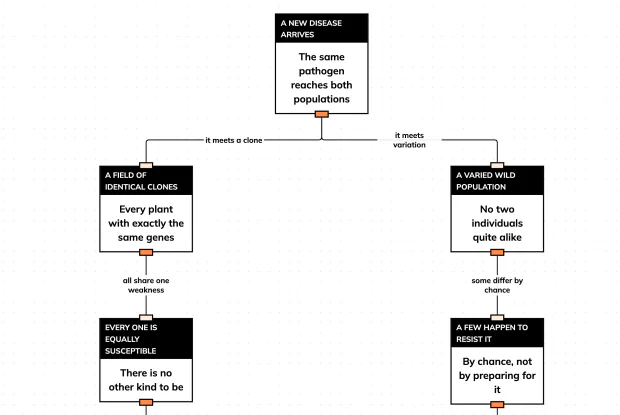
Why Have Two Parents At All? Variation Is Why
Sexual reproduction is slow, expensive and needs a partner. Trace what happens when one disease meets a clone population and a varied one, in an interactive playground, and see what the cost buys.