One Parent or Two? The Two Ways to Reproduce
Root Concept
Asexual reproduction involves one parent and produces offspring genetically identical to it, while sexual reproduction involves the fusion of two gametes, each carrying half a set of genes, and produces offspring that differ from their parents and from each other.
CodePLU Goal
Upgrading Human Mental Models
Learn how to think in Workflows

Concept Development By codeplu.com
Neither branch is better. They fail in opposite conditions, which is why both exist.
Copies, or Something New
Every living thing eventually makes more of its kind, and there are exactly two ways of going about it. The difference between them is not a detail of mechanism. It decides whether the next generation is identical to this one or different from it, and almost everything else about an organism's way of living follows from which it uses.
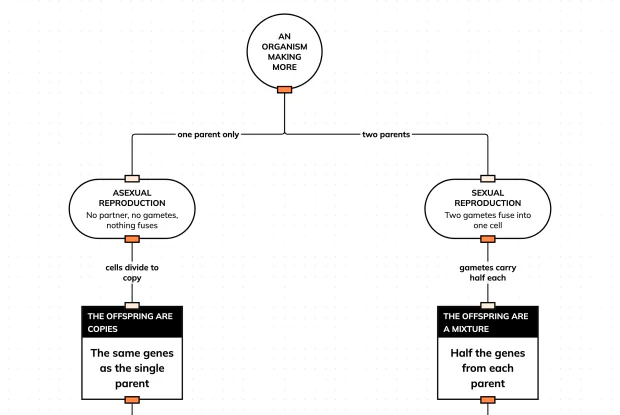
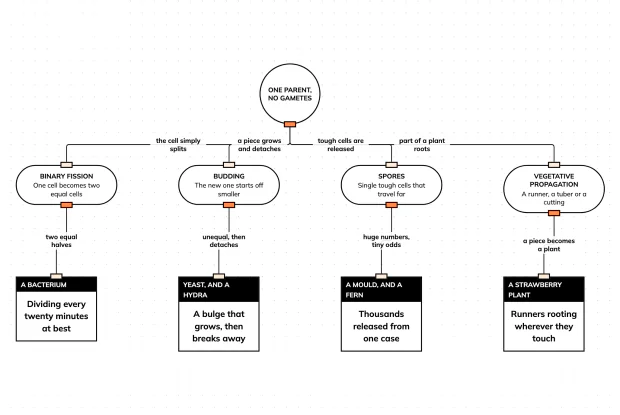
Asexual reproduction needs one parent and nothing else. A cell divides, or a piece grows out and detaches, or a spore is released, and what results carries exactly the same genes as the organism it came from. There is no partner to find, no gametes to make, and no waiting. A single bacterium dropped into a warm flask of broth can fill it overnight, and every cell in that flask is the same cell.
Sexual reproduction needs two parents, or at least two gametes. Each gamete carries half a set of genes, the two fuse, and the resulting cell has a full set made up of contributions from both. Because the two halves come from different individuals, and because which half each parent contributes is itself a matter of chance, no two offspring are the same and none is the same as either parent. That is slower, it costs a great deal more, and it is what nearly all large organisms do.
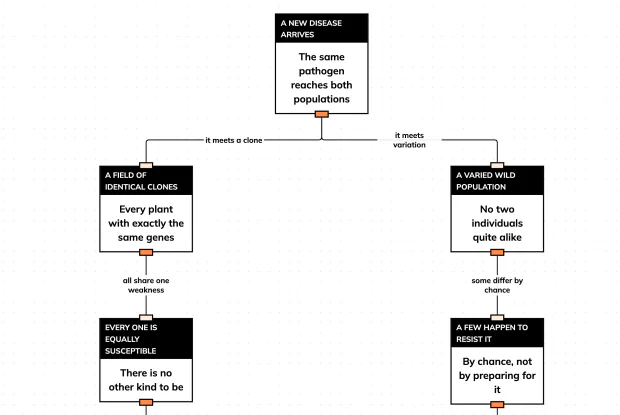
The playground runs both branches from the same starting point and they end somewhere genuinely different. Neither ending is better in general. Which one is better depends entirely on whether conditions are about to change.
What Each Route Costs and Buys
What makes offspring identical in asexual reproduction?
The fact that they come from ordinary cell division. When a cell divides to produce two cells, the DNA is copied first and each new cell receives a complete, identical set — that is the process the next tutorial takes in detail. Nothing is mixed, nothing is left out, and no second source of genes is involved, so a new organism produced this way carries the genes of its single parent exactly. A group of such organisms is called a clone, which simply means genetically identical individuals, and it is a perfectly ordinary situation in nature rather than anything artificial. Every greenfly on a rose bush in summer is likely to be one, and so is every potato plant in a field grown from the same stock.
Where does the variation in sexual reproduction come from?
From three places, and they compound. The first is that an offspring receives half its genes from each parent, so it is already a combination that has never existed before. The second is that which half a parent contributes is decided at random when gametes are made, so the same two parents can produce enormous numbers of different combinations — this is why siblings differ. The third is that which gamete meets which is itself chance. The result is that sexual reproduction does not merely allow variation, it manufactures it on a large scale every generation, and does so without anything having to go wrong. That last point is worth holding on to: variation here is the normal working of the system, not a copying error.
Why would any organism give up variation?
Because it is expensive and asexual reproduction is not. Finding a mate costs time and energy and may fail entirely; producing gametes costs resources; and an organism that reproduces sexually passes on only half its genes to each offspring rather than all of them. Against that, a single asexual individual can colonise an empty space by itself, with no partner, at whatever speed its cells can divide. Where conditions are good and stable, that is simply the better deal, which is why asexual reproduction is overwhelmingly common among microorganisms and among plants spreading through ground that already suits them. The strategy is not a primitive one that better organisms grew out of — it is the right answer to a particular situation, and organisms that can use both reach for it whenever that situation holds.
Do organisms have to choose one?
No, and a great many use both at different times, which is the clearest evidence that each has its own advantage. Greenfly reproduce asexually all summer, when conditions are good and speed is everything, and switch to sexual reproduction in autumn, producing eggs that overwinter. Strawberry plants send out runners to colonise nearby ground and also flower and set seed. Many fungi do both. The pattern is strikingly consistent: asexual when conditions are favourable and stable, sexual when they are about to become hard or unpredictable. The organisms are behaving as though variation were insurance: worth nothing while conditions hold, and worth everything when they do not. The last tutorial in this track is about why that insurance pays.
Real World Example
Why Every Cavendish Banana Is the Same Plant
Almost every banana sold in the world is a clone, propagated asexually for a century, which makes the whole crop a very large demonstration of what the left-hand branch costs.
Step 1
The fruit has no usable seeds
A supermarket banana contains only tiny dark specks where seeds would be, because the variety is sterile — a happy accident from the grower's point of view, since nobody wants to eat round a mouthful of hard seeds. But a plant with no viable seed cannot reproduce sexually at all. New plants are grown instead from suckers, shoots that come up from the base of an existing plant and are dug up and replanted. That is vegetative propagation, which is asexual, so every plant produced is genetically identical to the one it came from, and to every other plant in the industry descended from the same stock.
Step 2
It had happened once before
Until the 1950s the banana traded internationally was a different variety, Gros Michel, propagated the same way and therefore equally uniform. A soil fungus causing a wilt disease spread through the plantations, and because every plant had the same genes every plant was equally susceptible. There were no resistant individuals for the disease to run into, because there were no different individuals at all. The variety was effectively wiped out commercially, and the industry replanted with Cavendish, which happened to resist that particular strain — and was then propagated asexually in exactly the same way, which recreated the same situation with a different plant.
Step 3
And is happening again
A newer strain of the same wilt disease does affect Cavendish, and it has been spreading between growing regions for some years. The structural problem is exactly the one the left-hand branch of the playground ends on: a crop with no variation has no reserve of individuals that happen to cope. Sexual reproduction would supply that reserve automatically, generation after generation, at the cost of a slower and less uniform crop, which is not what a supermarket supply chain is built for. This is the trade-off in the playground, priced in an industry, and there is no clever way round it.
FAQs
Final Words
Two routes from the same starting point, ending somewhere genuinely different. One parent, ordinary cell division, and offspring carrying exactly the parent's genes: fast, cheap, possible for a single individual alone, and producing a population in which nothing differs. Two parents, gametes carrying half a set each, and offspring that are new combinations: slow, expensive, impossible alone, and producing a population in which everything differs.
Neither is better in the abstract, which is why so many organisms use both and switch between them. What settles it is whether conditions are about to change, and a field of clones meeting a new disease is the sharpest version of that question. The rest of this track takes the machinery apart, beginning with the cell division that makes the left-hand branch possible.
Continue This Track
This concept is part 1 of How Living Things Make More of Themselves.
One Parent or Two? The Two Ways to Reproduce
One parent gives copies, quickly. Two parents give offspring that all differ, slowly. Follow both routes from the same starting point in an interactive playground and see what each one buys.
How Does One Cell Become Two? Mitosis in Order
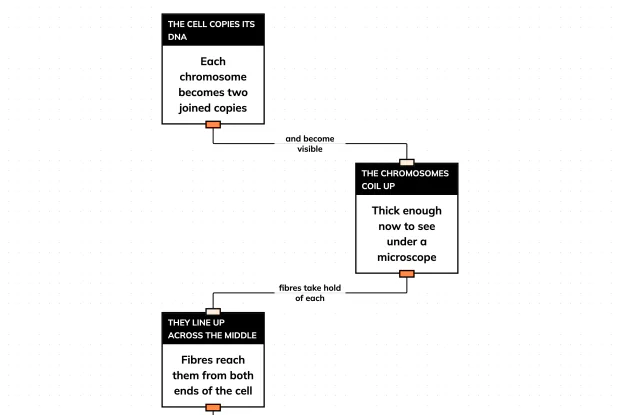
Mitosis makes two cells with identical sets of chromosomes. Follow the six stages in order in an interactive playground, and see why the lining-up step is what makes it accurate.
Why Do Gametes Carry Half? Follow the Arithmetic
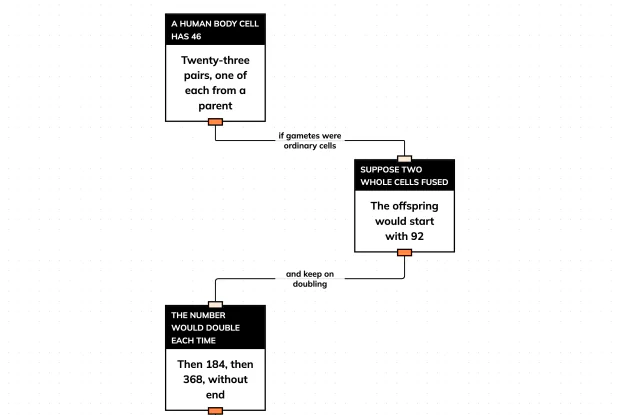
If a sperm and an egg each carried a full set of chromosomes, every generation would have twice as many as the last. Reason to meiosis step by step in an interactive playground.
Making More Without a Partner — Four Methods
Asexual reproduction is not one process. Sort binary fission, budding, spores and vegetative propagation by how the new organism actually gets started, in an interactive playground.
Why Have Two Parents At All? Variation Is Why
Sexual reproduction is slow, expensive and needs a partner. Trace what happens when one disease meets a clone population and a varied one, in an interactive playground, and see what the cost buys.