Why Do Gametes Carry Half? Follow the Arithmetic
Root Concept
Because fertilisation combines two gametes into one cell, each gamete must carry half the normal number of chromosomes or the number would double every generation, and meiosis is the division that halves it by following one round of DNA copying with two rounds of separation.
CodePLU Goal
Upgrading Human Mental Models
Learn how to think in Workflows

Concept Development By codeplu.com
Nothing here is memorised. The last step is forced by the arithmetic in the first three.
A Problem You Can Spot With Arithmetic Alone
Meiosis is usually introduced as a second kind of cell division that students are expected to learn alongside mitosis. It is far more satisfying to arrive at it, because the need for it follows from a single number and some counting.
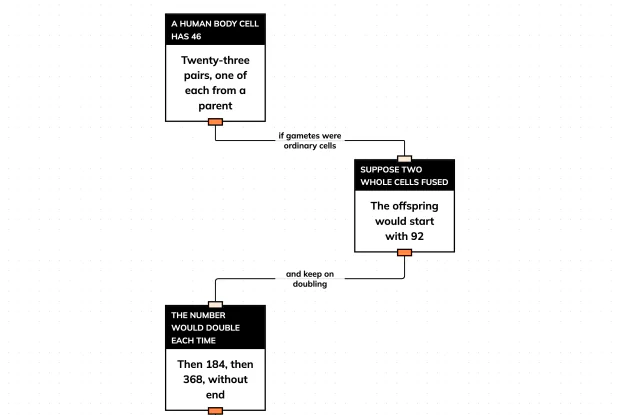
A human body cell contains forty-six chromosomes, arranged as twenty-three pairs. The pairing matters: one member of each pair came from one parent and the other from the other parent, which is why they come in twos rather than being forty-six unrelated things. Other species have other numbers — a fruit fly has eight, a dog seventy-eight — and the argument works the same way for all of them.
Now suppose fertilisation worked by two ordinary cells fusing. Forty-six and forty-six would give an offspring with ninety-two. That offspring's own children would have one hundred and eighty-four, and theirs three hundred and sixty-eight, and so on without limit. Nothing like that happens: every generation of every species has the same chromosome number as the last. So the supposition is wrong somewhere, and the only place it can be wrong is in the assumption that a gamete is an ordinary cell.
It is not. A gamete carries twenty-three single chromosomes rather than twenty-three pairs, so two of them fuse to give forty-six and the number holds steady for ever. And a cell division that produces cells with half the chromosomes of the parent cell is not something mitosis can do, so there has to be a second kind. That is meiosis, and the playground reaches it without being told.
Each Step of the Argument
What does it mean for chromosomes to come in pairs?
That the cell holds two versions of every chromosome, one inherited from each parent, carrying the same genes in the same order but not necessarily the same versions of those genes. Chromosome fourteen from a mother and chromosome fourteen from a father are a pair in this sense: both carry the gene for whatever that chromosome carries, and they may carry different forms of it. A cell with both members of every pair is called diploid, and one with only one member of each is haploid. Those two words are simply names for the situation the arithmetic forces, and the distinction between them is the whole subject of this tutorial.
Why can mitosis not make a gamete?
Because mitosis is built to produce exact copies, and that is precisely the wrong thing here. Every stage of it — copying the DNA first, lining the pairs up in the middle, pulling one copy of each to each end — is organised to guarantee that both new cells get a complete set. A cell produced by mitosis from a cell with forty-six chromosomes has forty-six. There is no step at which anything could be left out, and adding one would destroy the reliability that is the point of the whole arrangement. So gametes cannot be made by modifying mitosis slightly. They need a different process with a different design.
How does meiosis halve the number?
By copying the DNA once and then separating twice. The first division pulls the pairs apart, sending one whole chromosome of each pair to each side — and that is the step that halves the count, because each side now has one of each pair instead of two. The second division then separates the copies of each chromosome, as mitosis does. One round of copying followed by two rounds of separating gives four cells from one, each with half the original number. The arithmetic is simple: double it once, halve it twice, and you end up at half. The order is what makes it work, and it is also what makes meiosis easy to confuse with mitosis — the second division looks exactly like an ordinary one, and only the first does the thing that matters.
Why does which chromosome goes which way matter?
Because it is decided at random, and that is where most of the variation from the first tutorial comes from. When the pairs line up for the first division, each pair is oriented independently of the others, so a gamete can receive the mother's copy of one chromosome and the father's copy of the next in any combination. With twenty-three pairs that gives over eight million possible combinations from the same person, before any other source of variation is counted. Sexual reproduction manufactures difference, and this is the main machinery doing it. Notice that the randomness is not a flaw in an otherwise accurate process: mitosis is accurate on purpose and meiosis is random on purpose, because the two divisions are for different things.
Real World Example
Why Wheat Has Six Sets Instead of Two
The argument says chromosome numbers cannot keep doubling. Occasionally they double once, the result survives, and a new species exists — which is a large part of how crop plants came to be what they are.
Step 1
Sometimes meiosis fails to separate
Very occasionally the first division of meiosis does not pull a pair apart properly and a gamete ends up with a complete double set instead of a half set. In an animal this is almost always fatal or produces an infertile individual. In plants it is survivable surprisingly often, partly because plant development is far more flexible, and the result is an individual with twice the usual number of chromosome sets. Such a plant is described as polyploid, and it is frequently larger and more vigorous than its parents, with bigger cells, bigger leaves and bigger seeds.
Step 2
Bread wheat is the result of two such events
Modern bread wheat carries six sets of chromosomes rather than two, and the sets came from three different wild grass species. Two of those species hybridised and the offspring doubled its chromosomes, producing a fertile plant with four sets; that plant later crossed with a third species and doubled again. Each doubling happened thousands of years ago in the Middle East, was noticed by farmers because the grain was better, and was kept. The crop feeding a large share of the world is the product of exactly the accident the arithmetic rules out as a general pattern.
Step 3
Why it stops there
Doubling cannot keep happening indefinitely, and the reason is meiosis itself. Pairing up works cleanly when there are two of each chromosome; with three of each it becomes unreliable and gametes end up with wrong numbers, which is why triploid plants such as seedless bananas and some apples are sterile and have to be propagated asexually. Even-numbered sets can pair, odd-numbered ones cannot, and above a certain number the machinery struggles regardless. The doubling is a rare event that occasionally sticks, not a trend — which is why the argument in the playground still holds for every species generation after generation.
FAQs
Final Words
The whole argument fits into counting. A body cell has forty-six chromosomes in twenty-three pairs. If fertilisation joined two such cells the offspring would have ninety-two, and the generation after that one hundred and eighty-four, without end. That does not happen, so gametes cannot be ordinary cells — they must carry half, twenty-three singles rather than twenty-three pairs.
And since mitosis is built to give both new cells a complete set, some other division has to exist. Meiosis copies the DNA once and separates twice, producing four cells with half the original number each. It also does something the arithmetic did not demand: because each pair is oriented at random, it manufactures the variation the first tutorial said sexual reproduction was for. The next tutorial goes back to the other branch and sorts out how organisms manage with no gametes at all.
Continue This Track
This concept is part 3 of How Living Things Make More of Themselves.
One Parent or Two? The Two Ways to Reproduce
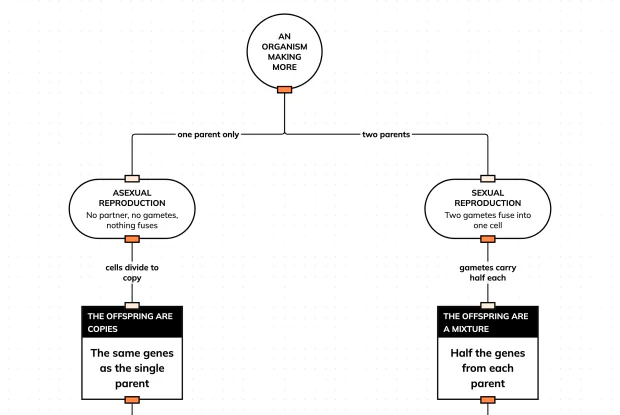
One parent gives copies, quickly. Two parents give offspring that all differ, slowly. Follow both routes from the same starting point in an interactive playground and see what each one buys.
How Does One Cell Become Two? Mitosis in Order
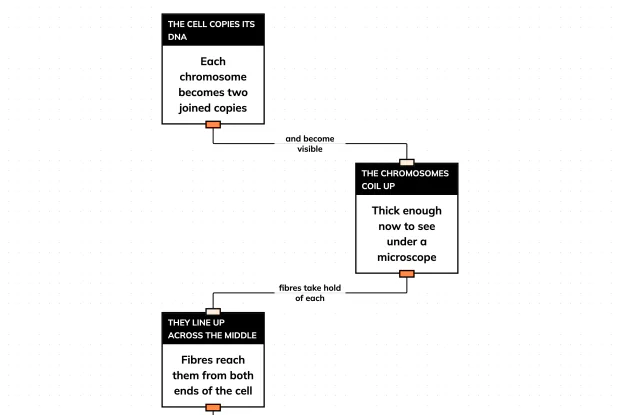
Mitosis makes two cells with identical sets of chromosomes. Follow the six stages in order in an interactive playground, and see why the lining-up step is what makes it accurate.
Why Do Gametes Carry Half? Follow the Arithmetic
If a sperm and an egg each carried a full set of chromosomes, every generation would have twice as many as the last. Reason to meiosis step by step in an interactive playground.
Making More Without a Partner — Four Methods
Asexual reproduction is not one process. Sort binary fission, budding, spores and vegetative propagation by how the new organism actually gets started, in an interactive playground.
Why Have Two Parents At All? Variation Is Why
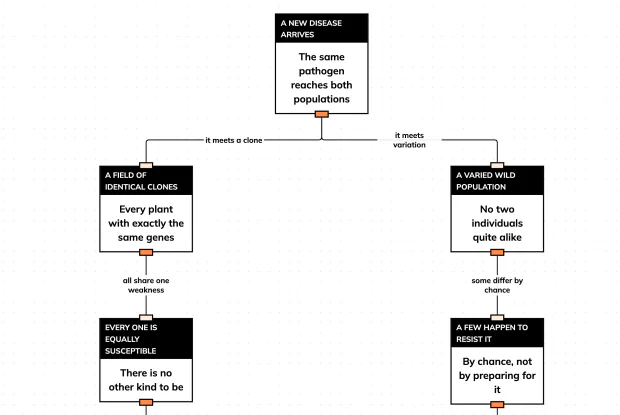
Sexual reproduction is slow, expensive and needs a partner. Trace what happens when one disease meets a clone population and a varied one, in an interactive playground, and see what the cost buys.