Why Is Gold Found as Gold and Iron as Rust?
Root Concept
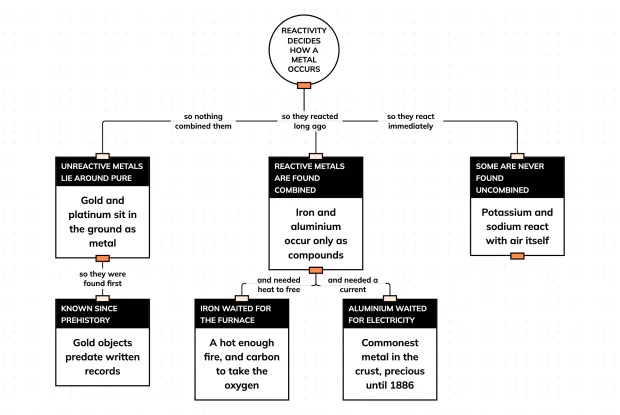
A metal’s position in the reactivity series decides how it is found in the ground: unreactive metals such as gold occur as the metal itself because nothing combined with them, while reactive metals occur only as compounds — which is also why the order in which humans learned to use metals follows the series in reverse.
CodePLU Goal
Upgrading Human Mental Models
Learn how to think in Workflows

Concept Development By codeplu.com
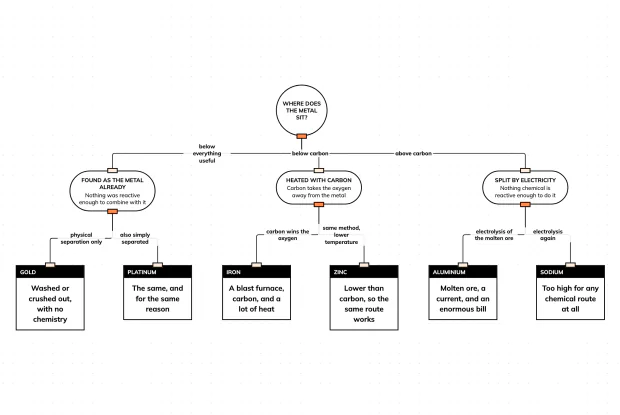
One property of a metal, and three separate consequences. None of them leads to the others.
A Fact About the Ground That Is Really About Chemistry
Gold is rare and is dug out of the ground as gold — recognisable, yellow, already metal. Aluminium is the most common metal in the Earth’s crust and is never found as aluminium anywhere, in any quantity. That looks like a fact about geology and is entirely a fact about reactivity.
The Earth has had a few billion years and an atmosphere full of oxygen. Any metal reactive enough to combine with oxygen, water or sulfur has had ample opportunity to do so, and has. What is left as metal is only what was unreactive enough to resist, which is a very short list: gold, platinum, and sometimes copper and silver.
Everything else is found as a compound, and the compound is called an ore. Iron occurs as iron oxide, aluminium as aluminium oxide, lead as lead sulfide. The metal is still there, atom for atom — nothing has been destroyed, as the conservation tutorial insisted — but it is chemically joined to something else and getting it out means reversing that.
The consequence is historical as well as chemical. Metals became available to humans roughly in reverse order of reactivity, because the less reactive ones need less to free them. The playground traces three separate consequences of the same single property.
Reading the Ground
Why has every reactive metal already reacted?
Because there has been enough time and enough oxygen. The Earth is around four and a half billion years old and its atmosphere has been oxygen-rich for roughly the last two billion, which is an enormous amount of opportunity. A reaction that is favourable will happen given time, even if it is slow, and over that span slow is no protection at all. So a metal reactive enough to combine with anything available has done so, and what survives as metal is only what had no favourable reaction open to it. Finding native metal is therefore evidence about that metal rather than luck about that location. The ground is reporting the series back to you.
What is an ore, exactly?
A rock containing enough of a metal compound to be worth extracting. Both halves of that matter. It has to contain the metal in a chemically combined form — iron oxide, aluminium oxide, lead sulfide — and it has to be concentrated enough that extracting it is worth the cost. Aluminium is in most ordinary clay, and clay is not an ore, because getting aluminium out of it would cost more than the aluminium is worth. Whether a rock counts as an ore can therefore change with the price of the metal and with the method available, which makes it partly an economic term and not purely a chemical one.
Why did humans learn to use metals in that order?
Because the less reactive a metal is, the less you have to do to free it. Gold and copper could be found as metal and worked with no chemistry at all, so they came first — gold objects predate writing. Copper and then tin could be smelted in a charcoal fire, giving the Bronze Age. Iron needed a considerably hotter fire and took far longer to master, which is why the Iron Age follows rather than precedes it. Aluminium, high in the series, resisted every method until electricity arrived — it was displayed beside crown jewels in the nineteenth century and became a drinks can after 1886 Each step up the series cost humanity a technology, and the ages are named after the metal that technology unlocked.
Does this mean reactive metals are useless?
The opposite, once you can get at them. Aluminium is light, strong enough when alloyed, and does not corrode away, which makes it one of the most useful structural metals there is. Lithium is near the top of the series and is in every phone battery precisely because it gives up electrons so readily. What reactivity costs you is the extraction, not the usefulness — and the bill is paid in energy, which is why aluminium smelters are built next to power stations and why recycling aluminium uses a small fraction of the energy of making it from ore. The cost is a one-off paid at extraction, and recycling avoids paying it twice.
Real World Example
Three Metals, Three Different Histories
The order in which these three became ordinary materials is a direct reading of where they sit in the series.
Step 1
Gold: worked before anyone understood metal
Gold is low enough in the series that it simply does not combine with anything in ordinary conditions, so it sits in riverbeds and rock as visible metal. It needs no smelting, no furnace and no chemistry — it can be picked up, hammered and shaped cold. That is why gold objects are found in graves thousands of years older than any written record, and why they come out of those graves still bright. Unreactive is the same property that made it the first metal worked and the one that survives burial. Nothing about gold had to be learned before it could be used.
Step 2
Iron: common, and out of reach for millennia
Iron is the fourth most abundant element in the crust and was useless to early humans, because it is always combined with oxygen. Freeing it needs a fire hot enough to let carbon take that oxygen away, which is a serious technical achievement with charcoal and bellows. The gap between the Bronze Age and the Iron Age is not a gap in ambition but in furnace temperature. Meteoric iron was worked before smelted iron, and it is the exception that proves the point — it arrives already as metal. Several early iron artefacts are meteoric, and were treated as extraordinarily precious for exactly that reason.
Step 3
Aluminium: the commonest, and the last to arrive
Aluminium makes up about eight per cent of the crust and was a precious metal within living memory of the industrial age. Nothing chemical available in the nineteenth century would take oxygen away from it, because almost nothing is more reactive than aluminium. The Hall-Héroult electrolysis process in 1886 brought the price down by orders of magnitude, and the metal went from display cabinets to kitchen foil. Abundance had never been the problem; the series was. The metal had been underfoot the whole time, in quantities nobody could reach, and what changed was not the geology but the method.
FAQs
Final Words
Where a metal is found is a fact about reactivity rather than about geology. The Earth has had billions of years and an oxygen-rich atmosphere, which is more than enough opportunity for any metal that could react to have done so. What is left as metal — gold, platinum, some copper and silver — is simply what had no favourable reaction available. Everything else is a compound, and a rock holding enough of one to be worth extracting is an ore.
The same property explains the order in which metals became ordinary. Gold needed no chemistry and was worked before writing; copper and tin needed a charcoal fire; iron needed a much hotter one; aluminium resisted everything until electricity arrived in 1886, despite being the commonest metal in the crust. Reactivity does not make a metal less useful — it makes it more expensive to free, and the bill is paid in energy. The next tutorial sorts the extraction methods by exactly that.
Continue This Track
This concept is part 3 of Metals and How We Get Them.
The Reactivity Series: Where Does the Order Come From?
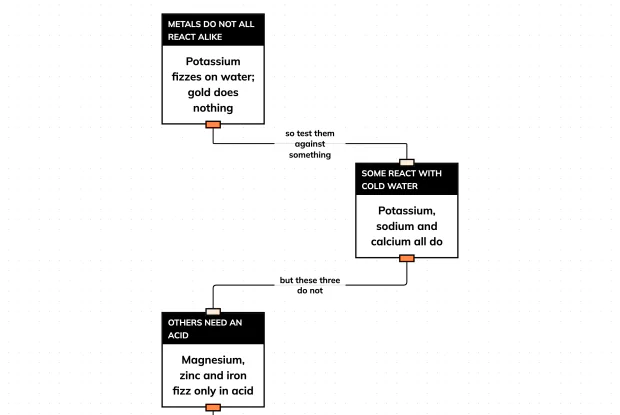
The reactivity series is usually handed over as a list to memorise. It is actually the result of three simple tests, and the order falls out of them. Build it step by step in an interactive playground.
What Is a Displacement Reaction? One Rule Decides
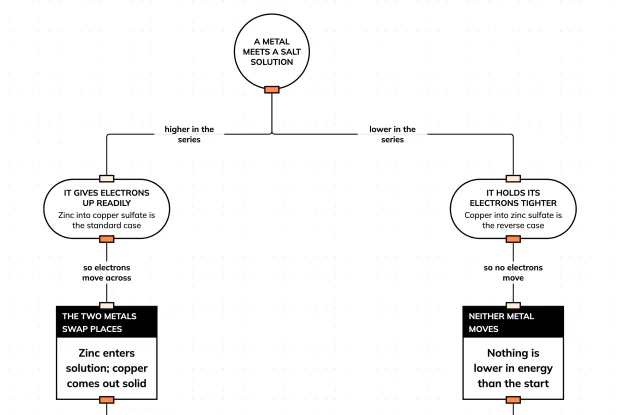
Put zinc into copper sulfate and the blue fades. Put copper into zinc sulfate and nothing at all happens. One rule predicts which way round it works, in an interactive playground.
Why Is Gold Found as Gold and Iron as Rust?
Gold is dug up as metal and aluminium never is, though aluminium is far more common. Reactivity explains both, and the order metals were discovered in. Trace it in an interactive playground.
How Is a Metal Extracted From Its Ore? Ask Carbon
There are three ways to get a metal out of the ground, and which one you need is decided entirely by where the metal sits relative to carbon. Sort them in an interactive playground.
Why Does Iron Rust Away but Aluminium Not?
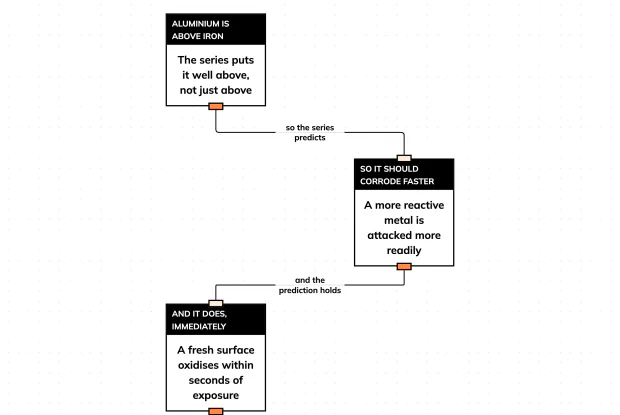
Aluminium sits well above iron in the reactivity series, so it ought to corrode faster. It does, and then stops. The reason is physical rather than chemical. Follow it in an interactive playground.