What Is a Displacement Reaction? One Rule Decides
Root Concept
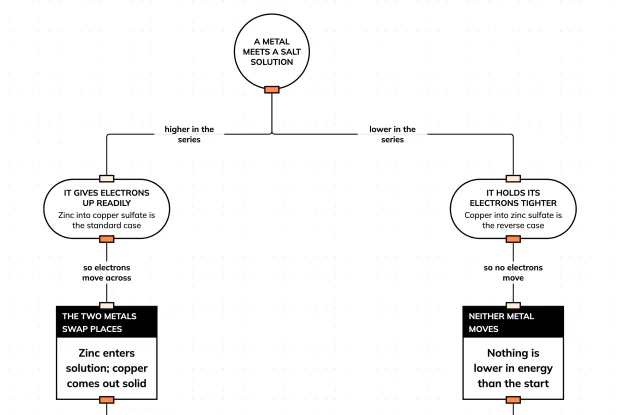
A displacement reaction happens when a metal higher in the reactivity series is put into a solution of a compound of a metal lower down, because the higher metal gives up its electrons more readily and takes the other’s place; the reverse combination produces no reaction whatever.
CodePLU Goal
Upgrading Human Mental Models
Learn how to think in Workflows

Concept Development By codeplu.com
Both branches start from the same beaker. One of the two outcomes is that nothing at all occurs.
A Reaction That Often Refuses
Drop a strip of zinc into blue copper sulfate solution and leave it. Within minutes the strip darkens, a reddish-brown deposit builds on it, and over an hour the blue drains out of the solution. Now do the opposite: put a strip of copper into colourless zinc sulfate solution and leave it as long as you like. Nothing happens, and nothing will.
That asymmetry is the whole lesson. One combination reacts and the other refuses, and which is which is decided entirely by the order the previous tutorial built. A metal higher in the reactivity series will take the place of a metal lower down; a metal lower down will not take the place of one higher up.
What is actually happening is a transfer of electrons. Zinc gives up its outer electrons more readily than copper does, so when zinc atoms meet copper ions in solution, the electrons move from the zinc to the copper. The zinc becomes zinc ions and dissolves; the copper ions become copper atoms and appear as solid metal. Run it the other way and there is no reason for any electron to move, so none does.
Displacement is also how the series is refined. Two metals that both fizz in acid cannot be separated by the acid test, but setting them against each other directly settles which is higher — which is what makes this more than a party trick.
What Decides the Outcome
What is actually moving?
Electrons, and nothing else needs to move for the reaction to happen. In copper sulfate solution the copper is present as Cu²⁺ ions, each short of two electrons. A zinc atom in contact with the solution gives up two electrons more readily than a copper ion holds onto its deficit, so the electrons transfer: the zinc atom becomes Zn²⁺ and goes into solution, and the copper ion becomes a neutral copper atom and drops out as solid. The sulfate takes no part at all — it was paired with copper at the start and is paired with zinc at the end, and is sometimes called a spectator ion for exactly that reason.
Why does the reverse not happen?
Because there is nothing in it. A reaction proceeds when the arrangement it produces is lower in energy than the one it started from, which is the rule the bonding track established. Zinc giving its electrons to copper reaches a lower arrangement, so it happens. Copper giving its electrons to zinc would reach a higher one, so it does not — and no amount of waiting, warming or stirring changes that. This is worth stressing because no reaction is a real result rather than a failed experiment. A beaker in which nothing occurs has told you the order of two metals just as definitely as one that changes colour. The experiment did not fail; it answered.
How does this refine the series?
By ordering metals that the crude tests put in the same group. Magnesium, zinc and iron all react with dilute acid, so the acid test cannot separate them. Set them against one another in solution and the answer comes out immediately: magnesium displaces zinc, zinc displaces iron, and neither works in reverse. That gives magnesium above zinc above iron, which no single test could have produced. Every pair can be checked this way, and because the results never contradict each other, the metals genuinely do lie on one line rather than merely beating each other in a circle. That consistency is what makes the series a genuine ranking rather than a convenient summary, and it is checked rather than assumed.
Does this only work with metals in solution?
No — the same rule applies to solid mixtures, and that is where it gets spectacular. Aluminium powder mixed with iron oxide and set off produces molten iron, because aluminium is higher in the series and takes the oxygen. The reaction gives out so much energy that the iron comes out liquid, and it is used to weld railway track in place, where no furnace could be brought. It is a demonstration carried out by professionals with proper equipment and is never improvised. The chemistry is the same as the beaker on a bench: a more reactive metal taking what a less reactive one was holding. Scale changes nothing about the rule.
Real World Example
Three Displacements, From a Beaker to a Railway
Displacement is easy to dismiss as a classroom colour change. The same reaction lays track and recovers metal from waste.
Step 1
Zinc and copper sulfate, watched over an hour
The standard demonstration is slow enough to follow and obvious enough to be convincing. A clean zinc strip goes into blue copper sulfate; within minutes it is coated in reddish-brown copper, and the blue of the solution fades steadily as the copper ions are used up. Weighing afterwards shows the zinc strip has lost mass and the deposit has gained it, and the totals account for each other exactly, which is the conservation rule from the reactions track turning up where you can see it. Nothing was created and nothing destroyed; a metal simply changed places with another one.
Step 2
Thermite welding joins rail where no furnace can go
Railway lines are joined by igniting a mixture of aluminium powder and iron oxide in a mould around the gap. Aluminium is higher in the series, so it takes the oxygen and leaves iron behind — and the reaction is exothermic enough to deliver that iron as a white-hot liquid that runs into the joint and sets. No power supply is needed, which is why the method survives on remote track. It is carried out by trained crews with shielding, and the glare is dangerous to look at directly. The whole process is portable, which is the entire reason it is still used.
Step 3
Scrap iron recovers copper from mine water
Water draining from old copper workings carries dissolved copper in quantities too low to mine conventionally but high enough to be worth recovering. Running it over scrap iron displaces the copper, which deposits as solid metal while the iron dissolves — the same reaction as the beaker, with the cheapest available metal spent to recover a more valuable one. It also cleans up a waste stream that would otherwise be a pollutant, so the series is doing two jobs at once. The iron is the cheaper metal and is spent deliberately, exactly as the sacrificial blocks on a hull are.
FAQs
Final Words
One rule decides every displacement: a metal higher in the reactivity series takes the place of a metal lower down, and the reverse combination does nothing at all. Zinc in copper sulfate strips the blue out of the solution and coats itself in copper; copper in zinc sulfate sits there indefinitely. What moves is electrons — zinc gives them up more readily than copper does — and the sulfate takes no part at any point.
Two things are worth carrying forward. No reaction is a genuine result rather than a failed attempt: a beaker where nothing happens has ordered two metals just as definitely as one that changes colour. And displacement is what turns the crude groups of the previous tutorial into a full order, because metals that the acid test cannot separate can always be set against each other directly. The next tutorial asks what that order has to do with where a metal is found in the ground.
Continue This Track
This concept is part 2 of Metals and How We Get Them.
The Reactivity Series: Where Does the Order Come From?
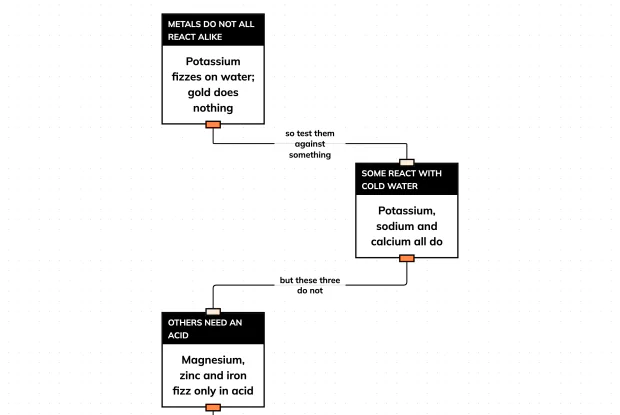
The reactivity series is usually handed over as a list to memorise. It is actually the result of three simple tests, and the order falls out of them. Build it step by step in an interactive playground.
What Is a Displacement Reaction? One Rule Decides
Put zinc into copper sulfate and the blue fades. Put copper into zinc sulfate and nothing at all happens. One rule predicts which way round it works, in an interactive playground.
Why Is Gold Found as Gold and Iron as Rust?
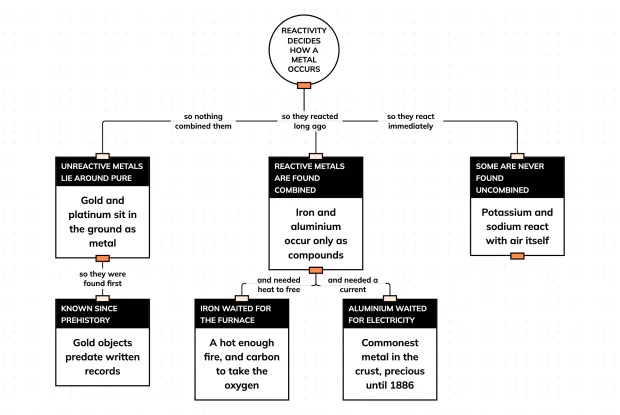
Gold is dug up as metal and aluminium never is, though aluminium is far more common. Reactivity explains both, and the order metals were discovered in. Trace it in an interactive playground.
How Is a Metal Extracted From Its Ore? Ask Carbon
There are three ways to get a metal out of the ground, and which one you need is decided entirely by where the metal sits relative to carbon. Sort them in an interactive playground.
Why Does Iron Rust Away but Aluminium Not?
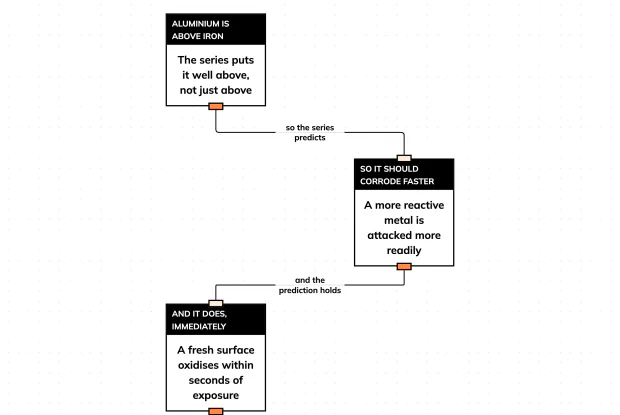
Aluminium sits well above iron in the reactivity series, so it ought to corrode faster. It does, and then stops. The reason is physical rather than chemical. Follow it in an interactive playground.