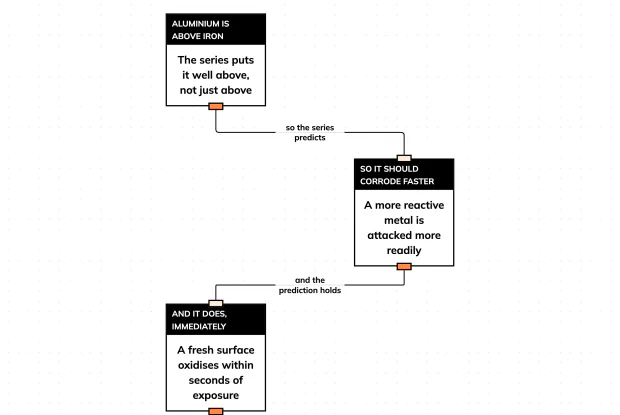
How Is a Metal Extracted From Its Ore? Ask Carbon
Root Concept
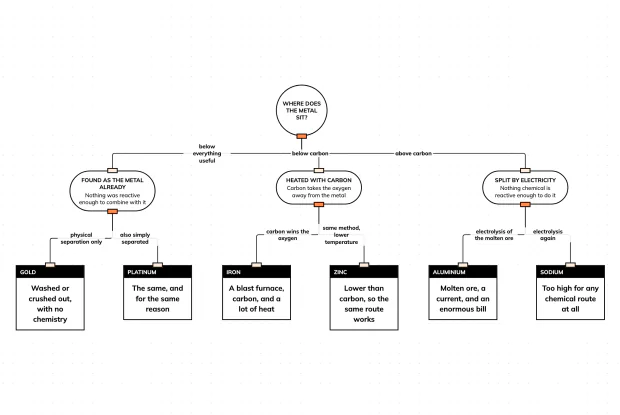
How a metal is extracted is decided by its position in the reactivity series relative to carbon: metals below carbon can be freed by heating their ore with it, because carbon takes the oxygen, while metals above carbon need electrolysis — and the few metals found uncombined need no chemistry at all.
CodePLU Goal
Upgrading Human Mental Models
Learn how to think in Workflows

Concept Development By codeplu.com
Three methods, one question. Carbon is in the series for exactly this purpose.
Three Methods, and One Question That Chooses
Getting a metal out of its ore looks like a collection of unrelated industrial processes — pans in a river, a blast furnace, a smelter wired to a power station. They are three answers to one question, and the question is where the metal sits in the reactivity series.
The previous tutorial established why extraction is needed at all: a reactive metal has long since combined with oxygen or sulfur, and the compound is lower in energy than the metal was. Getting the metal back means reversing that, and the more reactive the metal, the more has to be supplied to do it.
The dividing line is carbon, which is why carbon is in the series despite not being a metal. If the metal is below carbon, carbon will take the oxygen off it — so heating the ore with carbon frees the metal, and that has been possible since anyone could build a hot enough fire. If the metal is above carbon, carbon loses that contest and nothing chemically available will do the job, so the only route left is to force it with an electric current. That is electrolysis.
Below both of those is a third case needing no chemistry at all. Gold and platinum are already metal in the ground, so extracting them is a physical separation — the sorting problem from the mixtures track, not a reaction.
Choosing the Method
Why does heating with carbon work at all?
Because it is a displacement reaction, exactly like the ones in the previous tutorial, with carbon playing the part of the more reactive element. Iron oxide heated with carbon gives iron and carbon dioxide: the carbon takes the oxygen and the iron is left behind as metal. The rule is the same one — the element higher in the series ends up with the oxygen — and the only reason it works for iron and not for aluminium is where those two sit relative to carbon. In a blast furnace the carbon comes from coke, the heat comes from burning some of that coke, and limestone is added to carry away the rocky impurities as slag.
What is electrolysis doing that heat cannot?
Supplying energy in a form that forces electrons where they will not go on their own. Heating a metal above carbon with carbon simply does not work, because carbon cannot take the oxygen from something more reactive than itself — no amount of extra heat changes which element wins. An electric current does not have to win a contest: it pushes electrons onto the metal ions directly, turning them back into metal atoms, and drives the opposite change at the other electrode. The compound has to be molten or dissolved first, so that its ions are free to move, which is the condition the ionic lattice tutorial explained. Electricity sidesteps the contest rather than winning it.
Why is electrolysis so expensive?
Because it is paying the whole energy bill directly, and at scale. Freeing a reactive metal from a very stable compound requires a great deal of energy by definition, and electrolysis supplies all of it as electricity rather than borrowing most of it from a cheap chemical reaction the way carbon reduction does. The ore must also be kept molten throughout, which costs more again. This is why aluminium smelters are built beside hydroelectric dams and why the industry moves to wherever power is cheapest. It is also why aluminium recycling is worth doing so aggressively: melting a can skips the entire bill. The energy is the product’s real cost, and it does not go away.
Is there ever more than one option?
Sometimes, and the choice is then economic rather than chemical. Zinc sits below carbon and can be extracted by heating with it, but it is also produced by electrolysis where cheap electricity makes that purer or more convenient. Copper is extracted from its ore by heating, then often purified further by electrolysis to reach the purity that electrical wiring demands. So the series tells you what is possible, and cost, purity and local power prices decide what is actually done. What the series rules out stays ruled out: no amount of money extracts aluminium with carbon. Chemistry sets the boundary and economics works inside it, which is the usual division of labour in industrial processes.
Real World Example
The Same Three Methods at Industrial Scale
These are among the largest chemical operations on Earth, and each is a single line of the reactivity series made physical.
Step 1
A blast furnace is a displacement reaction, running continuously
Iron ore, coke and limestone are fed in at the top of a tower and hot air is blown in at the bottom. The coke burns to produce carbon monoxide, which takes the oxygen from the iron oxide, and molten iron collects at the base and is tapped off. The limestone reacts with sandy impurities to make slag, which floats and is drawn off separately. The furnace runs for years without stopping, because restarting one is enormously expensive — a practical fact that follows from how much heat it takes to reach working temperature. The chemistry is a school displacement reaction; the engineering is keeping it going.
Step 2
An aluminium smelter is wired to a power station
Aluminium oxide is dissolved in a molten bath and a very large current is passed through it. Aluminium collects at the bottom as liquid metal and oxygen is released at the carbon electrodes, which slowly burn away and have to be replaced. A single smelter can draw as much electricity as a small city, which is why they are sited where power is cheap rather than where the ore is. Iceland imports its ore across an ocean because its geothermal electricity costs less than shipping does. The ore is heavy and the electricity is not transportable, so the plant goes where the power is and the rock is brought to it.
Step 3
Gold panning is a separation, not a reaction
Gold is already metal in the ground, so no chemistry is needed to produce it — only a way of separating dense gold from lighter rock and sand. Panning does this with water and a swirling motion, and industrial versions use the same density difference at scale. It is the mixtures track applied to a riverbed: find the property the parts do not share, and exploit it. That gold needs no extraction chemistry is the clearest possible statement of where it sits in the series It is the only metal on the board that needs no reaction at all, and it is at the bottom for the same reason.
FAQs
Final Words
Three methods and one question. If the metal is already metal in the ground, as gold and platinum are, no chemistry is needed and the job is a physical separation. If it is below carbon in the series, heating its ore with carbon frees it, because carbon takes the oxygen — which is a displacement reaction run at industrial scale. If it is above carbon, nothing chemically available will do it and the only route is electrolysis.
That is why carbon sits in a series of metals: the line it draws decides how every metal in industry is produced. Electrolysis is expensive because it pays the whole energy bill as electricity rather than borrowing most of it from a cheap reaction, which is why aluminium smelters are built beside power stations and why recycling a can skips the bill entirely. The last tutorial in this track looks at what happens to a metal after you have gone to all that trouble.
Continue This Track
This concept is part 4 of Metals and How We Get Them.
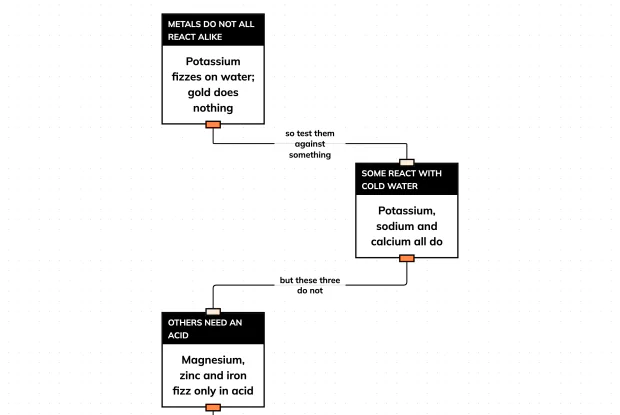
The Reactivity Series: Where Does the Order Come From?
The reactivity series is usually handed over as a list to memorise. It is actually the result of three simple tests, and the order falls out of them. Build it step by step in an interactive playground.
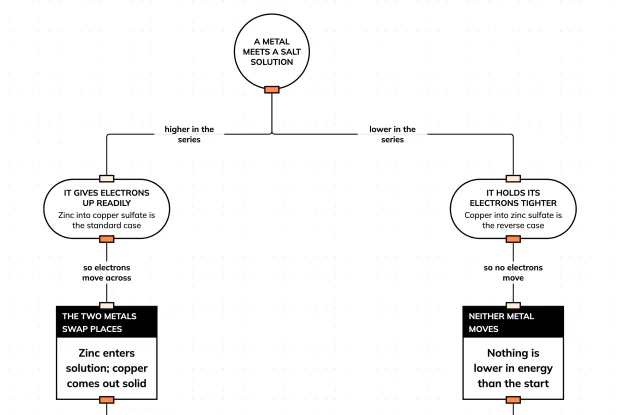
What Is a Displacement Reaction? One Rule Decides
Put zinc into copper sulfate and the blue fades. Put copper into zinc sulfate and nothing at all happens. One rule predicts which way round it works, in an interactive playground.
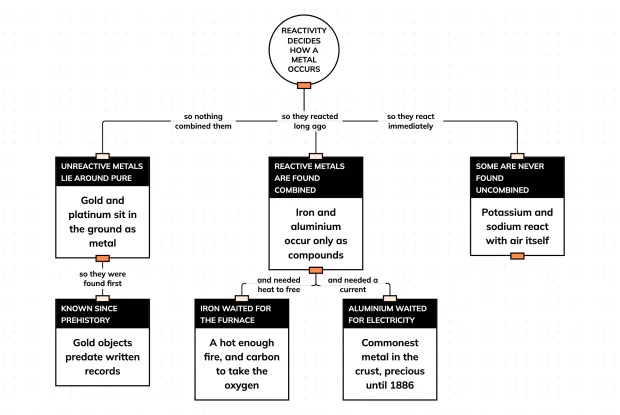
Why Is Gold Found as Gold and Iron as Rust?
Gold is dug up as metal and aluminium never is, though aluminium is far more common. Reactivity explains both, and the order metals were discovered in. Trace it in an interactive playground.
How Is a Metal Extracted From Its Ore? Ask Carbon
There are three ways to get a metal out of the ground, and which one you need is decided entirely by where the metal sits relative to carbon. Sort them in an interactive playground.
Why Does Iron Rust Away but Aluminium Not?
Aluminium sits well above iron in the reactivity series, so it ought to corrode faster. It does, and then stops. The reason is physical rather than chemical. Follow it in an interactive playground.