The Reactivity Series: Where Does the Order Come From?
Root Concept
Metals can be placed in order of how readily they react because the same metals always win the same contests: some react with cold water, others only with acid, and a few with neither, and that order — the reactivity series — predicts what a metal will do before it is tested.
CodePLU Goal
Upgrading Human Mental Models
Learn how to think in Workflows

Concept Development By codeplu.com
Nothing here is memorised. Each step narrows the field using one observation.
A List That Is Really a Result
The reactivity series arrives in most lessons as a column of metal names to be learned by heart, usually with a mnemonic. Learned that way it is a burden and it explains nothing. It is worth knowing that the order is not a convention anybody chose — it is what you get when you put metals through the same tests and write down which ones react.
The last track left a loose end here. It said that magnesium, zinc and iron fizz in dilute acid while copper, silver and gold are left alone, and referred to metals being above or below hydrogen in a reactivity order without ever saying where that order came from. This tutorial pays that debt.
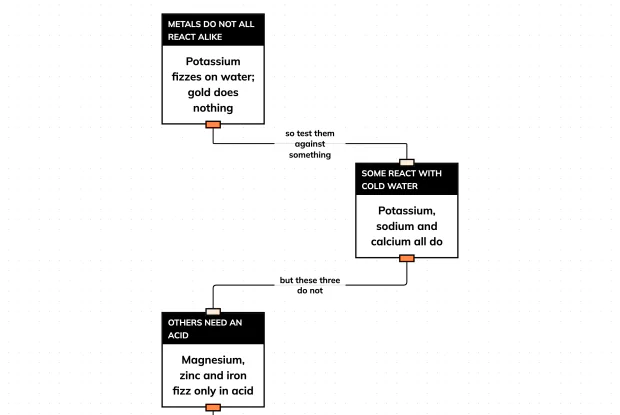
The tests are ordered from gentlest to harshest, which is what makes the result an order rather than a heap. Start with cold water: potassium, sodium and calcium react with it, and everything else does not. Move to dilute acid, which is harsher: magnesium, zinc and iron now react too. Finally, a few metals — copper, silver, gold — do nothing in either. Three tests, three groups, and the groups are nested.
That nesting is the whole point. Anything that reacts with cold water also reacts with acid, so the metals are not being sorted into unrelated boxes but strung out along a single line. The playground builds that line one observation at a time.
Building the Order
Why does the order of the tests matter?
Because using a harsh test first would lump everything together. If you began with concentrated acid, almost every metal would react and you would learn nothing about which reacts more readily. Starting with the gentlest condition that produces any reaction at all separates off the few metals that respond to it, then the next test separates the next few, and so on. This is a general method rather than a chemistry trick: to rank things, find a condition that only some of them pass, then tighten or loosen it. The reactivity series is built the same way a sorting algorithm works, by repeatedly splitting the field. What makes it chemistry rather than arithmetic is that the conditions have to be chosen so the splits mean something.
What does a metal reacting actually mean here?
That the metal gives up electrons and becomes a positive ion, which is the same behaviour the bonding track described. A more reactive metal is simply one that gives up its outer electrons more readily, because they are held less tightly. That is why group 1 metals sit at the top of the series and why reactivity increases going down that group — each step down puts the outer electron a shell further from the nucleus. So the order is not an arbitrary ranking of chemical enthusiasm. It is a ranking of how easily electrons are lost, and everything else in this track follows from it. The series and the periodic table are reporting the same property from two different directions.
Where does hydrogen fit into a list of metals?
It is put in the series despite not being a metal, because it gives the acid test a dividing line. An acid contains hydrogen ions, and a metal reacts with the acid only if it gives up electrons more readily than hydrogen does — so the metals that fizz in acid are precisely those above hydrogen in the series, and the ones that do not are below it. That is the claim the acids track made and did not justify. Including hydrogen turns a list of metals into something that predicts a specific reaction, which is a good reason to tolerate an oddity in the membership. Carbon is included for the same kind of reason, and marks a line that decides how metals are extracted.
How do you place a metal the simple tests cannot separate?
By making the metals compete directly, which is the subject of the next tutorial. Zinc and iron both react with acid, so the acid test puts them in the same group without ordering them. Putting one metal into a solution of the other’s compound settles it: the more reactive one takes the place of the less reactive one, and the direction that works tells you which is which. This refines the crude groups into a full order, and it is also the standard way a newly made metal would be placed. The tests give you the shape; the competitions give you the detail. Neither on its own would produce a usable order, which is why the series is built from both.
Real World Example
What the Order Predicts Before Anything Is Tried
The series earns its place by answering questions about metals nobody has put in front of you, which a memorised list cannot do.
Step 1
Why sodium is stored under oil and gold is not
Sodium sits near the top of the series, so it reacts with water and with the water vapour in ordinary air, which is why laboratory sodium is kept under oil to keep air away from it. The reaction with water is vigorous enough that it is only ever demonstrated by a teacher behind a screen, using a very small piece. Gold sits at the bottom and needs no protection at all, which is why gold jewellery survives being worn for decades and gold artefacts come out of the ground looking much as they went in.
Step 2
Why copper pipes carry water and iron ones do not
Copper is below hydrogen in the series, so it does not react with water or with the weak acids in it, which is exactly what you want in a pipe that will sit full of water for fifty years. Iron is above hydrogen and corrodes steadily in the same conditions, so iron pipes have to be coated, lined or replaced. The choice of material is the series being applied as engineering: a position on a list decides what a building is plumbed with, and the cost difference is accepted because the alternative fails. Lead was used for the same reason for centuries, until a different property of it turned out to matter more.
Step 3
Why a sacrificial anode protects a ship
Blocks of zinc or magnesium are bolted to steel ship hulls and underground pipelines, and they are meant to corrode. Both metals are above iron in the series, so they give up electrons more readily and are attacked in preference to the steel, which survives untouched until the blocks are eaten away and replaced. It looks like deliberately adding a weak point and is the opposite: the series predicts exactly which metal will be sacrificed, so the damage can be aimed at something cheap and bolted on. Replacing a block on a schedule is an entirely different problem from replacing a hull, which is the whole of the engineering case.
FAQs
Final Words
The reactivity series is a result, not a list somebody decided on. Test metals against cold water and three react; move to dilute acid and several more join them; try both on copper, silver and gold and nothing happens at all. Because the groups are nested — anything that attacks water also attacks acid — the metals end up strung along a single line rather than sorted into unrelated boxes.
What the line actually ranks is how readily a metal gives up its outer electrons, which is why group 1 sits at the top and why reactivity increases going down that group. Hydrogen and carbon are included despite not being metals, because each marks a dividing line that predicts something: metals above hydrogen fizz in acid, and metals below carbon can be extracted by heating with it. The next tutorial settles the order within a group by making two metals compete directly.
Continue This Track
This concept is part 1 of Metals and How We Get Them.
The Reactivity Series: Where Does the Order Come From?
The reactivity series is usually handed over as a list to memorise. It is actually the result of three simple tests, and the order falls out of them. Build it step by step in an interactive playground.
What Is a Displacement Reaction? One Rule Decides
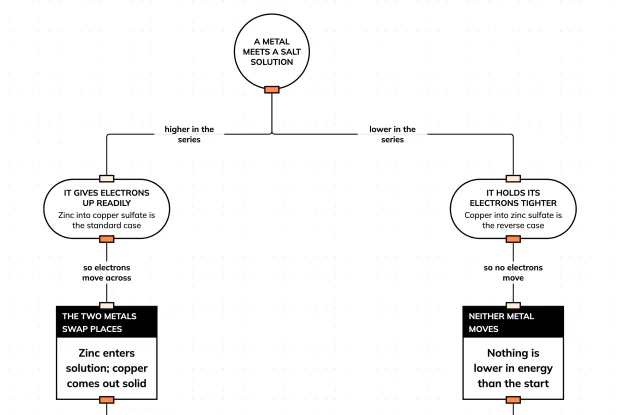
Put zinc into copper sulfate and the blue fades. Put copper into zinc sulfate and nothing at all happens. One rule predicts which way round it works, in an interactive playground.
Why Is Gold Found as Gold and Iron as Rust?
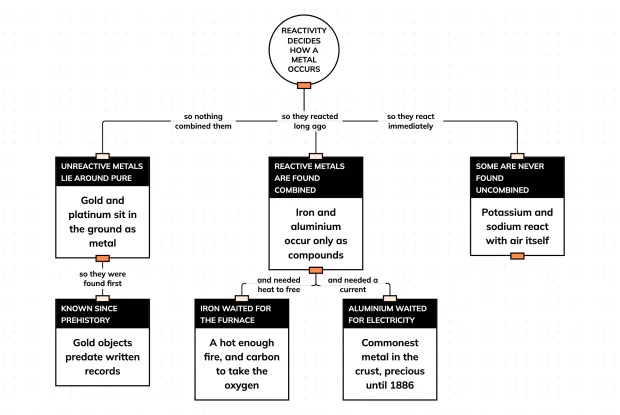
Gold is dug up as metal and aluminium never is, though aluminium is far more common. Reactivity explains both, and the order metals were discovered in. Trace it in an interactive playground.
How Is a Metal Extracted From Its Ore? Ask Carbon
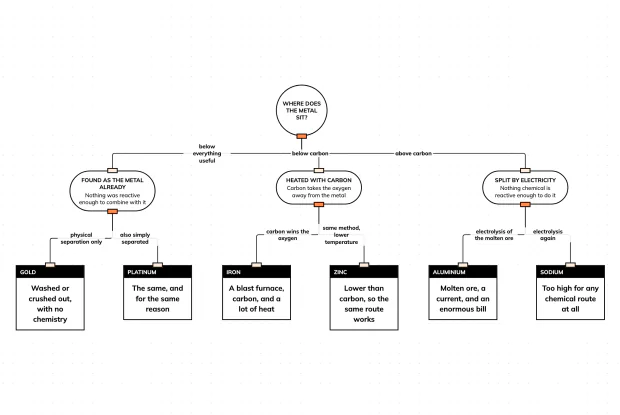
There are three ways to get a metal out of the ground, and which one you need is decided entirely by where the metal sits relative to carbon. Sort them in an interactive playground.
Why Does Iron Rust Away but Aluminium Not?
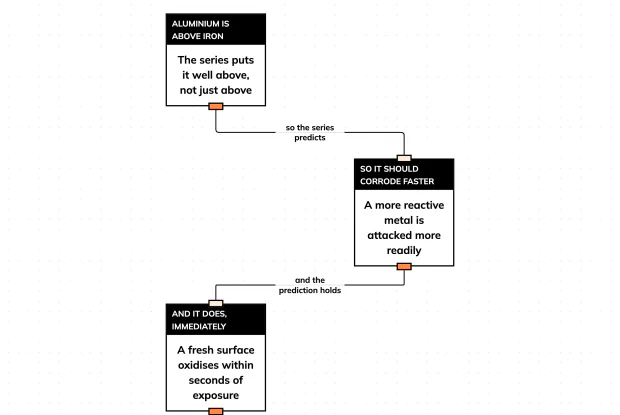
Aluminium sits well above iron in the reactivity series, so it ought to corrode faster. It does, and then stops. The reason is physical rather than chemical. Follow it in an interactive playground.