Why Does Iron Rust Away but Aluminium Not?
Root Concept
Aluminium is more reactive than iron and does oxidise immediately, but its oxide forms a thin, tough layer that stays bonded to the surface and seals the metal beneath, whereas rust flakes away and exposes fresh iron — so the difference between them is physical rather than chemical.
CodePLU Goal
Upgrading Human Mental Models
Learn how to think in Workflows

Concept Development By codeplu.com
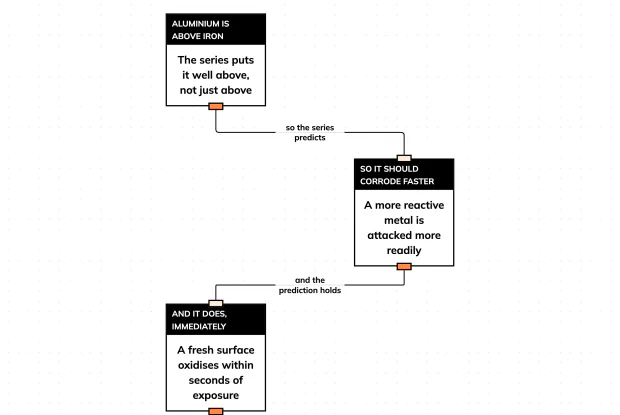
The prediction in step two is correct. What the series cannot tell you is what the product does next.
A Prediction That Appears to Fail
Leave a steel gate outside and in a few years it is orange and flaking. Leave an aluminium window frame outside and in thirty years it looks much as it did. The obvious conclusion is that aluminium is the less reactive metal, and the reactivity series says the opposite — aluminium sits well above iron, not marginally so.
This is worth taking seriously rather than filing as an exception, because the series is not wrong here. Aluminium really is more reactive, and it really does corrode faster: a freshly cut aluminium surface reacts with the oxygen in the air within seconds. You have never seen bare aluminium metal for more than a moment.
What happens next is the difference, and it is a physical difference rather than a chemical one. Aluminium oxide forms a layer only a few millionths of a millimetre thick that is hard, tightly bonded to the metal underneath, and continuous. Oxygen and water cannot get past it, so the corrosion stops almost as soon as it starts, and the layer repairs itself if scratched.
Rust does the opposite. It is bulkier than the iron it came from, so it cracks and flakes away, exposing fresh iron to start again. Iron does not corrode faster than aluminium — it simply never stops. The playground follows the prediction through to where it actually breaks.
Why the Two Oxides Behave Differently
What does rusting actually need?
Iron, oxygen and water, all three. This is easy to test and the result is decisive: iron in dry air does not rust, iron in boiled water sealed from air does not rust, and iron with both present does. The product is hydrated iron oxide, which is why the water matters rather than being incidental, and why rusting is faster in damp climates and faster still near the sea, where dissolved salt speeds the process considerably. Because all three are needed, every method of preventing rust works by removing one of them — which is a much shorter thing to remember than a list of methods. Remove the oxygen, remove the water, or stop either reaching the metal.
Why does the aluminium layer stay put?
Because it takes up almost exactly the same room as the metal it replaced, so it forms a continuous skin with nothing to crack it. Aluminium oxide is also extremely hard — it is the same compound as corundum, which is what sapphire and emery are — and chemically very unreactive, so it is not attacked by what attacked the metal. The result is a seal only a few millionths of a millimetre thick that stops everything. Scratch it and the exposed aluminium oxidises within seconds and the seal closes again, which is a property no coating applied from outside can match. The protection is made of the metal it protects, which is why it cannot peel, wash off or be missed during application.
Why does rust not do the same?
Because it is bulkier than the iron it came from, so the layer is under stress from the moment it forms. It expands as it grows, cracks, lifts and flakes away, and each flake takes a patch of protection with it and exposes fresh metal underneath. Rust is also porous rather than continuous, so water and oxygen reach the iron through it even before it falls off. That is why a rusted surface keeps rusting at much the same rate instead of slowing down, and why a steel structure left alone eventually fails rather than reaching a stable state. The orange layer is not a scab but an open wound, and the difference between the two oxides is entirely in how they sit on the surface.
So how is iron protected?
By removing one of the three requirements, and every method is a version of that. Painting, greasing and plastic coating all keep oxygen and water off, and work until the coating is broken. Galvanising covers the steel in zinc, which does two jobs: it is a barrier, and because zinc is above iron in the series it is attacked in preference even where the coating is scratched — the sacrificial principle from the first tutorial. Stainless steel takes the other route entirely and borrows aluminium’s trick: adding chromium produces a tightly bonded chromium oxide layer that seals the surface the same way. The iron in it is still iron and would still rust if the chromium layer were breached, which is why scratched stainless steel can spot.
Real World Example
Three Structures and Three Different Answers
Corrosion protection is one of the largest ongoing costs in engineering, and the choice of method is always the same short argument.
Step 1
The Forth Bridge, and painting as a permanent job
The steel rail bridge over the Firth of Forth was for a century the standard example of a job that never ends, because the paint protecting it had to be renewed continuously — finish one end and the other needs doing. Paint works by keeping oxygen and water off the steel, and it fails wherever it is chipped or weathered, which on an exposed estuary is everywhere. A modern coating applied in the early 2000s is expected to last decades, which changed the phrase into a historical one. The chemistry did not change; the coating did, and the maintenance schedule followed.
Step 2
Galvanised steel protects even where it is scratched
Crash barriers, farm gates and roofing sheets are coated in zinc by dipping them in the molten metal. The zinc keeps air and water off, as paint does — but it also goes on working after the coating is damaged, because zinc is above iron in the series and corrodes in preference to it. A scratch in paint starts a rust patch; a scratch in galvanising does not. It is the sacrificial anode idea applied as a surface rather than bolted on as a block. The zinc is spent slowly, so the coating has a lifetime rather than lasting forever.
Step 3
Anodising thickens the layer aluminium makes anyway
Aluminium window frames and phone cases are often anodised, which uses electrolysis to grow the natural oxide layer deliberately thicker and more even. The metal was already protecting itself; anodising makes the seal tougher, more uniform and able to hold dye, which is why anodised aluminium comes in colours that do not chip off. It is a rare case of a protective treatment that works with the metal’s own chemistry instead of covering it up. The layer is grown rather than applied, so there is nothing to peel off later. Anodising is the metal doing the work, helped along.
FAQs
Final Words
The series predicts that aluminium should corrode faster than iron, and it is right. A fresh surface oxidises within seconds; nobody has seen bare aluminium for more than a moment. What the series cannot tell you is what the product does next, and that is where the two metals part company.
Aluminium oxide takes up almost the same room as the metal it replaced, so it forms a continuous, hard skin that seals the surface and repairs itself when scratched. Rust is bulkier and porous, so it cracks, flakes and exposes fresh iron, and the process never ends. Iron does not corrode faster than aluminium — it simply never stops. Every method of protecting iron removes one of the three things rusting needs. The best either borrow aluminium’s trick, as stainless steel does with chromium, or spend a more reactive metal, as galvanising does with zinc. What this track never asked is how fast any of it happens, which is where the next one starts.
Continue This Track
This concept is part 5 of Metals and How We Get Them.
The Reactivity Series: Where Does the Order Come From?
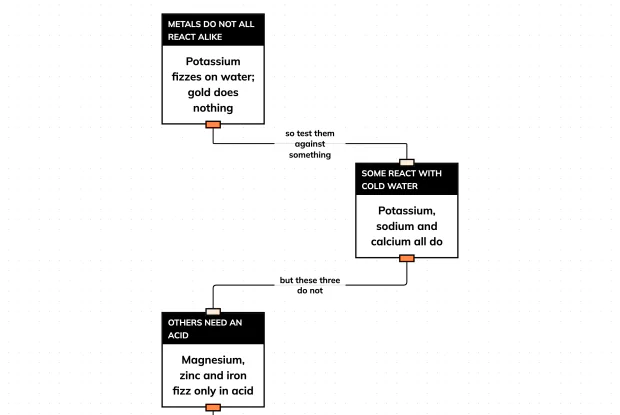
The reactivity series is usually handed over as a list to memorise. It is actually the result of three simple tests, and the order falls out of them. Build it step by step in an interactive playground.
What Is a Displacement Reaction? One Rule Decides
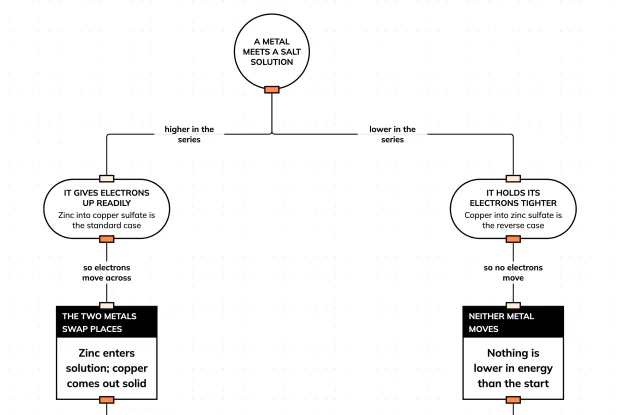
Put zinc into copper sulfate and the blue fades. Put copper into zinc sulfate and nothing at all happens. One rule predicts which way round it works, in an interactive playground.
Why Is Gold Found as Gold and Iron as Rust?
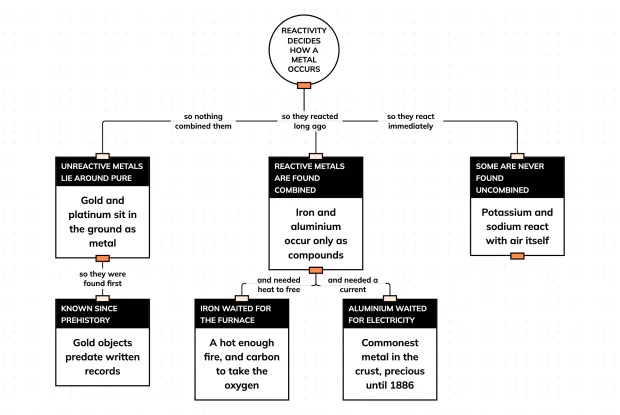
Gold is dug up as metal and aluminium never is, though aluminium is far more common. Reactivity explains both, and the order metals were discovered in. Trace it in an interactive playground.
How Is a Metal Extracted From Its Ore? Ask Carbon
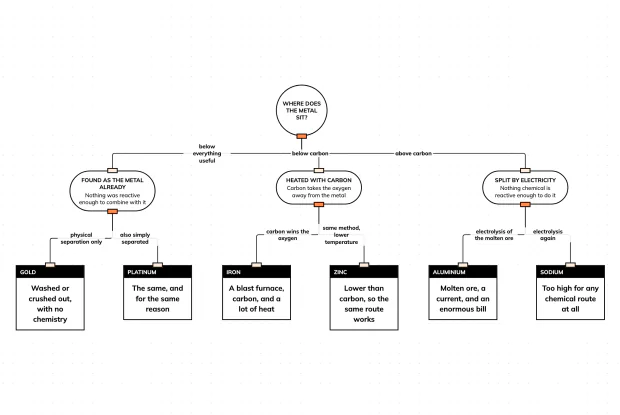
There are three ways to get a metal out of the ground, and which one you need is decided entirely by where the metal sits relative to carbon. Sort them in an interactive playground.
Why Does Iron Rust Away but Aluminium Not?
Aluminium sits well above iron in the reactivity series, so it ought to corrode faster. It does, and then stops. The reason is physical rather than chemical. Follow it in an interactive playground.