Metals and How We Get Them
Five parts built on one ordered list, and the track opens by refusing to hand that list over as something to memorise. The reactivity series is a result: test metals against cold water and three react, move to dilute acid and several more join them, try both on copper, silver and gold and nothing happens at all. Because the groups nest, the metals end up strung along a single line rather than sorted into boxes — and what the line ranks is how readily a metal gives up its outer electrons. The second part refines the order by making metals compete directly, and insists on something easy to miss: when nothing happens, that is a real answer rather than a failed experiment. The third turns the series on the ground itself. Gold is dug up as gold and aluminium never is, though aluminium is far commoner, because the Earth has had billions of years and an oxygen-rich atmosphere — any metal that could react has. That also explains why metals became available to humans in reverse order of reactivity, with aluminium arriving last despite being underfoot the whole time. The fourth part sorts the extraction methods, and carbon turns out to be the dividing line that decides whether electricity is needed. The last part takes a prediction the series appears to get wrong — aluminium is more reactive than iron and survives far better — and finds that the series is right and the difference is physical: aluminium oxide seals the surface, and rust flakes off and exposes more.
CodePLU Goal
Upgrading Human Mental Models
Learn how to think in Workflows
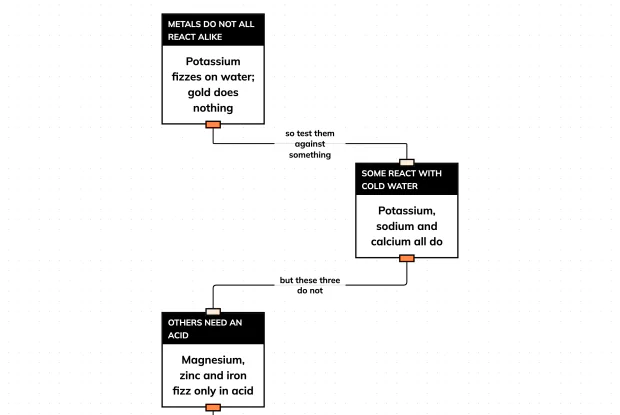
The Reactivity Series: Where Does the Order Come From?
The reactivity series is usually handed over as a list to memorise. It is actually the result of three simple tests, and the order falls out of them. Build it step by step in an interactive playground.
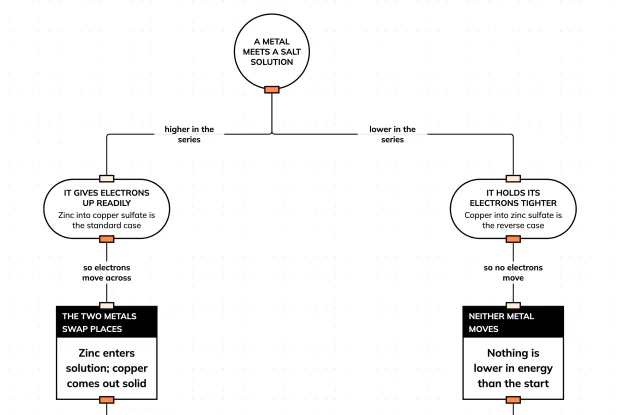
What Is a Displacement Reaction? One Rule Decides
Put zinc into copper sulfate and the blue fades. Put copper into zinc sulfate and nothing at all happens. One rule predicts which way round it works, in an interactive playground.
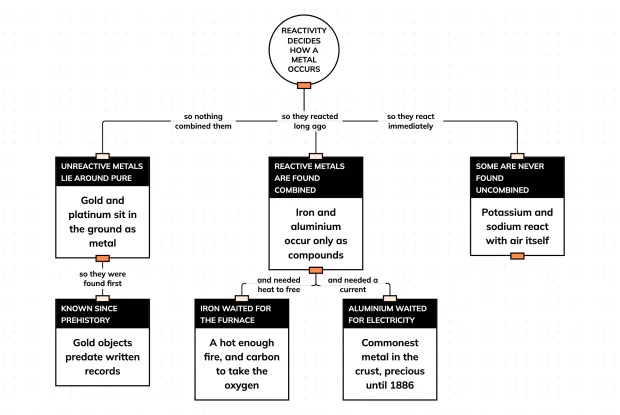
Why Is Gold Found as Gold and Iron as Rust?
Gold is dug up as metal and aluminium never is, though aluminium is far more common. Reactivity explains both, and the order metals were discovered in. Trace it in an interactive playground.
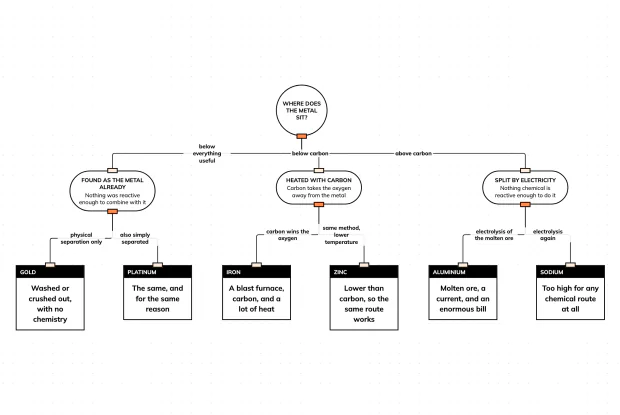
How Is a Metal Extracted From Its Ore? Ask Carbon
There are three ways to get a metal out of the ground, and which one you need is decided entirely by where the metal sits relative to carbon. Sort them in an interactive playground.
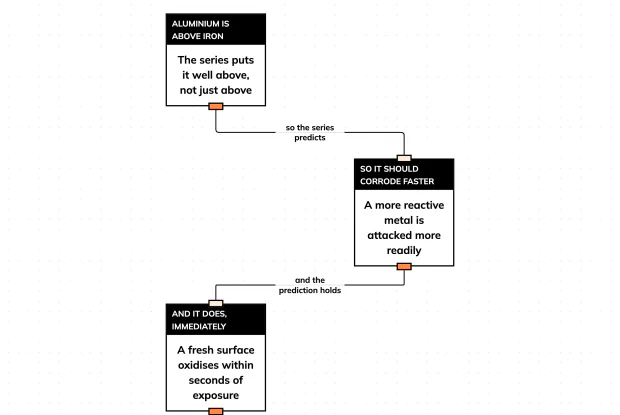
Why Does Iron Rust Away but Aluminium Not?
Aluminium sits well above iron in the reactivity series, so it ought to corrode faster. It does, and then stops. The reason is physical rather than chemical. Follow it in an interactive playground.