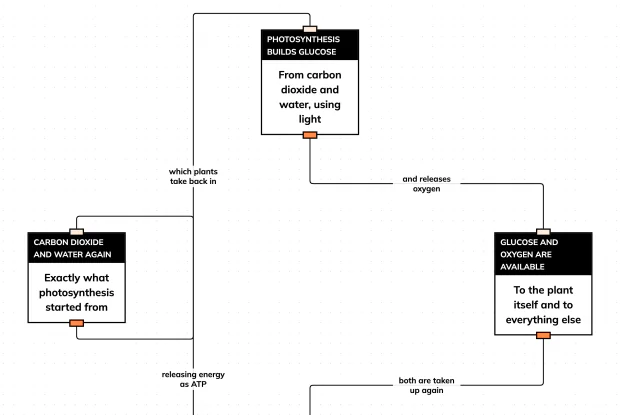
Why Must Every Cell Respire? Follow the Reasoning
Root Concept
A cell needs energy continuously for active transport, synthesis and movement, but cannot use the energy in glucose directly, so respiration releases it in small steps that charge ATP, a molecule the cell can spend immediately and cannot stockpile.
CodePLU Goal
Upgrading Human Mental Models
Learn how to think in Workflows

Concept Development By codeplu.com
The last step is the one that matters. Nothing here can be done in advance and saved up.
Money You Cannot Spend
It is easy to say that respiration releases energy and leave it there. The more useful question is why a cell needs to bother at all, given that it already has glucose and glucose already contains the energy. Working that through gives the reason respiration takes the peculiar form it does.
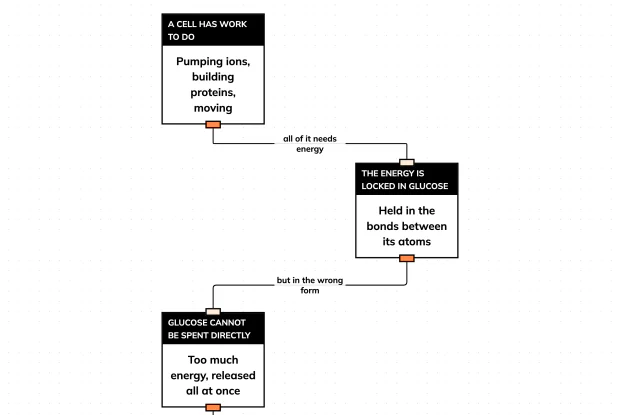
All the energy a cell needs is available in glucose, held in the bonds between its atoms. But a cell cannot spend glucose any more than you can buy a sandwich with a house. The quantity is wrong — releasing everything in one glucose molecule at once would produce a burst of heat that would damage the cell — and the form is wrong, because nothing in the cell is built to take energy from a sugar molecule directly.
So respiration breaks glucose down in a long series of small controlled steps, and uses the energy from those steps to charge up a different molecule, ATP. ATP is the small change: it holds a modest, standard amount of energy, it can be spent anywhere in the cell by anything that needs it. The catch is at the end of the chain, and it is the reason respiration never stops.
Each Step of the Argument
What does a cell spend energy on?
Three broad things, and they run constantly rather than occasionally. The first is active transport, moving substances across membranes against a concentration gradient, which the contrast between diffusion and active transport set out in Track 4. The second is synthesis: joining amino acids into proteins, joining glucose units into starch or cellulose, copying DNA. Every bond made costs energy. The third is movement, from a muscle fibre shortening to the internal shuttling of materials around a cell. In warm-blooded animals there is a fourth, maintaining body temperature, which is largely paid for by the heat that respiration releases anyway. Even holding a concentration different from the surroundings is a continuous cost rather than a one-off one, because membranes leak and the difference has to be maintained against that leak for as long as the cell is alive.
Why can a cell not use glucose directly?
Two reasons, one about quantity and one about form. A glucose molecule holds a large amount of energy — enough, if released at once, to raise the local temperature sharply and denature the very enzymes the cell depends on. Burning sugar in air demonstrates the point: it releases exactly the same total energy as respiration does, as heat and light, all in a moment. The second reason is that the cell's machinery is not built to accept energy in that form. Enzymes that drive energy-requiring reactions are built to work with ATP specifically, so glucose has to be converted into something they can actually use. The comparison usually drawn is with money: glucose is the savings and ATP is the small change, and no shop takes the savings.
What is ATP and why does it suit the job?
ATP stands for adenosine triphosphate, and the useful part is the three phosphate groups in a row at one end. Breaking the last of them off releases a small, convenient quantity of energy and leaves ADP, adenosine diphosphate, which respiration can then recharge by attaching a phosphate again. So the molecule cycles between a charged and an uncharged state over and over. The amount of energy involved is modest enough to be useful for a single job, the release is immediate, and the same molecule works everywhere in the cell, so one currency serves every process that needs paying for. Having a single standard form also means the cell needs no separate supply route for each different job.
Why can respiration never stop?
Because ATP cannot be stockpiled. A cell holds only a very small quantity at any moment — enough for a few seconds of its own activity — and it is being spent and recharged continuously. There is no reservoir to draw on, which means the recharging has to keep pace with the spending at all times. Glucose, by contrast, can be stored in quantity, as starch in plants and glycogen in animals, so the fuel can be put by even though the spendable form cannot. That is why respiration runs in every living cell every second, and why an interruption in the oxygen supply becomes serious within minutes rather than hours — the fuel is still there and has simply become unusable.
Real World Example
What Happens in a Sprint
A sprint pushes the ATP system to its limit faster than anything else, which makes the timings visible. Each stage is a different answer to the same shortage.
Step 1
The first two seconds run on stored ATP
A muscle cell holds a small quantity of ATP ready to use, and at the start of a sprint that is what is being spent. It is gone almost immediately — the usual estimate is around two seconds of maximum effort. This is the clearest possible demonstration that ATP is not a store. If a cell could stockpile it the way it stockpiles glycogen, a sprinter would simply fill up beforehand and the rest of the race would need no further supply at all. Nothing works that way, and the reserve is measured in seconds.
Step 2
Then the recharging has to keep up
From the third second onward, every molecule of ATP being spent has to be recharged at the moment it is needed. Respiration in the muscle cells is running as fast as it can, breaking down glucose released from stored glycogen, and the heart and breathing rates climb to deliver oxygen fast enough to support it. For a short while they succeed. Over a longer run this is the steady state an athlete settles into, with supply and demand matched and the pace held at whatever level that balance allows, which is what separates a pace that can be held for an hour from one that cannot be held for a minute.
Step 3
When oxygen cannot arrive fast enough
In an all-out sprint the oxygen supply cannot keep up with demand however hard the heart and lungs work, and the muscle cells switch to releasing energy without it. That yields far less ATP per glucose molecule and leaves a waste product behind, which is why it can only be sustained briefly and why the burning sensation builds. The next tutorial but one takes that route properly. What matters here is that the cell does not stop: when the usual method fails, it falls back on a worse one rather than pausing, because pausing is not among the options available to something that is alive.
FAQs
Final Words
The argument runs in five steps. A cell has continuous work to do — pumping, building, moving. The energy for it is held in glucose. Glucose cannot be spent directly, because the quantity is far too large to release at once and the form is not one the cell's machinery accepts. So respiration takes the molecule apart gradually and uses each small release to charge ATP. And because ATP cannot be stored in any quantity, that process has to keep running.
That last step is what turns a piece of chemistry into a fact about being alive. Fuel can be put by; spendable energy cannot. A plant stores starch and an animal stores glycogen, and both still have to respire every second to convert it into something usable. The next tutorial goes to where most of that conversion physically happens.
Continue This Track
This concept is part 2 of Where Living Things Get Their Energy.
Breathing Is Not Respiration — Sort Them Out
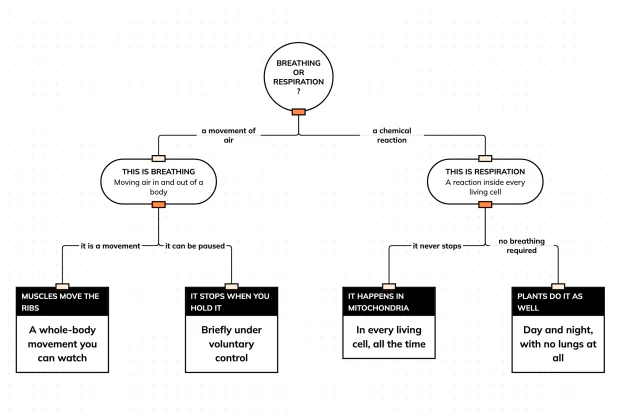
Breathing moves air into a body. Respiration releases energy inside every living cell, including a plant's. Sort four statements into the right one in an interactive playground.
Why Must Every Cell Respire? Follow the Reasoning
Glucose holds energy but a cell cannot spend it directly — it is the wrong form and there is too much of it at once. Reason step by step to why respiration never stops, in an interactive playground.
What Is Inside a Mitochondrion? Label the Folds
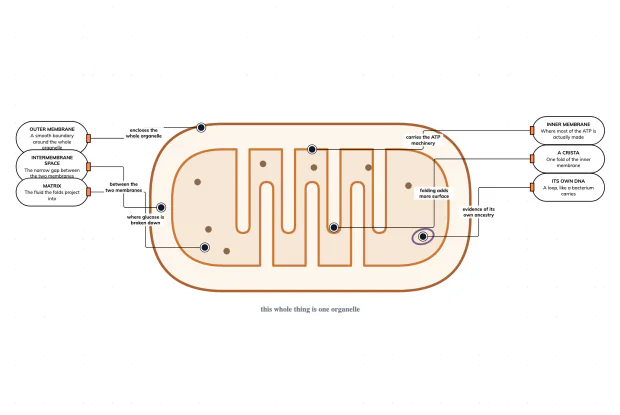
A mitochondrion has two membranes, and the inner one folds deep inside. Label the outer membrane, the matrix, a crista and its own loop of DNA in an interactive playground, and see why the folding matters.
Respiring With and Without Oxygen — Two Routes
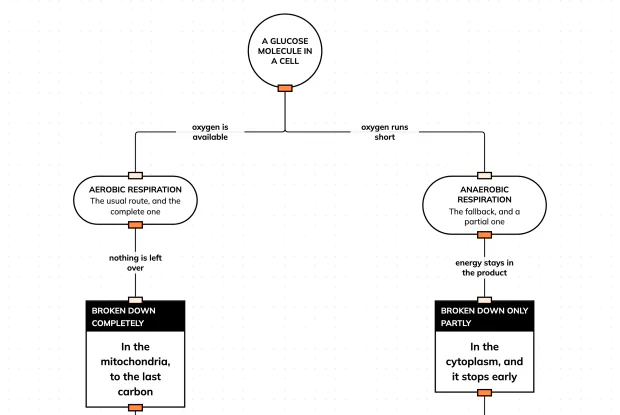
With oxygen, glucose is broken down completely for a large yield of ATP. Without it, the breakdown stops early and leaves lactic acid or ethanol behind. Follow both routes in an interactive playground.
Do Plants Respire As Well? Yes, Day and Night
Plants respire every hour of their lives, including in full sunshine. Close the loop between photosynthesis and respiration in an interactive playground and see why a plant is not the reverse of an animal.