Where Living Things Get Their Energy
This track has to clear a word out of the way before it can teach anything. In ordinary speech respiration means breathing, and in biology it means a chemical reaction inside every living cell — so the track opens by sorting the two apart, with a plant as the decisive case, since a tree respires every hour of its life and has no mechanism for moving air at all. It then asks why a cell bothers: the energy is already in glucose, but the quantity is far too large to release at once and the form is not one the cell's machinery accepts, so respiration releases it in small steps that charge ATP — a currency that cannot be stockpiled, which is precisely why the process can never pause. The mitochondrion is then drawn properly rather than as one organelle among many, because the thing that matters about it only shows at size: two membranes, the inner one folded deep into the matrix, because the machinery that makes ATP sits in that membrane and area sets the output. The last two tutorials take the two routes the reaction can follow depending on whether oxygen is there, and then put respiration back beside photosynthesis, where the commonest mistake in school biology is waiting: plants are not the reverse of animals, and what cycles round that loop is matter, never energy.
CodePLU Goal
Upgrading Human Mental Models
Learn how to think in Workflows
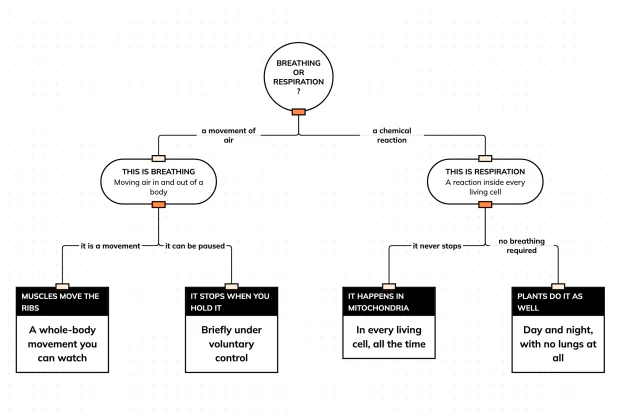
Breathing Is Not Respiration — Sort Them Out
Breathing moves air into a body. Respiration releases energy inside every living cell, including a plant's. Sort four statements into the right one in an interactive playground.
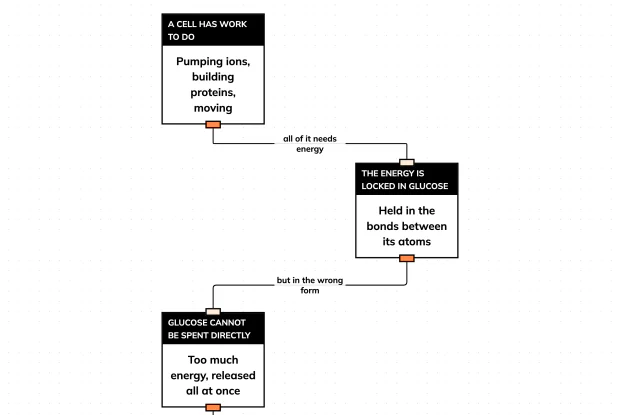
Why Must Every Cell Respire? Follow the Reasoning
Glucose holds energy but a cell cannot spend it directly — it is the wrong form and there is too much of it at once. Reason step by step to why respiration never stops, in an interactive playground.
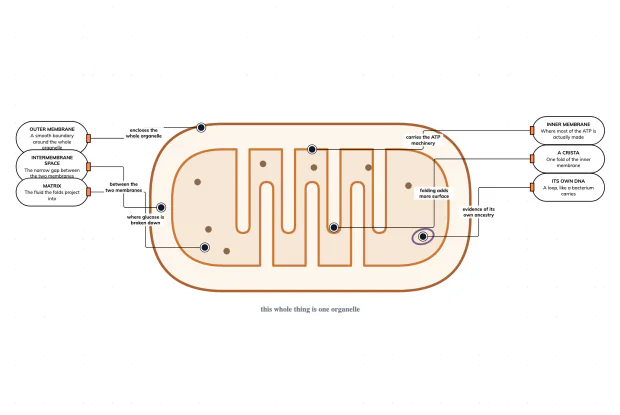
What Is Inside a Mitochondrion? Label the Folds
A mitochondrion has two membranes, and the inner one folds deep inside. Label the outer membrane, the matrix, a crista and its own loop of DNA in an interactive playground, and see why the folding matters.
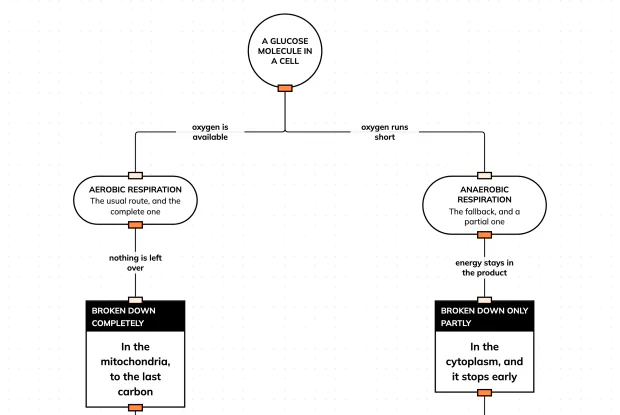
Respiring With and Without Oxygen — Two Routes
With oxygen, glucose is broken down completely for a large yield of ATP. Without it, the breakdown stops early and leaves lactic acid or ethanol behind. Follow both routes in an interactive playground.
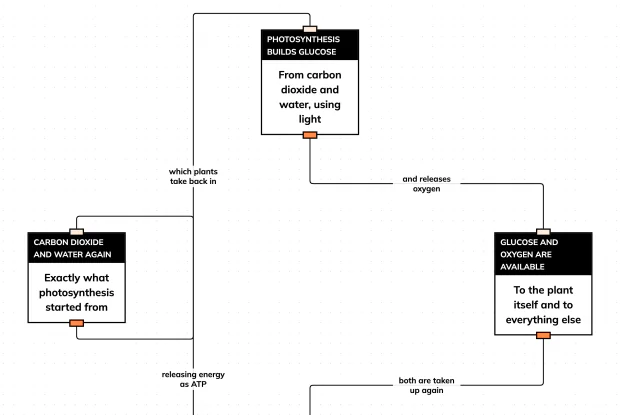
Do Plants Respire As Well? Yes, Day and Night
Plants respire every hour of their lives, including in full sunshine. Close the loop between photosynthesis and respiration in an interactive playground and see why a plant is not the reverse of an animal.