Do Plants Respire As Well? Yes, Day and Night
Root Concept
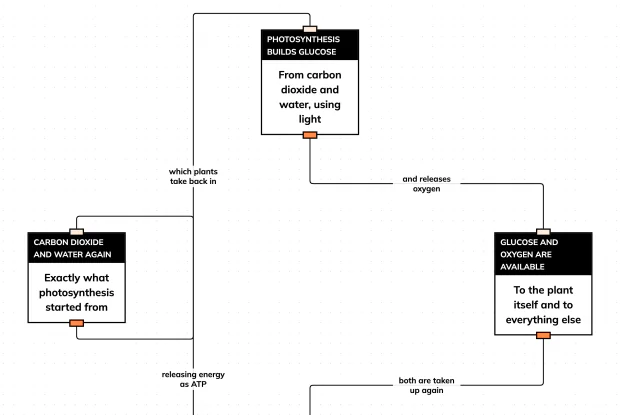
Plants respire continuously, day and night, in the same way animals do; in daylight photosynthesis runs faster than respiration so there is a net release of oxygen, while in darkness only respiration runs and there is a net uptake of oxygen.
CodePLU Goal
Upgrading Human Mental Models
Learn how to think in Workflows

Concept Development By codeplu.com
The closing edge is the point. Nothing in this loop has a beginning or an end.
The Most Common Mistake in School Biology
The idea goes like this: animals breathe in oxygen and breathe out carbon dioxide, and plants do the reverse, so the two balance each other out. It is tidy, it is memorable, and it is wrong in a way that matters.
Plants respire. Every living cell in a plant breaks down glucose to release energy, using oxygen and producing carbon dioxide, exactly as your cells do and for exactly the same reason — ATP cannot be stockpiled and the cell has work to do. A root cell deep in the soil has never seen light, has no chloroplasts at all, and depends entirely on respiring the sugar sent down to it. A plant that stopped respiring would die as quickly as you would.
What is true is that a plant does something extra. In daylight it also photosynthesises, and in reasonable light photosynthesis runs considerably faster than respiration — commonly several times faster. So although the plant is using oxygen and producing carbon dioxide the whole time, it is producing oxygen and using carbon dioxide faster, and the net movement of gas is outward for oxygen and inward for carbon dioxide. At night photosynthesis stops, respiration carries on as it always has, and the net movement reverses.
So the balance between plants and animals is real at the level of the whole living world, and that is what the playground draws. It is not a statement about what any individual plant is doing, and treating it as one produces the idea that plants respire only at night, which is false.
Reading the Loop
How can a plant do both at once?
Because they happen in different organelles and are not in each other's way. Photosynthesis takes place in chloroplasts, respiration in mitochondria, and a plant cell in a leaf contains both. During the day a palisade cell is building glucose in its chloroplasts and simultaneously breaking glucose down in its mitochondria, which sounds wasteful until you remember what each is for. Photosynthesis stores energy in a molecule; respiration converts that stored energy into the spendable form the cell actually uses. Building a store and drawing on it are not contradictory activities, and most of the glucose made is not respired immediately anyway — it is converted to starch, or sent to the roots, or built into cellulose.
What is compensation point?
The light intensity at which photosynthesis and respiration happen to run at exactly the same rate, so the gases cancel out and a leaf appears to be exchanging nothing at all. Below it, respiration dominates and the plant takes in oxygen on balance. Above it, photosynthesis dominates and oxygen leaves. It occurs around dawn and again around dusk, and the useful thing about it is what it demonstrates: a measurement of zero gas exchange does not mean nothing is happening. Both processes are running at full speed and simply happen to be cancelling. Reading a net figure as if it were a total is the same error as thinking plants do not respire in daylight.
Where does the carbon in a cycle actually go?
Round and round, which is the point of drawing it as a ring. A carbon atom in the air enters a leaf as carbon dioxide, is built into glucose, and may then be respired straight back out, or stored as starch, or built into cellulose and locked into a tree trunk for a century, or eaten by an animal and respired out by that animal instead. Every route ends in the same place eventually — carbon dioxide released by something respiring, or by something decomposing, which is also respiring. The decomposers from an earlier track are part of this loop rather than an appendix to it, and without them the carbon would not return at all.
Why does the loop have no starting point?
Because every stage is both a consequence of the one before it and a cause of the one after, and the board has no input node and no output node on purpose. It would be easy to call photosynthesis the beginning, since it is where energy enters, but the carbon dioxide it starts from was produced by respiration, which used glucose produced by photosynthesis. The energy is not in a loop at all — it arrives from the sun, passes through, and leaves as heat, which is what the food chains tutorial in Track 1 established. The matter is what cycles. Separating those two is most of what this diagram is for.
Real World Example
A Pondweed in a Sealed Tube
The compensation point is not a theoretical idea — it can be found in a school laboratory with a sprig of pondweed, a sealed tube and an indicator that changes colour with carbon dioxide.
Step 1
In the dark, carbon dioxide builds up
A tube of pondweed in water with hydrogencarbonate indicator, wrapped in foil so no light reaches it, turns the indicator towards yellow over an hour or two. Yellow means carbon dioxide has increased. The plant is respiring and nothing is removing the carbon dioxide, so it accumulates. This single result is enough to settle the question the tutorial opens with: a plant in the dark behaves exactly like an animal in a sealed tube, because in the dark that is precisely what it is doing. Anyone holding the opposites idea has to explain a plant that produces carbon dioxide and consumes oxygen for twelve hours out of every twenty-four.
Step 2
In bright light, it is used up
An identical tube left in good light turns the indicator towards purple, which means carbon dioxide has fallen. Photosynthesis is running faster than respiration, so more carbon dioxide is being taken in than is being produced and the balance moves the other way. The plant has not stopped respiring — it is doing both, and the indicator shows only the difference between them. Nothing in the result distinguishes a plant that respires slowly from one that respires fast and photosynthesises faster still, which is exactly why the indicator cannot be read as a measurement of either process on its own.
Step 3
In dim light, nothing appears to happen
A third tube at low light, perhaps shaded by a layer or two of muslin, leaves the indicator at its original colour. That is the compensation point, and it is the most instructive of the three results because it looks like a failed experiment. Nothing is happening only in the sense that the two processes are cancelling exactly. Both are running. A fourth tube with no pondweed at all, kept alongside, confirms that the indicator itself is not drifting and that the colour changes in the other tubes came from the plant rather than from the water or the light.
FAQs
Final Words
Plants respire, continuously, in every living cell, through every hour of day and night. In daylight they also photosynthesise, faster than they respire, so the net movement of gas runs one way; after dark only respiration remains and it runs the other. The exchange you can measure outside a leaf is always a difference between two processes, never one process on its own.
The loop is real at the scale of the whole living world — carbon moving from air into plants, through animals and decomposers, and back to the air — and the closing edge is what makes it a cycle rather than a chain. But what goes round is matter. The energy arrives from the sun, is captured, is spent, and leaves as heat, exactly as the first track in this subject showed. This track began by separating two words and ends by separating two more.
Continue This Track
This concept is part 5 of Where Living Things Get Their Energy.
Breathing Is Not Respiration — Sort Them Out
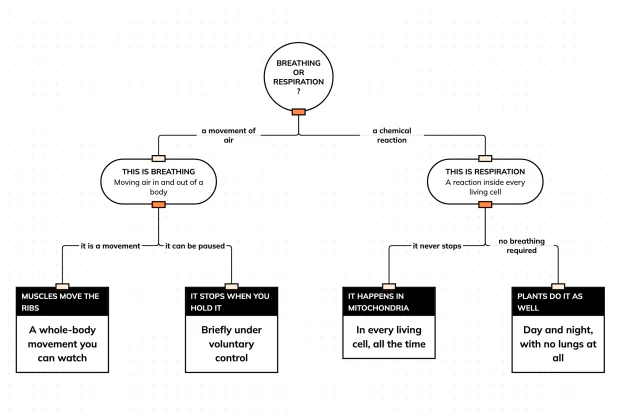
Breathing moves air into a body. Respiration releases energy inside every living cell, including a plant's. Sort four statements into the right one in an interactive playground.
Why Must Every Cell Respire? Follow the Reasoning
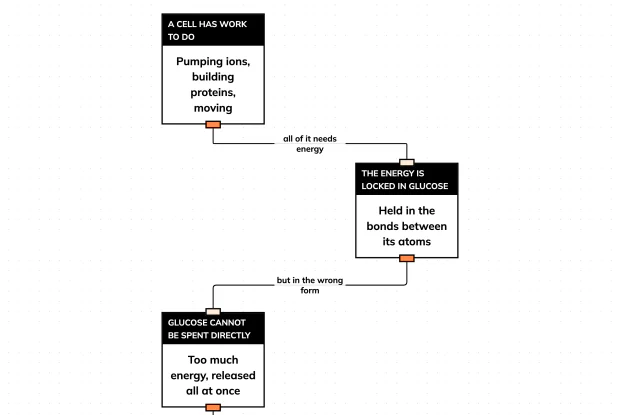
Glucose holds energy but a cell cannot spend it directly — it is the wrong form and there is too much of it at once. Reason step by step to why respiration never stops, in an interactive playground.
What Is Inside a Mitochondrion? Label the Folds
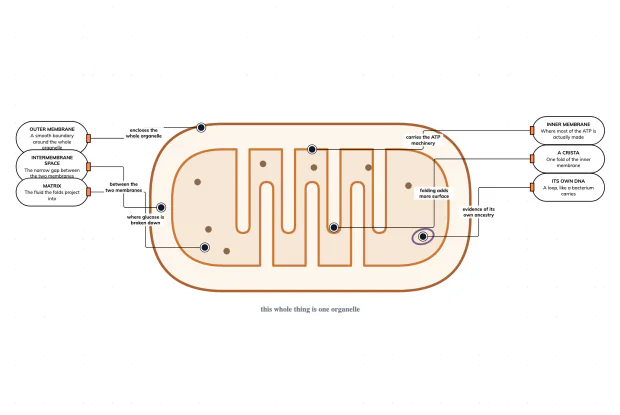
A mitochondrion has two membranes, and the inner one folds deep inside. Label the outer membrane, the matrix, a crista and its own loop of DNA in an interactive playground, and see why the folding matters.
Respiring With and Without Oxygen — Two Routes
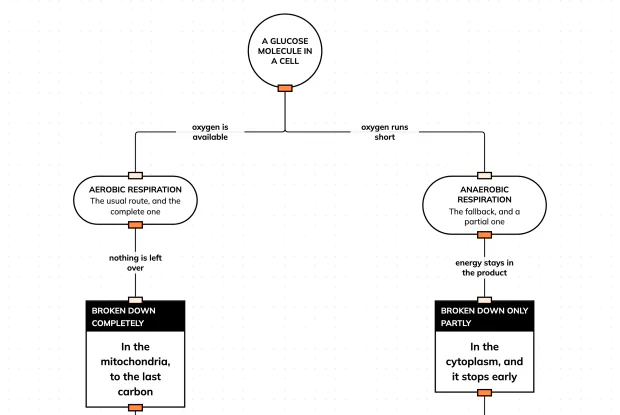
With oxygen, glucose is broken down completely for a large yield of ATP. Without it, the breakdown stops early and leaves lactic acid or ethanol behind. Follow both routes in an interactive playground.
Do Plants Respire As Well? Yes, Day and Night
Plants respire every hour of their lives, including in full sunshine. Close the loop between photosynthesis and respiration in an interactive playground and see why a plant is not the reverse of an animal.