What Is Inside a Mitochondrion? Label the Folds
Root Concept
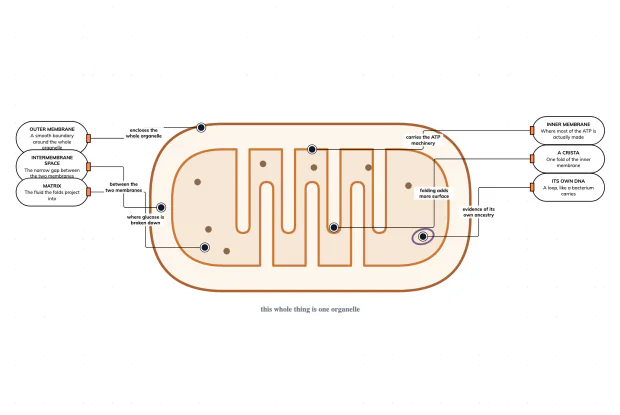
A mitochondrion is enclosed by two membranes; the inner one is folded into cristae that greatly increase its surface area, and it carries the machinery that makes most of a cell's ATP, while the matrix inside holds the enzymes that break glucose products down and the organelle's own loop of DNA.
CodePLU Goal
Upgrading Human Mental Models
Learn how to think in Workflows

Concept Development By codeplu.com
Flatten the folds out and the inner membrane would be many times larger than the outer one.
The Organelle Drawn Properly
An earlier tutorial labelled the parts of a cell and showed a mitochondrion as one organelle among several, at a size where it is a small bean with a few lines in it. That is the right level for that tutorial and the wrong level for this one, because the thing that matters about a mitochondrion is a detail that only shows at a larger scale.
It has two membranes rather than one. The outer membrane is smooth and runs right round the organelle. Inside it, separated by a narrow gap, is a second membrane — and that one is not smooth at all. It folds repeatedly and deeply inward, so that long fingers of it project into the fluid at the centre. Each fold is called a crista, and the fluid they project into is the matrix.
The folding is not decoration. Most of a cell's ATP is made by machinery embedded in the inner membrane, so the amount of ATP a mitochondrion can produce depends directly on how much inner membrane there is. Folding is how you fit a large area into a small volume, which is the same trick the previous tutorial on the leaf relied on and the same one the lining of a gut uses. Flatten out the cristae of a single mitochondrion and the inner membrane would be several times the area of the outer one that contains it.
Reading the Structure
Why are there two membranes?
Because the two are doing different jobs, and because of where mitochondria came from. The outer membrane simply encloses the organelle and keeps its contents together, and it is fairly permeable — small molecules pass through it without much difficulty. The inner membrane is far more selective and is where the ATP-making machinery sits, so it has to control what crosses it very tightly. Keeping the two separate creates the narrow intermembrane space, and that space turns out to matter: the process that makes ATP works by driving hydrogen ions out across the inner membrane into that gap and then letting them flow back through the machinery, which is only possible if there is a sealed compartment to drive them into.
What happens in the matrix?
The middle part of respiration. Glucose is first broken into smaller molecules in the cytoplasm outside the mitochondrion altogether, and those products are what enters. Inside the matrix, enzymes dissolved in the fluid take them apart the rest of the way, releasing carbon dioxide and loading energy onto carrier molecules. Those carriers then deliver it to the inner membrane, where the ATP is actually made. So the organelle has a sensible division of space: the dismantling happens in the fluid, where enzymes can move around freely, and the energy conversion happens on a membrane, where the machinery can be arranged in a fixed order and the hydrogen ions can be driven across. The carbon dioxide a person breathes out is produced here, which is worth connecting: it leaves a mitochondrion, crosses into the blood, and is carried away.
Why do some cells have far more mitochondria than others?
Because the number matches how much ATP the cell spends. A muscle cell, which contracts repeatedly and uses energy in bursts, is packed with them. A liver cell, which carries out a great many chemical conversions, has thousands. A cell in the lining of the gut, pumping absorbed molecules against a gradient all day, has far more than a cell whose main job is to sit there. Within a single mitochondrion the same principle applies to the folding itself: mitochondria in high-demand tissues tend to have more and deeper cristae than those in tissues that need less. The structure tracks the demand at both levels, which is a useful habit of mind in biology generally — when something varies between cells, ask what those cells do differently rather than what they are made of differently.
Why does a mitochondrion have its own DNA?
This is one of the stranger facts in cell biology and it has a widely accepted explanation. A mitochondrion contains a small circular loop of DNA and its own ribosomes, it makes some of its own proteins, and it divides in two rather than being built from scratch by the cell. Every one of those is a feature of a bacterium rather than of an organelle. The accepted account is that mitochondria descend from free-living bacteria that were taken inside a larger cell and stayed, an idea called endosymbiosis. The loop of DNA in the figure is the clearest piece of evidence for it, and chloroplasts carry the same signature.
Real World Example
Counting Mitochondria Across Four Cells
Nothing demonstrates what mitochondria are for better than comparing cells that differ enormously in how much work they do.
Step 1
A heart muscle cell is crowded with them
Cardiac muscle contracts continuously for a lifetime without ever resting for long, which makes it about the most ATP-hungry tissue there is. Mitochondria occupy a very large share of the volume of each cell — commonly cited figures put it around a third — so that the cell is substantially made of the machinery that powers it. The cristae in those mitochondria are also unusually densely packed. Both features are the same adaptation at different scales: more inner membrane, because more inner membrane means more ATP per second. A heart that stops for want of oxygen stops within minutes, and this is why: there is nothing stored to run on.
Step 2
A skin cell has far fewer
A cell in the outer layers of skin is doing comparatively little. It is not contracting, not pumping large quantities of anything against a gradient, and not synthesising at any great rate; it is mostly sitting in place forming a barrier. Its ATP demand is correspondingly modest and its mitochondria are fewer and less elaborately folded. The cell is not smaller or simpler in any general sense — it simply has a smaller energy bill, and the organelle count follows the bill rather than the size. Comparing the two cells under an electron microscope makes that difference obvious long before anything else about them does.
Step 3
A red blood cell has none at all
A mature mammalian red blood cell has no mitochondria whatsoever, and no nucleus either. Both were discarded as it matured, which leaves more room for haemoglobin and makes the cell more flexible for squeezing through narrow capillaries. It still needs energy, and it gets it by breaking glucose down without oxygen in the cytoplasm — which yields very little ATP but works. There is a certain logic to it: a cell whose job is carrying oxygen does not consume any of its own cargo. It is also the reason a red blood cell cannot repair itself and lasts only a few months before being replaced.
FAQs
Final Words
Two membranes, and everything interesting follows from the second one. The outer membrane encloses the organelle. The inner membrane carries the machinery that makes most of a cell's ATP, and because that machinery sits in a membrane, the amount of membrane sets the output — so it folds, deeply and repeatedly, into cristae projecting into the matrix. The matrix holds the enzymes that finish taking glucose products apart, and a small loop of DNA that should not really be there.
That loop is worth remembering. Its own DNA, its own ribosomes, division in two, and a size close to a bacterium's all point the same way: this organelle appears to have been a separate organism once. The next tutorial leaves the structure and asks what happens when the oxygen the inner membrane depends on is not available.
Continue This Track
This concept is part 3 of Where Living Things Get Their Energy.
Breathing Is Not Respiration — Sort Them Out
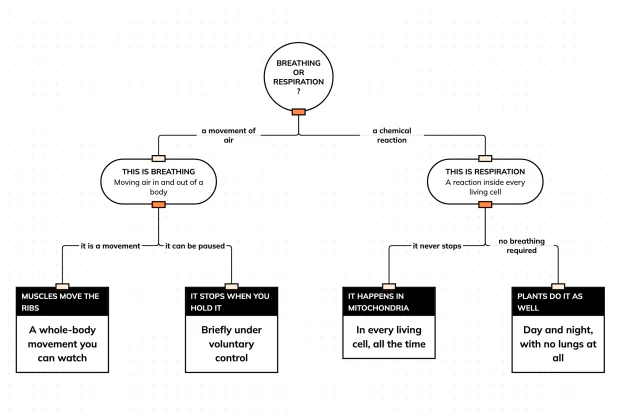
Breathing moves air into a body. Respiration releases energy inside every living cell, including a plant's. Sort four statements into the right one in an interactive playground.
Why Must Every Cell Respire? Follow the Reasoning
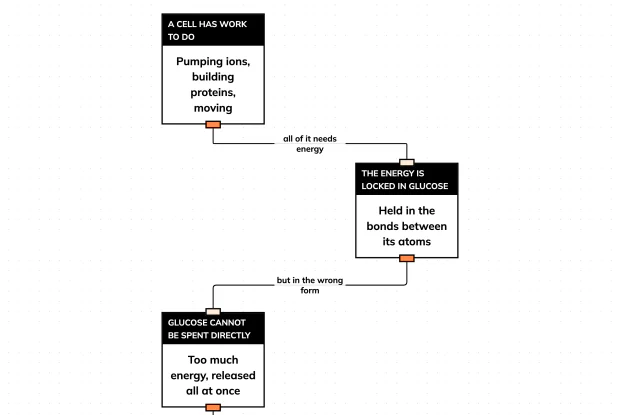
Glucose holds energy but a cell cannot spend it directly — it is the wrong form and there is too much of it at once. Reason step by step to why respiration never stops, in an interactive playground.
What Is Inside a Mitochondrion? Label the Folds
A mitochondrion has two membranes, and the inner one folds deep inside. Label the outer membrane, the matrix, a crista and its own loop of DNA in an interactive playground, and see why the folding matters.
Respiring With and Without Oxygen — Two Routes
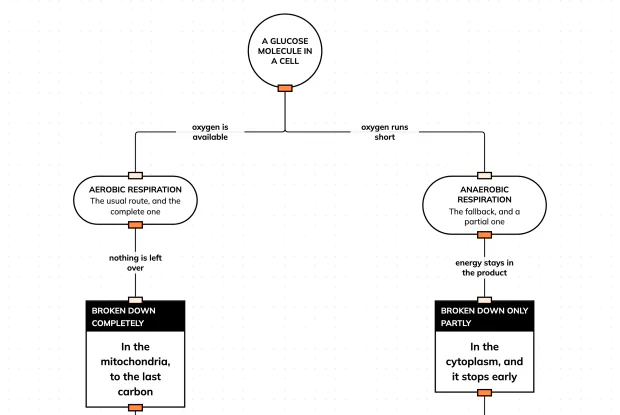
With oxygen, glucose is broken down completely for a large yield of ATP. Without it, the breakdown stops early and leaves lactic acid or ethanol behind. Follow both routes in an interactive playground.
Do Plants Respire As Well? Yes, Day and Night
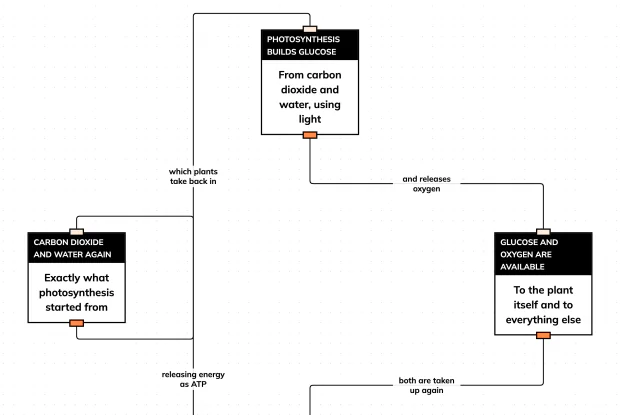
Plants respire every hour of their lives, including in full sunshine. Close the loop between photosynthesis and respiration in an interactive playground and see why a plant is not the reverse of an animal.