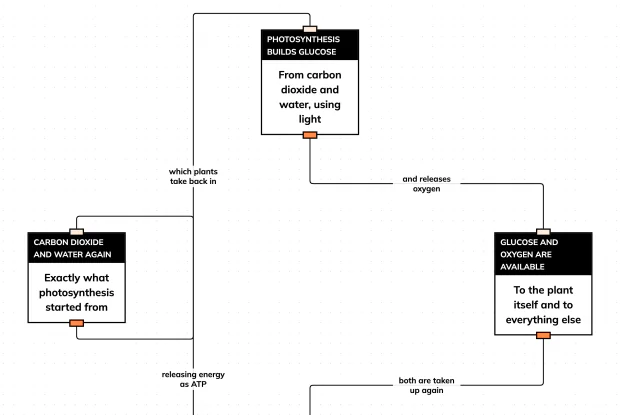
Respiring With and Without Oxygen — Two Routes
Root Concept
Aerobic respiration uses oxygen to break glucose down completely to carbon dioxide and water, releasing a large quantity of ATP, while anaerobic respiration breaks it down only partially without oxygen, yielding far less ATP and leaving lactic acid in animals or ethanol and carbon dioxide in yeast.
CodePLU Goal
Upgrading Human Mental Models
Learn how to think in Workflows

Concept Development By codeplu.com
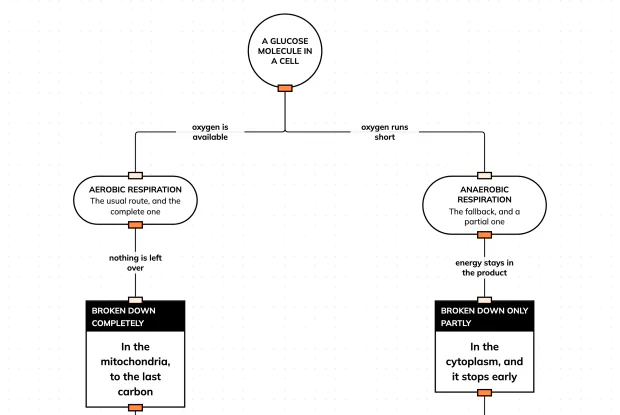
Both branches start from the same molecule. Only one of them finishes taking it apart.
Finishing the Job, or Stopping Early
Respiration has been described so far as though there were one version of it. There are two, they start identically, and the difference between them is simply whether oxygen is there when it is needed.
Both routes begin the same way. In the cytoplasm, outside any organelle, a glucose molecule is split into two smaller molecules and a small amount of ATP is produced. That first stage needs no oxygen at all and happens in every cell, always. What happens next is where the two part company.
If oxygen is available, those smaller molecules enter the mitochondria and are taken apart the rest of the way. Every carbon atom ends up in carbon dioxide and every hydrogen ends up in water, and a large quantity of ATP is produced along the way — roughly thirty times as much as that first stage gave. This is aerobic respiration, and the word simply means with air.
If oxygen is not available, the mitochondria cannot be used, and the breakdown stops where it started. The cell converts the small molecules into something it can at least set aside — lactic acid in an animal, or ethanol and carbon dioxide in yeast — and carries on collecting the small ATP yield from the first stage. This is anaerobic respiration. It is much worse, it leaves a waste product that has to be dealt with later, and it is enormously better than nothing, because a cell that stops making ATP is a cell in serious trouble within seconds.
Comparing the Two Routes
Why does the yield differ so much?
Because of how much of the glucose is actually taken apart. The energy in glucose is held in the bonds between its atoms, so releasing it means breaking those bonds, and a molecule broken down completely releases far more than one broken down halfway. Aerobic respiration goes all the way to carbon dioxide and water, which are about as low in energy as carbon and hydrogen compounds get. Anaerobic respiration stops at lactic acid or ethanol, and both of those still contain a great deal of chemical energy — ethanol so much that it can be burned as a fuel. That unreleased energy is the difference, and it is why the yields are roughly two ATP against about thirty.
What is oxygen actually doing?
Taking away the hydrogen at the end of the chain, which is less dramatic than it sounds and absolutely essential. The process on the inner membrane of a mitochondrion works by passing hydrogen and electrons along a series of carriers, and something has to accept them at the far end or the whole line backs up and stops. Oxygen is that final acceptor, and combining with hydrogen is what produces the water. Without it the carriers fill up and nothing further can pass, which is why the absence of oxygen shuts down the mitochondrial stages completely rather than merely slowing them. The first stage in the cytoplasm is unaffected because it does not use that machinery.
Why do animals and yeast produce different waste?
Because they solve the same chemical problem with different enzymes. The problem is identical: the first stage needs a particular carrier molecule returned to it in an empty state, and with the mitochondria unavailable there has to be some other way of emptying it. An animal cell empties it by converting the product of the first stage into lactic acid. A yeast cell empties it by converting the same product into ethanol, releasing carbon dioxide in the process. Neither waste product is useful to the organism making it, and both are a nuisance to it. Both are extremely useful to us: lactic acid from bacteria makes yoghurt and cheese, and ethanol from yeast makes bread rise and beer ferment. Two of the oldest food technologies there are rest on an organism dealing with a shortage of oxygen.
What happens to the lactic acid afterwards?
It is removed once oxygen is available again, which is why hard exercise is followed by a period of continued heavy breathing even after the effort has stopped. Lactic acid is carried in the blood to the liver, where oxygen is used to convert it back into substances the body can use or respire properly. The extra oxygen needed for that is sometimes called the oxygen debt, and the name is apt: the cell borrowed against future oxygen in order to keep producing ATP during the shortage, and the debt is settled afterwards. Yeast has no equivalent arrangement and simply releases its ethanol into the surroundings, which it can afford to do because it has somewhere to put it and no bloodstream to keep clean.
Real World Example
A Loaf of Bread and a Bottle of Beer
Yeast respiring without oxygen produces ethanol and carbon dioxide together. Two of the oldest food technologies there are differ mainly in which of the two is wanted.
Step 1
In dough, the gas is the point
Yeast mixed into dough feeds on sugars in the flour. With very little oxygen available in a dense dough it respires anaerobically, producing ethanol and carbon dioxide. The carbon dioxide is trapped as thousands of small bubbles in the stretchy gluten network, and the dough rises. The ethanol is also there, in small quantities, and evaporates off during baking — which is why a bakery smells the way it does. The product being kept is the gas, and the alcohol is incidental — which is a slightly surprising thing to realise about an ordinary loaf. The holes in a slice of bread are a record of yeast respiring without enough oxygen.
Step 2
In a fermenting vessel, the alcohol is the point
The same organism, carrying out the same reaction on sugars from malted barley or grape juice, is wanted for the opposite product. Here the vessel is sealed so that air cannot get in, which keeps the yeast anaerobic and keeps it producing ethanol rather than switching to the aerobic route. The carbon dioxide is allowed to escape through a valve, or deliberately retained to make the drink fizzy. Nothing about the biology differs between this and the dough; only which product is collected does. The sealing matters, though: let air in and the yeast switches to the aerobic route, gets far more ATP per sugar molecule, and makes no alcohol at all.
Step 3
The yeast eventually stops itself
Fermentation does not run indefinitely, because ethanol is toxic to the yeast producing it. Once the concentration reaches somewhere around fifteen per cent, depending on the strain, the yeast can no longer survive in its own waste and the process halts. Any drink stronger than that has to be concentrated afterwards by distilling. It is a neat illustration of what anaerobic respiration really is: an organism accepting a poor yield and an accumulating waste product because the alternative is no ATP at all. The yeast is not making alcohol for anyone's benefit, including its own — it is coping with a shortage, and eventually the coping kills it.
FAQs
Final Words
One molecule of glucose, and the only question is whether oxygen is there. Both routes begin identically in the cytoplasm, splitting glucose and collecting a small ATP yield. With oxygen, the pieces go into the mitochondria and are taken apart completely to carbon dioxide and water, for about thirty times that initial return. Without it, the breakdown stops where it began and the cell converts the pieces into lactic acid or ethanol simply to keep the first stage running.
The anaerobic route is worse in every respect except the one that matters at the time: it works when the other does not. A sprinting muscle, a waterlogged root and a sealed vat of fermenting grape juice are all the same compromise. This track has one tutorial left, and it puts respiration back beside photosynthesis, where the commonest mistake in the whole of school biology is waiting.
Continue This Track
This concept is part 4 of Where Living Things Get Their Energy.
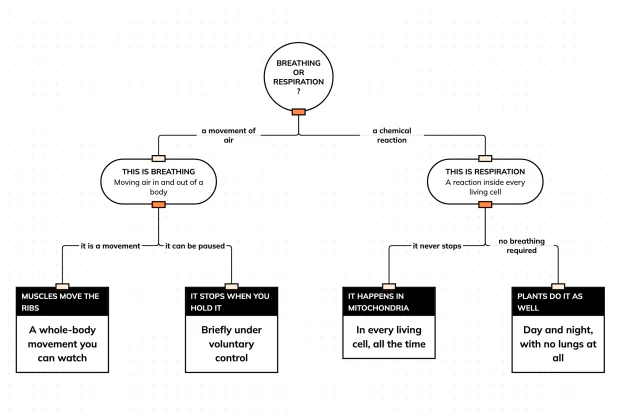
Breathing Is Not Respiration — Sort Them Out
Breathing moves air into a body. Respiration releases energy inside every living cell, including a plant's. Sort four statements into the right one in an interactive playground.
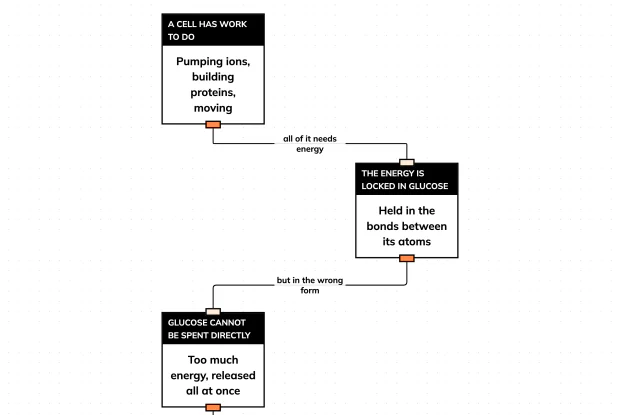
Why Must Every Cell Respire? Follow the Reasoning
Glucose holds energy but a cell cannot spend it directly — it is the wrong form and there is too much of it at once. Reason step by step to why respiration never stops, in an interactive playground.
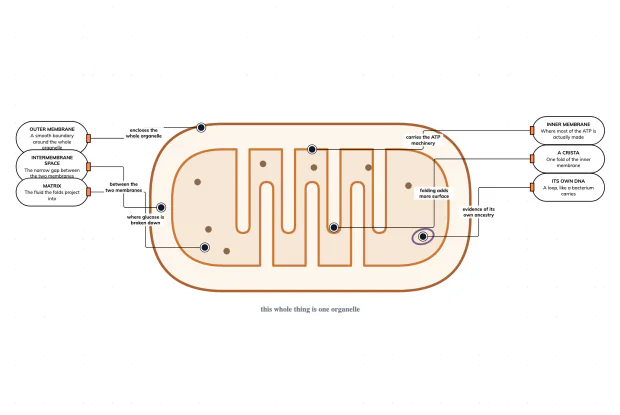
What Is Inside a Mitochondrion? Label the Folds
A mitochondrion has two membranes, and the inner one folds deep inside. Label the outer membrane, the matrix, a crista and its own loop of DNA in an interactive playground, and see why the folding matters.
Respiring With and Without Oxygen — Two Routes
With oxygen, glucose is broken down completely for a large yield of ATP. Without it, the breakdown stops early and leaves lactic acid or ethanol behind. Follow both routes in an interactive playground.
Do Plants Respire As Well? Yes, Day and Night
Plants respire every hour of their lives, including in full sunshine. Close the loop between photosynthesis and respiration in an interactive playground and see why a plant is not the reverse of an animal.