Breathing Is Not Respiration — Sort Them Out
Root Concept
Breathing is the muscular movement of air into and out of an organism, while respiration is the chemical release of energy from glucose inside every living cell, so organisms with no breathing mechanism at all still respire continuously.
CodePLU Goal
Upgrading Human Mental Models
Learn how to think in Workflows

Concept Development By codeplu.com
A plant has no lungs and respires every minute of its life. That alone separates the two words.
Two Words for Two Completely Different Things
In ordinary speech "respiration" means breathing, and a hospital uses the word that way. In biology it means something else entirely, and keeping the two apart is the single most useful thing to get right before anything else in this track makes sense.
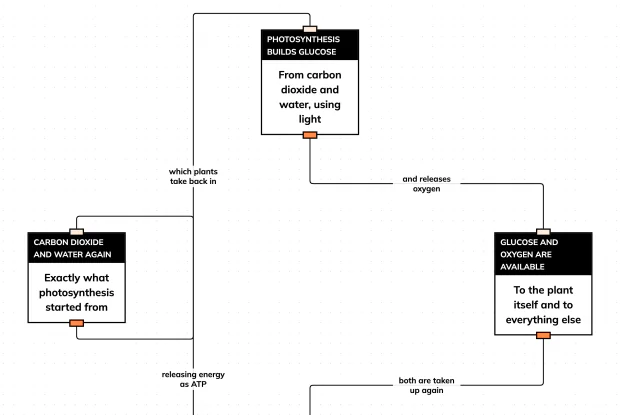
Breathing is a movement. Muscles pull the ribs and the diaphragm, the chest cavity changes volume, and air moves in and out. It happens in an organism as a whole, it is something you can watch and count, and it can be deliberately paused for a while. An earthworm does not do it. A tree does not do it. A single bacterium certainly does not do it.
Respiration is a chemical reaction. Inside a cell, glucose is broken down and the energy stored in it is released in a form the cell can spend. It happens in every living cell of every living thing, continuously, from the moment the organism is alive until the moment it is not. It cannot be paused for even a second. It needs no lungs, no ribs and no air passages, because it is not about moving air — it is about taking a molecule apart.
The two are related, which is exactly why they get confused. Breathing, in organisms that do it, is how oxygen is brought in for respiration and how the carbon dioxide respiration produces is got rid of. Breathing serves respiration. But serving something is not the same as being it, and a great many living things manage the second without the first.
Telling Them Apart
What is actually happening when you breathe?
Muscles are changing the volume of a cavity so that air moves. The diaphragm flattens and the muscles between the ribs pull the rib cage up and out, which makes the space inside the chest larger; air moves in because the pressure inside has fallen. Relaxing reverses it. The whole process is mechanical and involves no chemical change at all — the oxygen that goes in is the same oxygen that reaches the blood, and nothing has been broken down or built up. Breathing is transport. It is closer in kind to a pump than to a reaction, and the detail of how it works in a human body belongs with the body systems rather than here.
What is actually happening when a cell respires?
A glucose molecule is being taken apart and the energy that held it together is being transferred into a form the cell can use immediately. Where oxygen is available the breakdown is complete, and the products are carbon dioxide and water. The reaction does not happen in one step but in a long controlled sequence, which matters because releasing all that energy at once would simply destroy the cell. Most of the sequence takes place inside the mitochondria, which is the subject of a later tutorial in this track. Nothing about any of this requires an organism to have a body cavity, a muscle, or an opening to the outside.
Why do plants prove the distinction?
Because a plant respires constantly and does not breathe at all. It has no muscles to move air and no cavity to move it into. Gases reach its cells by diffusion through stomata and air spaces, which the previous track described in detail, and diffusion is not breathing — nothing is being pumped and nothing is being moved by an organism's own effort. Every living cell in a plant is nevertheless respiring, day and night, exactly as yours are, because every one of them needs energy to stay alive. If respiration meant breathing, a tree would be dead. The same argument works for a mushroom, a yeast cell and a bacterium, none of which has any mechanism for moving air and all of which respire for as long as they live.
So what is gas exchange?
It is the third word in this area and the one that most usefully replaces the other two when people get muddled. Gas exchange is oxygen moving into an organism and carbon dioxide moving out, by whatever means that organism uses. In a mammal it happens in the lungs and breathing delivers the air to them. In a fish it happens across gills. In an insect it happens through tubes running into the body. In a plant it happens through stomata by diffusion alone. Breathing is one organism's method of achieving gas exchange; respiration is the reaction that makes gas exchange necessary in the first place. Keeping the three words in that order — reaction, requirement, method — makes most of the usual confusion disappear.
Real World Example
Seeds Germinating in a Sealed Flask
The classic way to show that respiration is not breathing is to measure it in an organism that cannot breathe, and germinating seeds are ideal because they respire hard while doing nothing visible.
Step 1
Soaked seeds go into a vacuum flask
Peas or beans are soaked overnight so that they begin to germinate, and a quantity of them is sealed into an insulated flask with a thermometer through the stopper. A second flask is set up identically but with seeds that have been boiled first and then rinsed in disinfectant, so they are dead but otherwise the same material in the same conditions. That second flask is the control, and it is doing exactly the job the foil did in the starch test: making the two set-ups differ in one respect only, so that anything which happens in one and not the other has a single explanation.
Step 2
The living seeds get warmer
Over a day or two the thermometer in the flask of living seeds climbs several degrees above room temperature, while the flask of dead seeds stays where it started. Nothing is moving, nothing is visible, and no air is being pumped anywhere. The heat is coming from respiration: releasing energy from glucose is never perfectly efficient, and the proportion that is not captured in a usable form leaves as heat. The seeds are warm for exactly the same reason you are, and the insulated flask simply stops that heat escaping fast enough to hide it. A pile of damp grass clippings heats up for the same reason, as does a compost heap, where the respiring organisms are microbes rather than seeds.
Step 3
Carbon dioxide appears as well
Running air from the flask through limewater turns it milky, which is the standard test for carbon dioxide, and the air from the dead seeds does not. So the living seeds are consuming oxygen, producing carbon dioxide and releasing heat, which is respiration in full, in an organism with no lungs, no gills, no muscles and no movement whatsoever. Anyone who thinks respiration means breathing has to explain how a sealed jar of beans managed it. The experiment is also a reminder that respiration is why stored grain has to be kept dry and cool: damp seed respires, warms, and spoils.
FAQs
Final Words
One is a movement and one is a reaction. Breathing uses muscles to move air into and out of a body, happens at the level of the whole organism, can be watched, counted and briefly stopped, and most living things do not do it at all. Respiration takes glucose apart inside a cell to release the energy held in it, happens in every living cell of every living thing, and never stops.
They are connected, and that connection is the reason the words get fused: in organisms that breathe, breathing is how oxygen is delivered for respiration and how its carbon dioxide is removed. But a flask of beans with no lungs gets warm and turns limewater milky, and a tree respires through every night of its life. The rest of this track is about the reaction, and it starts with why no cell can do without it.
Continue This Track
This concept is part 1 of Where Living Things Get Their Energy.
Breathing Is Not Respiration — Sort Them Out
Breathing moves air into a body. Respiration releases energy inside every living cell, including a plant's. Sort four statements into the right one in an interactive playground.
Why Must Every Cell Respire? Follow the Reasoning
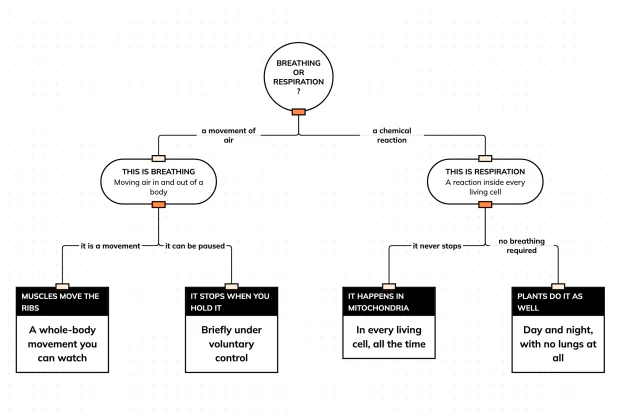
Glucose holds energy but a cell cannot spend it directly — it is the wrong form and there is too much of it at once. Reason step by step to why respiration never stops, in an interactive playground.
What Is Inside a Mitochondrion? Label the Folds
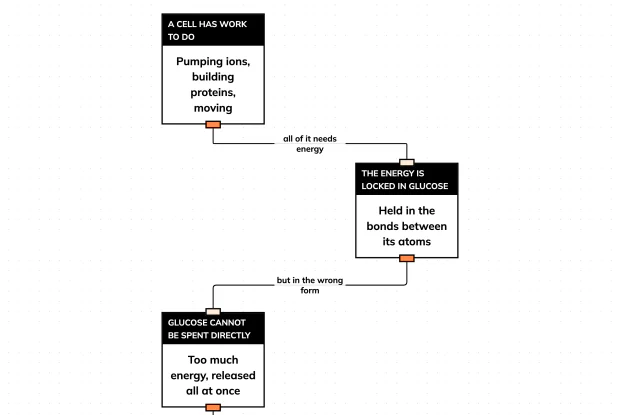
A mitochondrion has two membranes, and the inner one folds deep inside. Label the outer membrane, the matrix, a crista and its own loop of DNA in an interactive playground, and see why the folding matters.
Respiring With and Without Oxygen — Two Routes
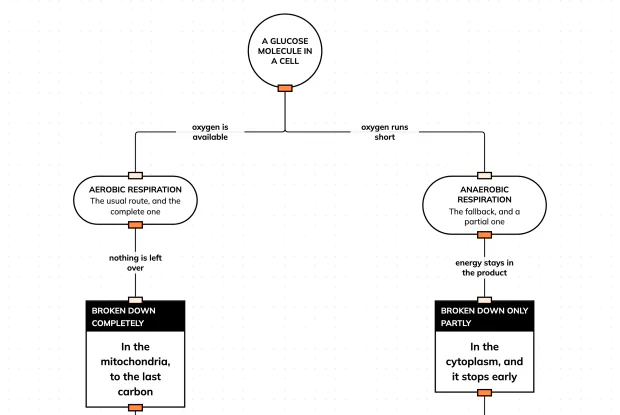
With oxygen, glucose is broken down completely for a large yield of ATP. Without it, the breakdown stops early and leaves lactic acid or ethanol behind. Follow both routes in an interactive playground.
Do Plants Respire As Well? Yes, Day and Night
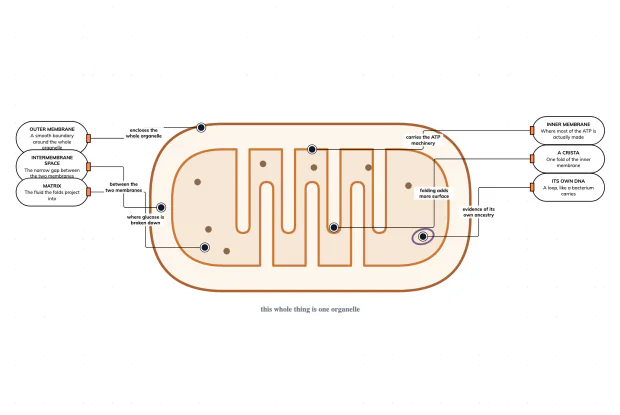
Plants respire every hour of their lives, including in full sunshine. Close the loop between photosynthesis and respiration in an interactive playground and see why a plant is not the reverse of an animal.