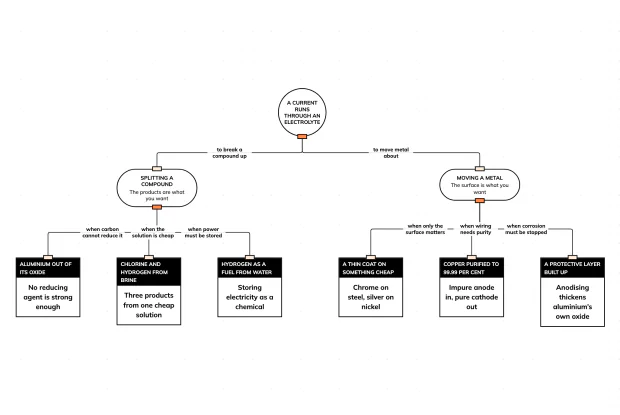
Why Does Electrolysis Need a Liquid?
Root Concept
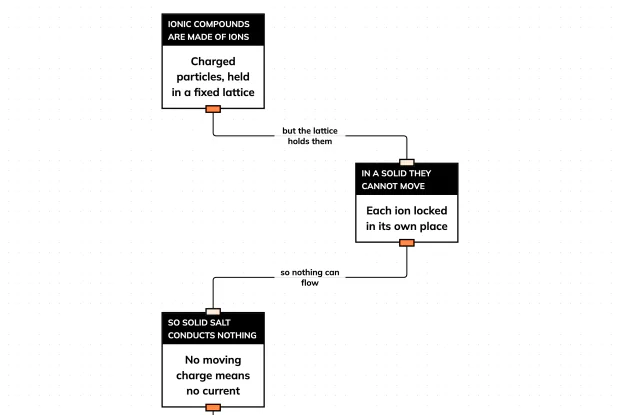
Electrolysis works by moving ions to electrodes, and the ions in a solid ionic compound are locked in a lattice and cannot travel — so the compound has to be melted or dissolved first, which frees the ions it already contained.
CodePLU Goal
Upgrading Human Mental Models
Learn how to think in Workflows

Concept Development By codeplu.com
Nothing is added anywhere in this chain. The same ions are present at the top and at the bottom; only their freedom to move changes.
The Same Substance, Two Different Answers
Take a lump of ordinary salt, touch the two probes of a circuit tester to it and nothing happens. No current, no reading, no light. Melt the same salt and test it again, and it conducts well enough to run a serious industrial process. Dissolve it in water instead and it conducts too.
Nothing has been added. The salt that conducts is made of exactly the same particles as the salt that does not. That is the fact this tutorial exists to explain, and it is a better starting point for electrolysis than any definition, because the whole technique depends on it.
The bonding track established what salt is made of: not molecules, but ions — sodium atoms that have given an electron away and are positive, chlorine atoms that have taken one and are negative — stacked in a regular lattice held together by the attraction between opposite charges. Charged particles are exactly what a current needs. So the ingredients for conduction are there in the solid, and the solid still does not conduct.
What is missing is movement. A current is charge going somewhere, and in a solid lattice every ion is pinned by its neighbours and can only vibrate in place. Melting the lattice, or dissolving it, breaks those positions apart and lets the ions travel — and once they can travel, they can reach an electrode and react there, which is electrolysis.
Working Through the Argument
Why does a solid ionic compound not conduct?
Because conduction needs charge to move, and in a lattice nothing goes anywhere. The ions are charged, which is half of what is required, but each one is surrounded by ions of the opposite charge pulling it in every direction at once. The result is a structure so rigid that the ions can only vibrate about fixed points, and vibrating in place moves no charge from one side of the sample to the other. This is worth separating carefully from the usual explanation of why something does not conduct, which is that it has no charged particles to move. Solid salt has charged particles in abundance. What it has is nowhere for them to go.
What does melting actually change?
It supplies enough energy to overcome the attractions holding the lattice in shape, so the arrangement collapses and the ions become free to move past one another. They are still ions — melting is a physical change, and no bond within an ion is broken — but they are now a liquid of charged particles rather than a rigid grid of them. That is why the melting point of an ionic compound matters so much to anybody doing electrolysis. Salt melts at around 800 °C, which is why industrial electrolysis of a molten compound is an expensive business, and why anything that lowers that temperature is worth a great deal.
Why does dissolving work as well?
Because water pulls the lattice apart without any heating. Water molecules are slightly positive at one end and slightly negative at the other, so they cluster around each ion with the appropriate end facing it and draw it away from its neighbours. The ions end up surrounded by water and free to drift, which is the same freedom melting provides and reached far more cheaply. A solution is therefore the easy way to do electrolysis in a classroom, and it introduces a complication that the third part of this track deals with: the water itself can take part in the reaction. That is the price of the cheaper route: an extra competitor at both electrodes that molten electrolysis never has to consider.
Is this the same as how a metal conducts?
No, and keeping the two apart prevents a lot of confusion. A metal conducts because of the electron sea described in the bonding track: the ions stay put and loose electrons drift through them, so a metal conducts perfectly well while solid and nothing is chemically changed by the current passing. An electrolyte is the other way round. The electrons do not travel through it at all; the IONS do, carrying their charge bodily from one end to the other and reacting when they arrive. That is why a wire is unchanged by a current and an electrolyte is decomposed by one. A copper wire carrying a current for fifty years is still copper wire; an electrolyte carrying one is steadily consumed.
Real World Example
Three Tests on the Same Compound
The classic school demonstration is one substance tested under three conditions, and only the conditions change.
Step 1
Solid lead bromide: the bulb stays dark
A crucible of lead bromide powder is wired into a circuit with a bulb and two carbon rods pushed into it. Nothing happens at all. The powder contains lead ions and bromide ions in enormous numbers, every one of them carrying a charge, and the circuit is complete apart from the sample itself. The bulb stays dark because none of those charges can travel, which is the single observation the rest of the demonstration is designed to explain. A circuit that is complete in every other respect is stopped by one solid lump, and the lump is full of charge.
Step 2
Melted: the bulb lights and the liquid changes
A Bunsen under the crucible takes the solid past its melting point and the bulb comes on. Nothing was added between the two observations except heat, and heat adds no charged particles. Watch for a few minutes and the electrodes begin to change: a brown vapour comes off one and a bead of silvery metal collects at the other. The compound is being taken apart into the two elements it was made from, which is what electrolysis means. Heat alone could not have done that; it took heat to free the ions and a current to pull them apart.
Step 3
Allowed to set again: the bulb goes out
Turn the Bunsen off and the melt solidifies, and as it does the bulb dims and goes out. That last step is the one that makes the argument airtight, because it rules out the idea that heating had somehow created something new. The change runs backwards as easily as forwards and tracks the physical state exactly. Conduction is a property of the liquid, not of the compound, and the ions were present throughout. Running an experiment backwards is often the cheapest way to rule out an explanation, and it rules out this one in about a minute.
FAQs
Final Words
An ionic compound contains charged particles whether it is solid or liquid, so the reason solid salt will not conduct is not an absence of charge but an absence of movement. Every ion in a lattice is pinned by the attraction of its neighbours and can do nothing but vibrate in place, and vibrating in place carries no charge from one electrode to the other.
Melting breaks the lattice and frees the ions without changing them, and dissolving achieves the same thing more cheaply by letting water molecules draw each ion away from its neighbours. Either way the compound becomes an electrolyte: a liquid in which the charge is carried by ions that travel bodily through it rather than by electrons slipping past fixed atoms, which is why a wire survives a current and an electrolyte is taken apart by one. The next tutorial follows those ions to the electrodes and asks what happens when they arrive.
Continue This Track
This concept is part 1 of Pulling Compounds Apart With Electricity.
Why Does Electrolysis Need a Liquid?
Solid salt will not conduct electricity, and molten salt will. Nothing has been added — follow the argument that explains the difference, in an interactive playground.
What Happens at Each Electrode? Oxidation and Reduction
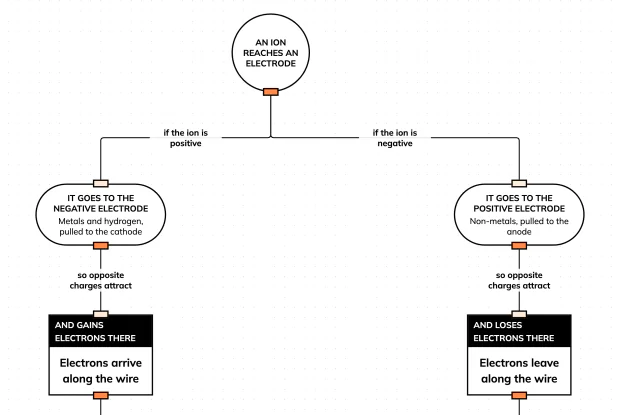
Positive ions go one way and negative ions the other, and what happens when they arrive is the opposite in each case. Follow both routes in an interactive playground.
Which Ion Reacts in a Solution? The Water Complication
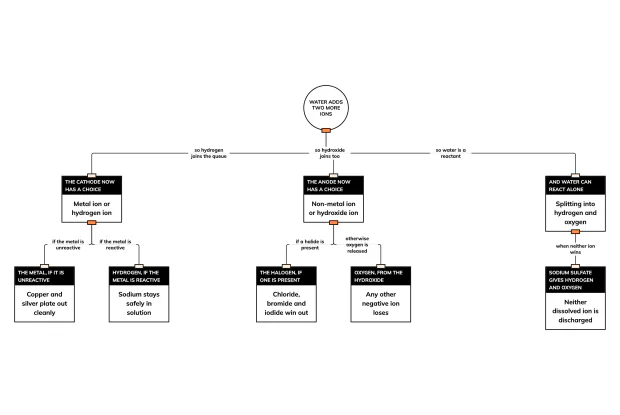
Electrolysing a molten compound gives its two elements. Electrolysing a solution often gives something else entirely, because the water joins in. Work out which ion wins, in an interactive playground.
How Is Aluminium Extracted by Electrolysis?
Aluminium is the commonest metal in the Earth’s crust and was once more valuable than gold. Follow the five steps that changed that, in an interactive playground.
What Is Electrolysis Used For? Six Jobs It Does
Electrolysis splits compounds, but half of what it is used for is moving metal from one place to another without splitting anything. Sort the six main jobs in an interactive playground.