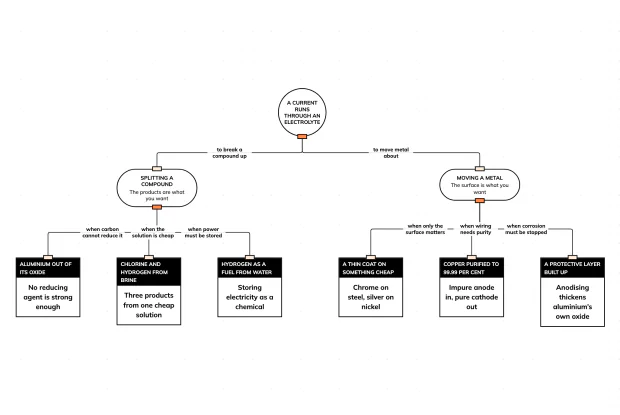
Which Ion Reacts in a Solution? The Water Complication
Root Concept
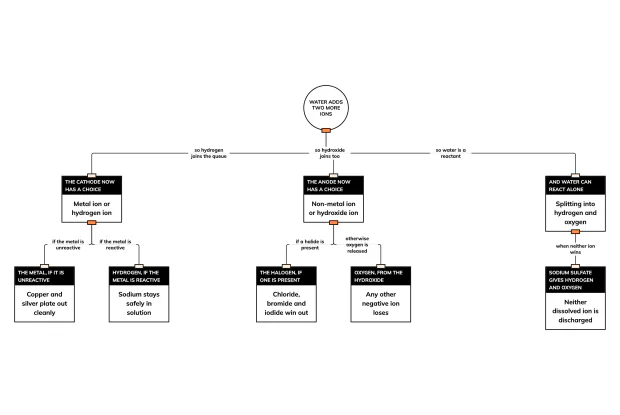
Water supplies hydrogen ions and hydroxide ions as well as the dissolved compound, so at the cathode a metal is deposited only if it is less reactive than hydrogen, and at the anode a halogen is released if one is present and oxygen otherwise.
CodePLU Goal
Upgrading Human Mental Models
Learn how to think in Workflows

Concept Development By codeplu.com
The cause is not a reaction. It is simply the presence of two extra ions, and every complication below follows from them being there.
Why a Solution Is Harder Than a Melt
Electrolyse molten lead bromide and you get lead and bromine. The compound contains two kinds of ion, each goes to its own electrode, and each is discharged. There is nothing to decide. Electrolyse a solution of sodium chloride and you do not get sodium and chlorine — you get hydrogen and chlorine, and the sodium stays dissolved. Something has changed, and what has changed is the water.
Water is mostly intact molecules, but a very small fraction of them are split at any moment into a hydrogen ion and a hydroxide ion. The acids track established this and used it to explain pH. The fraction is tiny, but it is never zero and it is constantly replenished, so any aqueous solution contains four kinds of ion rather than two: the two from the dissolved compound, plus hydrogen ions and hydroxide ions from the water itself.
That turns each electrode from a delivery point into a competition. At the cathode there are now two positive ions arriving — the metal and hydrogen — and only one of them will be discharged. At the anode there are two negative ions, the compound’s and hydroxide, and the same applies. The question for the rest of this tutorial is what decides the winner in each case.
The answers are short and worth learning as rules, but they are not arbitrary rules: both come straight from how tightly each particle holds its electrons, which is what the reactivity series has been measuring all along.
Settling Each Competition
What decides the winner at the cathode?
The reactivity series, with hydrogen placed in it. Being discharged at the cathode means taking electrons in, and a reactive metal is precisely one that gives electrons away readily and takes them back reluctantly — so a reactive metal ion is the harder of the two to discharge. The rule that follows is simple: if the metal is MORE reactive than hydrogen, hydrogen is discharged and the metal ion stays in solution; if the metal is LESS reactive than hydrogen, the metal is deposited. So copper, silver and gold plate out cleanly, while sodium, potassium, calcium and magnesium never do from a solution. This is also why the metals track said those metals have to be extracted from a molten compound rather than a solution — in water you would simply make hydrogen.
What decides the winner at the anode?
Whether a halide ion is present. If the solution contains chloride, bromide or iodide, that ion is discharged and the halogen is released — chlorine from a chloride, bromine from a bromide. If the negative ion is anything else, such as a sulfate or a nitrate, it is not discharged at all and the hydroxide ions from the water are oxidised instead, releasing oxygen. Sulfate and nitrate ions hold onto their electrons far too firmly to give one up at an ordinary voltage, so they survive the process untouched and remain in the solution at the end. The rule is therefore worth phrasing as a single question: is there a halide? If yes, the halogen; if no, oxygen.
Why does the water never run out?
Because it is being consumed as a whole molecule, not just as the few ions it had split into. When hydrogen ions are discharged at the cathode the supply is immediately topped up by more water molecules splitting, and the same happens at the anode with hydroxide. The net effect in a solution of something like sodium sulfate is that water itself is decomposed into hydrogen and oxygen while the sodium and sulfate ions sit there unchanged throughout. The solution slowly gets more concentrated, because the water is leaving as gas and the salt is not, which is a detail that catches people out when they expect the dissolved compound to be the thing consumed.
How do you predict a product in practice?
By asking three questions in order, which is quicker than remembering cases. First, what four ions are present — the two from the compound and the two from water, which are always there. Second, at the cathode, is the metal above or below hydrogen in the reactivity series; above means hydrogen gas, below means the metal. Third, at the anode, is there a halide; yes means the halogen, no means oxygen. Those three answers give both products for any ordinary solution, and the method works just as well on a combination you have never seen, which a list of memorised examples does not. It also makes the exceptions easy to spot, because an unusual answer always traces back to one of the three questions having an unusual answer.
Real World Example
Three Solutions, Three Different Answers
Each of these is a standard school electrolysis, and the three outcomes between them cover every case the rules have to handle.
Step 1
Copper chloride: copper and chlorine, as expected
The four ions present are copper, chloride, hydrogen and hydroxide. At the cathode, copper is well below hydrogen in the reactivity series, so copper wins and a pink-brown layer plates onto the electrode. At the anode, chloride is a halide, so chlorine is released and can be smelled faintly or detected with damp litmus, which it bleaches. This is the easy case, where the water loses both competitions and the result looks exactly like the molten compound would have given. Both halves of the dissolved compound are recovered, which is the outcome people wrongly expect from every solution.
Step 2
Sodium chloride: hydrogen and chlorine, not sodium
The same method, a different answer at one electrode. Sodium is far above hydrogen in the reactivity series, so hydrogen is discharged at the cathode and bubbles off while the sodium ions stay dissolved. At the anode chloride is still a halide, so chlorine is still released. The sodium and hydroxide ions left behind make the solution strongly alkaline, which is why this process is run industrially on an enormous scale: it produces hydrogen, chlorine and sodium hydroxide at once, all three of them valuable. One cell, three products, and the only reason there are three is that the water took part.
Step 3
Sodium sulfate: hydrogen and oxygen, and nothing else
Here the dissolved compound loses both competitions. Sodium is above hydrogen, so hydrogen comes off at the cathode. Sulfate is not a halide and will not give up an electron, so hydroxide is oxidised instead and oxygen comes off at the anode. The sodium sulfate takes no part at all and is there at the end exactly as it was at the start — it is doing nothing but making the water conduct. What is actually being electrolysed is the water. That is worth sitting with, because the label on the bottle names the one substance in the beaker that does not react.
FAQs
Final Words
A molten compound has only its own two ions, so electrolysing it gives its two elements and there is nothing to decide. A solution has four, because a small fraction of the water is always split into hydrogen ions and hydroxide ions, and that turns each electrode into a competition between two candidates.
The cathode is settled by the reactivity series with hydrogen placed in it: a metal more reactive than hydrogen holds its electrons too well to take them back, so hydrogen is discharged instead and the metal stays dissolved. The anode is settled by one question — is a halide present? If so the halogen is released, and if not the hydroxide is oxidised and oxygen comes off. Three questions answer any ordinary case: which four ions, which side of hydrogen, and is there a halide.
The next tutorial takes the hardest real example of a molten electrolysis — the one the metals track said needed electricity and did not explain.
Continue This Track
This concept is part 3 of Pulling Compounds Apart With Electricity.
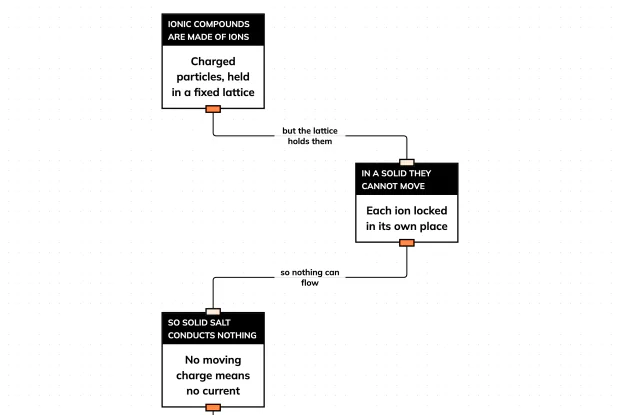
Why Does Electrolysis Need a Liquid?
Solid salt will not conduct electricity, and molten salt will. Nothing has been added — follow the argument that explains the difference, in an interactive playground.
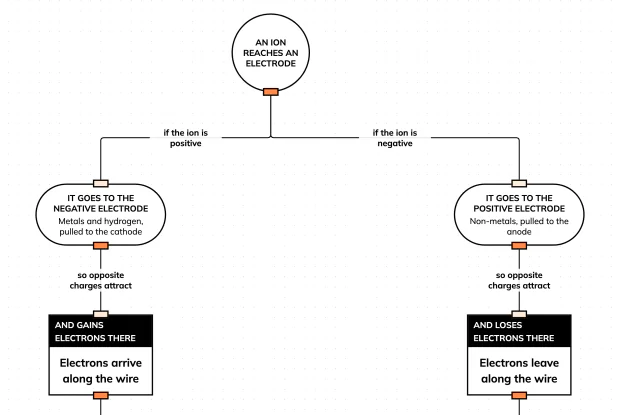
What Happens at Each Electrode? Oxidation and Reduction
Positive ions go one way and negative ions the other, and what happens when they arrive is the opposite in each case. Follow both routes in an interactive playground.
Which Ion Reacts in a Solution? The Water Complication
Electrolysing a molten compound gives its two elements. Electrolysing a solution often gives something else entirely, because the water joins in. Work out which ion wins, in an interactive playground.
How Is Aluminium Extracted by Electrolysis?
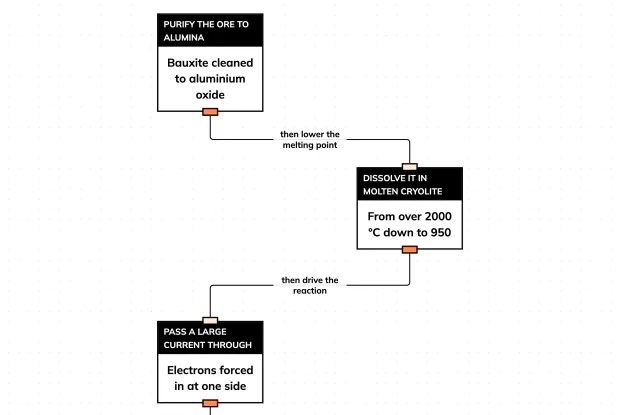
Aluminium is the commonest metal in the Earth’s crust and was once more valuable than gold. Follow the five steps that changed that, in an interactive playground.
What Is Electrolysis Used For? Six Jobs It Does
Electrolysis splits compounds, but half of what it is used for is moving metal from one place to another without splitting anything. Sort the six main jobs in an interactive playground.