How Is Aluminium Extracted by Electrolysis?
Root Concept
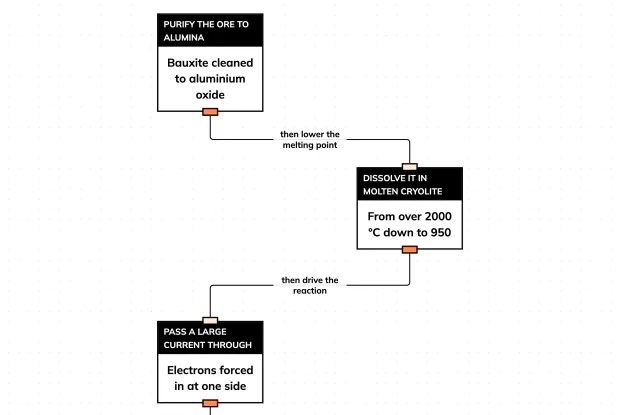
Aluminium is extracted by electrolysing purified aluminium oxide dissolved in molten cryolite, which lowers the working temperature from over 2000 °C to around 950 — the metal collects at the cathode and oxygen at the carbon anodes, steadily burning them away.
CodePLU Goal
Upgrading Human Mental Models
Learn how to think in Workflows

Concept Development By codeplu.com
Every step is something somebody does, and doing them in a different order fails — there is nothing to pass a current through until the second step has been carried out.
The Metal That Was Once Worth More Than Gold
Aluminium is the most abundant metal in the Earth’s crust. It is in ordinary clay, in most rocks, and in enormous deposits of an ore called bauxite. And for most of the nineteenth century it was a precious metal — Napoleon III is said to have reserved aluminium cutlery for his most important guests and given everyone else gold, and the cap of the Washington Monument was made of it in 1884 as a display of wealth.
The metals track explained why. Aluminium sits high in the reactivity series, well above carbon, so it cannot be freed from its ore by heating with carbon the way iron is. It holds its electrons too tightly for that, and the only way to force them back is electricity. That tutorial said so and moved on, and this is the one that opens the cell.
Knowing that electrolysis is required does not make it cheap, though. Aluminium oxide melts at over 2000 °C, and keeping hundreds of tonnes of anything at that temperature is close to impossible industrially. For decades that single number was what kept aluminium rare, and the problem was not chemistry but heat.
The step that solved it is the second one on the board above, and it is the reason aluminium is now cheap enough to throw away. The rest of the process is straightforward electrolysis of exactly the kind the first two tutorials described.
Taking the Steps in Order
Why does the ore need purifying first?
Because bauxite is a mixture, and everything in it that is not aluminium oxide would either waste current or contaminate the metal. Bauxite is mostly aluminium oxide but carries iron oxides, silica and clay minerals with it, and the red colour of the waste left over comes from the iron. Separating them relies on a difference in chemistry rather than a difference in size: aluminium oxide dissolves in hot sodium hydroxide solution and most of the impurities do not, so the mixture can be treated, filtered and the aluminium oxide recovered as a white powder. Only then is there anything worth putting in a cell. The red residue left behind is produced in vast quantity and is one of the serious environmental problems of the industry.
What does the cryolite actually do?
It acts as a solvent, so the aluminium oxide can be in a liquid state without being anywhere near its own melting point. Cryolite is a mineral containing sodium, aluminium and fluorine, and it melts at around 1000 °C — hot, but achievable. Aluminium oxide dissolves in the molten cryolite much as salt dissolves in water, and the resulting mixture works at roughly 950 °C instead of the 2000-plus the pure oxide would need. The ions are free to move, which is all electrolysis requires, and the energy bill falls by an enormous factor. This is exactly the move the first tutorial described, choosing dissolving over melting because it is cheaper — carried out here with a molten mineral in place of water, because water would be no use at this temperature.
What happens at each electrode?
The same two things as in any electrolysis, with aluminium and oxygen as the players. Aluminium ions carry a charge of plus three, so they travel to the cathode and each takes three electrons to become an aluminium atom: Al³⁺ + 3e⁻ → Al. The cathode is the carbon lining of the whole cell, and since molten aluminium is denser than the melt above it, the metal collects in a pool on the floor and is siphoned off. Oxide ions carry a charge of minus two and travel to the anode, where each gives up two electrons: 2O²⁻ → O₂ + 4e⁻. So the two products are molten aluminium and oxygen gas, which is where the complication in the last step comes from.
Why do the anodes have to be replaced?
Because they are made of carbon and the anode is where oxygen is being released, at nearly a thousand degrees. Carbon and oxygen at that temperature do exactly what they do anywhere else: they react, forming carbon dioxide, so the anodes are steadily eaten away from the surface down and have to be lowered, trimmed and eventually swapped out. This is a continuous running cost that no amount of clever engineering removes, because it is the chemistry of the process rather than a flaw in it. It also means an aluminium smelter emits carbon dioxide from the cell itself, quite separately from whatever was emitted generating the electricity. Those are two separate emissions and are frequently reported as one.
Real World Example
Where the Cost Goes
Almost every commercial fact about aluminium traces back to the amount of current the process demands, and each of these is a visible result of it.
Step 1
Smelters are built where electricity is cheapest
Aluminium smelting consumes so much power that the plants are located by the electricity supply rather than by the ore or the customers. Iceland imports bauxite from thousands of miles away to smelt it on cheap geothermal and hydroelectric power, and the same logic puts smelters in Norway, Quebec and parts of the Middle East. Shipping heavy ore across an ocean is cheaper than paying a higher tariff for current, which tells you how dominant the electricity cost is. No other common metal is produced this way. The ore follows the power, which is the reverse of how almost every other extraction industry is laid out.
Step 2
Recycling uses about a twentieth of the energy
Melting an aluminium can and casting it again needs heat but no electrolysis at all, because the metal is already metal and nothing has to be prised away from oxygen. That takes roughly five per cent of the energy of making the same aluminium from ore. It is the reason aluminium recycling is genuinely worthwhile rather than merely virtuous, and why scrap aluminium has a real resale value where many other recyclables do not. The saving comes directly from skipping the step this tutorial is about. Nothing has to be recovered chemically, because the aluminium was never un-made in the first place.
Step 3
The price collapsed once the process was found
Aluminium cost more than silver in the 1850s. Within about fifteen years of the cryolite method being worked out in 1886 — independently and almost simultaneously by Charles Hall in America and Paul Héroult in France — the price had fallen by a factor of more than a hundred, and within a few decades it was a material for saucepans and foil. Nothing changed about the chemistry of aluminium in that time. What changed was one step: finding something the oxide would dissolve in. A solvent rather than a reaction is what moved this metal from the jeweller to the kitchen drawer.
FAQs
Final Words
Aluminium is the commonest metal in the crust and was once a precious one, and the gap between those facts is entirely about how hard it is to separate from oxygen. It sits above carbon in the reactivity series, so heating the ore with carbon does nothing and only electricity can force its electrons back.
That was not enough, because aluminium oxide melts above 2000 °C. The step that made the metal cheap was finding that it dissolves in molten cryolite, giving free-moving ions at around 950 °C — the same choice of dissolving over melting the first tutorial described, with a molten mineral standing in for water. After that it is ordinary electrolysis: aluminium at the cathode, oxygen at the anodes, and anodes that burn away because carbon and oxygen at that temperature can do nothing else.
The last part asks what the whole technique is for, because splitting ores is only half of it.
Continue This Track
This concept is part 4 of Pulling Compounds Apart With Electricity.
Why Does Electrolysis Need a Liquid?
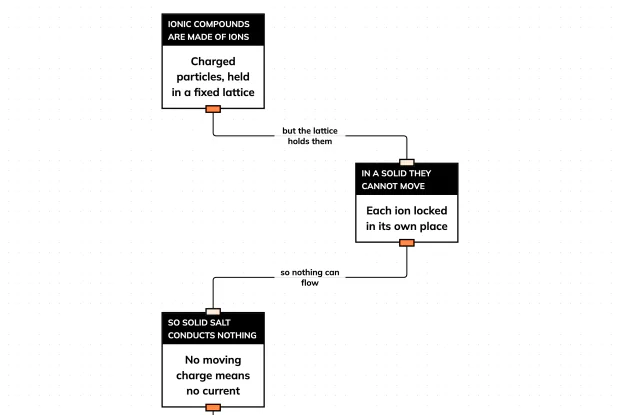
Solid salt will not conduct electricity, and molten salt will. Nothing has been added — follow the argument that explains the difference, in an interactive playground.
What Happens at Each Electrode? Oxidation and Reduction
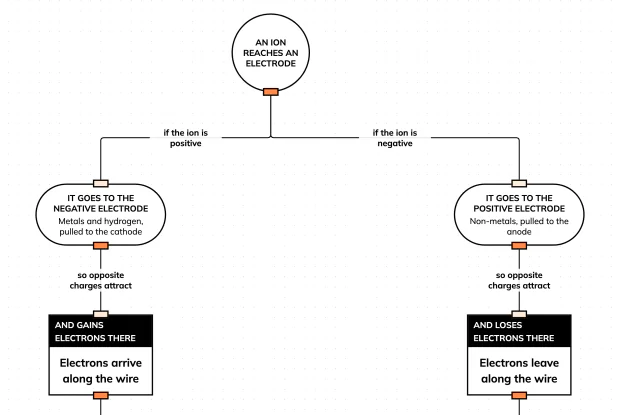
Positive ions go one way and negative ions the other, and what happens when they arrive is the opposite in each case. Follow both routes in an interactive playground.
Which Ion Reacts in a Solution? The Water Complication
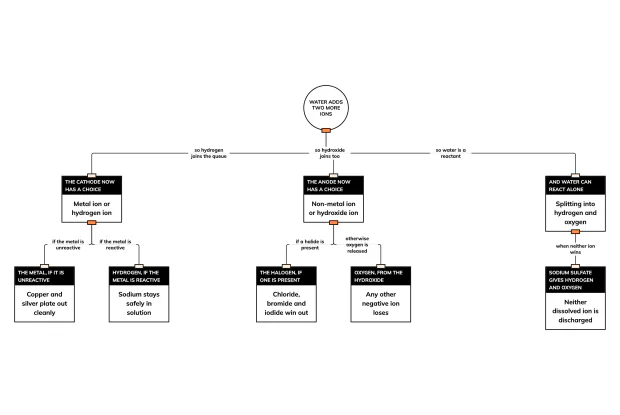
Electrolysing a molten compound gives its two elements. Electrolysing a solution often gives something else entirely, because the water joins in. Work out which ion wins, in an interactive playground.
How Is Aluminium Extracted by Electrolysis?
Aluminium is the commonest metal in the Earth’s crust and was once more valuable than gold. Follow the five steps that changed that, in an interactive playground.
What Is Electrolysis Used For? Six Jobs It Does
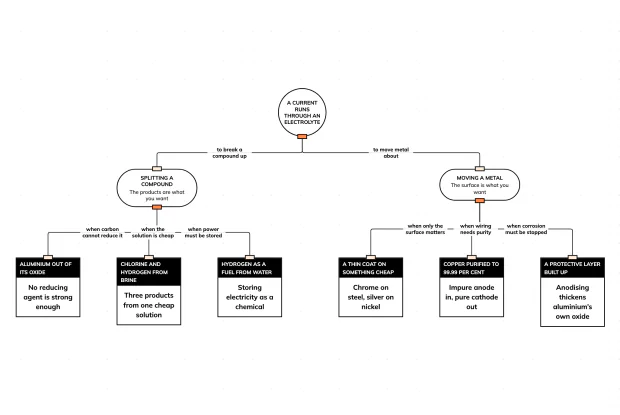
Electrolysis splits compounds, but half of what it is used for is moving metal from one place to another without splitting anything. Sort the six main jobs in an interactive playground.