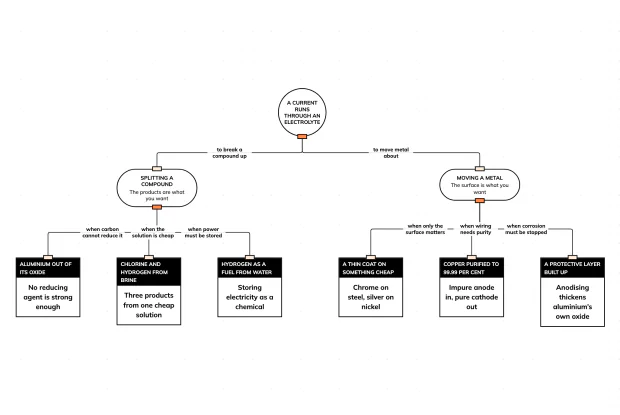
What Happens at Each Electrode? Oxidation and Reduction
Root Concept
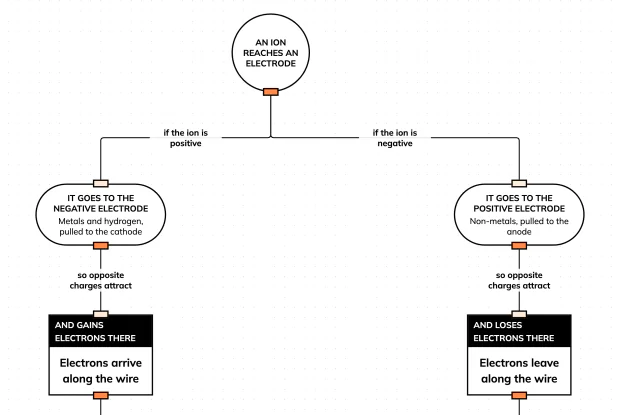
In electrolysis, positive ions travel to the negative electrode and gain electrons there, which is reduction and gives a metal or hydrogen, while negative ions travel to the positive electrode and lose electrons, which is oxidation and releases a non-metal.
CodePLU Goal
Upgrading Human Mental Models
Learn how to think in Workflows

Concept Development By codeplu.com
The two branches are mirror images, and swapping them over is the single most common error in the topic.
Where the Ions Go, and What Happens When They Arrive
Once a compound is molten or dissolved, its ions can move. The previous tutorial got them that far. Now there are two electrodes dipped into the liquid, one connected to the negative terminal of the supply and one to the positive, and every ion in the liquid is being pulled towards one of them.
Which one is not a rule to memorise — it is just the attraction of opposite charges that has been in play since the bonding track. A positive ion is pulled to the negative electrode, and a negative ion to the positive electrode. The electrode names follow from that: the negative one is called the cathode and the positive one the anode.
What matters is what happens on arrival, and here the two sides do opposite things. A positive ion is positive because it is short of electrons, and the cathode is the electrode with electrons being pushed into it, so the ion takes what it needs and becomes a neutral atom. A negative ion is negative because it has an electron too many, and the anode is where electrons are being drawn away, so it gives its extra one up and becomes neutral too.
Those two events have names that are worth getting straight here rather than later. Gaining electrons is reduction. Losing them is oxidation. Both happen at once in any electrolysis, one at each electrode, because the electrons taken in at one end are exactly the ones released at the other.
Following Each Route
What decides which electrode an ion goes to?
Nothing more than its charge. The cathode is connected to the negative terminal of the supply and therefore carries a negative charge, so it attracts everything positive in the liquid — metal ions, and hydrogen ions where they are present. The anode carries a positive charge and attracts everything negative, which means the non-metal ions. There is no chemistry in this step at all; it is the same attraction that holds an ionic lattice together, now being used to sort the ions by charge and send them to opposite ends of the container. The chemistry starts when they get there, and not before. This is worth holding onto, because the names cathode and anode carry no information on their own and are easy to swap by accident.
What does the cathode do to an ion?
It hands it electrons. A sodium ion carries a charge of plus one because the sodium atom it came from gave an electron away, so to become a sodium atom again it needs exactly one electron back — and at the cathode there is a supply of them arriving down the wire. The ion takes one, the charge is cancelled, and a sodium atom is deposited. Written as a half equation that is Na⁺ + e⁻ → Na, which says the same thing in four symbols. A copper ion with a charge of plus two needs two electrons rather than one, and an aluminium ion three, so the charge on the ion tells you how many are required.
What does the anode do to an ion?
It takes electrons away. A chloride ion carries a charge of minus one because the chlorine atom it came from took an electron in, so it has one to give back, and the anode is where electrons are being pulled into the wire. The ion gives its extra electron up and becomes a chlorine atom, which immediately pairs with another to make a molecule of chlorine gas — bubbling off the electrode, since group 7 elements exist in pairs. As a half equation, 2Cl⁻ → Cl₂ + 2e⁻. The two electrons released here are the two consumed at the cathode, which is why the current is the same all the way round.
Why do oxidation and reduction mean this?
Because the definitions were broadened once electrons were understood. Oxidation originally meant combining with oxygen, which is why the word looks the way it does, and reduction meant having oxygen taken away — the sense used in the metals track, where carbon reduces an ore. Then it became clear that what was really happening in those reactions was electron transfer, and that the same transfer happens in plenty of reactions with no oxygen anywhere. So the definitions were rewritten around electrons: oxidation is loss, reduction is gain. Electrolysis is the cleanest possible example, because the two halves happen in different places and you can watch each one. A metal appears at one end of the crucible while a gas comes off the other, and the two are the same transfer seen from each side.
Real World Example
Molten Lead Bromide, Electrode by Electrode
The demonstration from the previous tutorial, now followed at each electrode separately.
Step 1
At the cathode: a bead of lead
Lead ions carry a charge of plus two and are drawn to the negative electrode, where each takes two electrons and becomes a lead atom. The atoms collect as a silvery bead at the bottom of the crucible, which is a metal appearing from a liquid that contained no metal before. As a half equation: Pb²⁺ + 2e⁻ → Pb. That is reduction, although nothing has had oxygen removed from it — the electron definition is the one doing the work. Nothing in the crucible contains oxygen at all, and the reduction is as real as any in the metals track.
Step 2
At the anode: a brown vapour
Bromide ions carry a charge of minus one and are drawn to the positive electrode, where each gives up its extra electron. The bromine atoms pair up and leave as a brown vapour, visible above the crucible and unmistakable. As a half equation: 2Br⁻ → Br₂ + 2e⁻. That is oxidation, again with no oxygen involved anywhere, and it is happening at the same moment as the reduction at the other electrode. The brown colour is the clearest evidence in the whole demonstration, because bromine vapour looks like nothing else that could be there, and no other product of this cell is coloured.
Step 3
The two halves are one reaction
Add the two half equations together and the electrons cancel, leaving PbBr₂ → Pb + Br₂ — the compound taken apart into its elements, which is what was observed. The electrons do not accumulate anywhere; every one released at the anode travels round the circuit and is delivered at the cathode. That is why oxidation and reduction always come as a pair, and why a circuit has to be complete for either to happen at all, however hot the crucible still is. The pair is the reaction, not two things that happen to coincide. Break the circuit and both stop in the same instant, however hot the crucible still is.
FAQs
Final Words
Which electrode an ion travels to is decided by its charge alone, using the same attraction that held the lattice together. Positive ions go to the cathode, negative ions to the anode. No chemistry has happened yet — the ions have simply been sorted to opposite ends.
The chemistry is what happens on arrival, and the two ends do opposite things. A positive ion is short of electrons and the cathode supplies them, so a metal or hydrogen is deposited: that is reduction. A negative ion has one too many and the anode draws it away, so a non-metal is released: that is oxidation. Neither definition mentions oxygen; both were rewritten around electrons. And the two always happen together: every electron given up at one electrode is delivered at the other.
That is the clean case, where the only ions came from the compound itself. The next tutorial dissolves something in water, which adds two more ions and makes the result much harder to predict.
Continue This Track
This concept is part 2 of Pulling Compounds Apart With Electricity.
Why Does Electrolysis Need a Liquid?
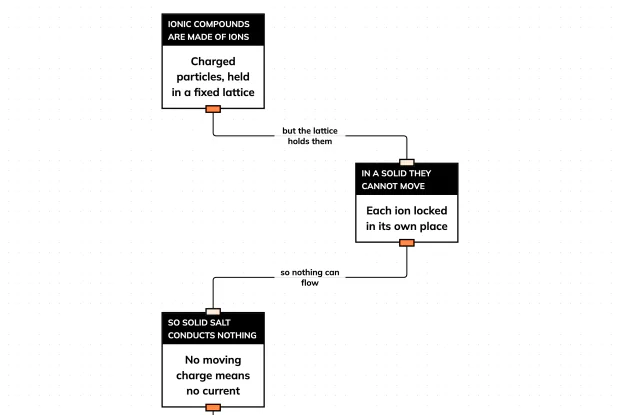
Solid salt will not conduct electricity, and molten salt will. Nothing has been added — follow the argument that explains the difference, in an interactive playground.
What Happens at Each Electrode? Oxidation and Reduction
Positive ions go one way and negative ions the other, and what happens when they arrive is the opposite in each case. Follow both routes in an interactive playground.
Which Ion Reacts in a Solution? The Water Complication
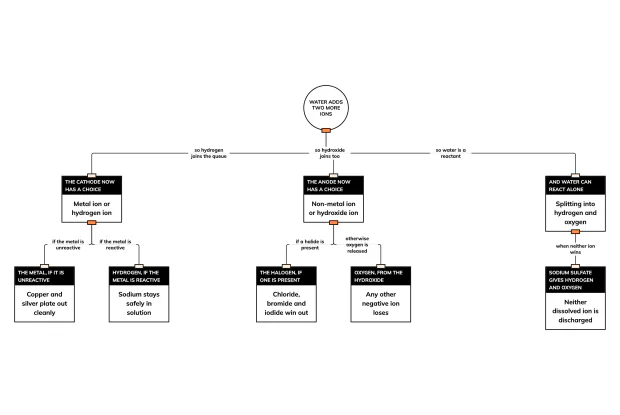
Electrolysing a molten compound gives its two elements. Electrolysing a solution often gives something else entirely, because the water joins in. Work out which ion wins, in an interactive playground.
How Is Aluminium Extracted by Electrolysis?
Aluminium is the commonest metal in the Earth’s crust and was once more valuable than gold. Follow the five steps that changed that, in an interactive playground.
What Is Electrolysis Used For? Six Jobs It Does
Electrolysis splits compounds, but half of what it is used for is moving metal from one place to another without splitting anything. Sort the six main jobs in an interactive playground.