What Is Electrolysis Used For? Six Jobs It Does
Root Concept
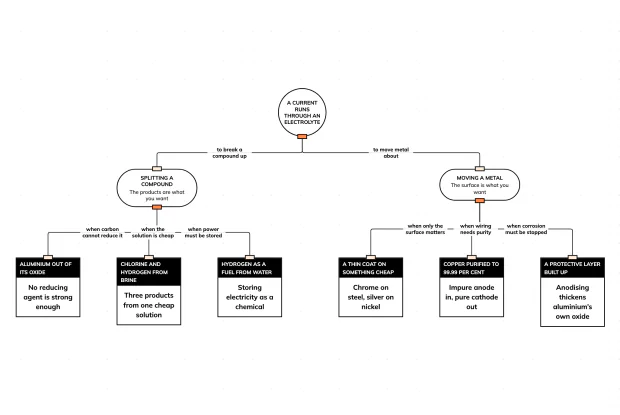
Electrolysis is used either to decompose a compound when no chemical reducing agent is strong enough, giving products such as aluminium, chlorine and hydrogen, or to move a metal from one electrode to another, which is how plating, refining and anodising work.
CodePLU Goal
Upgrading Human Mental Models
Learn how to think in Workflows

Concept Development By codeplu.com
The split is not about the apparatus, which is much the same in both columns. It is about which end of the cell you care about when it finishes.
Two Reasons to Pass a Current Through a Liquid
Everything so far in this track has treated electrolysis as a way of taking compounds apart. That is how it was discovered and it is what the word means, and it covers some of the largest chemical industries there are — aluminium from its oxide, and chlorine, hydrogen and sodium hydroxide from ordinary salt water.
But roughly half of what electrolysis is used for does not decompose anything in the end. If the anode is made of the same metal as the one dissolved in the solution, something different happens: the anode dissolves away and the identical metal plates out on the cathode. Nothing has been split, and no new substance has been made. Metal has simply been moved from one place to another, atom by atom, through the liquid.
That sounds like a pointless exercise and it is one of the most useful things in industrial chemistry, because where the metal ends up matters enormously. It can be moved onto a cheap object to give it an expensive surface, or away from a lump of impure metal and onto a pure one, leaving the impurities behind.
So the honest way to sort the uses is by what you want when the cell is switched off. In one column the products are the point and the electrodes are just apparatus. In the other the electrodes are the point and the solution is just a way of getting metal from one to the other.
Sorting the Jobs
When is splitting a compound the only option?
When nothing chemical is strong enough to do it. The metals track set out the dividing line: a metal below carbon in the reactivity series can be freed by heating its ore with carbon, because carbon wants the oxygen more. A metal above carbon cannot, and that includes aluminium, magnesium, calcium, sodium and potassium. For those, electrolysis is not the cheaper route or the cleaner route — it is the only route anybody has, because a current can force electrons where no reducing agent can push them. The same applies to chlorine, which is far too reactive to be found free and is made almost entirely by electrolysing salt solution on an industrial scale.
How does electroplating actually work?
The object to be plated is made the cathode, the solution contains ions of the plating metal, and the anode is usually a bar of that same metal. Then everything balances: metal ions in the solution are reduced onto the object, and the anode is oxidised to replace exactly the ions that were used up, so the concentration of the solution never changes. A silver anode dissolves at the same rate silver appears on the spoon. The reason this is worth doing is almost always economic — a thin layer of silver, chromium or gold on a cheap base gives the appearance, the corrosion resistance or the conductivity of the expensive metal for a fraction of the material cost.
How do you purify a metal with it?
By running the same trick with a deliberately impure anode. A slab of crude copper is made the anode and a thin sheet of pure copper the cathode, in a copper sulfate solution. Copper dissolves off the anode, travels as ions and plates onto the cathode — but the impurities do not, because they are either too reactive to be discharged at the cathode or too unreactive to dissolve at the anode in the first place. The unreactive ones simply fall off as the copper around them disappears, collecting as a sludge beneath the anode that is rich enough in silver, gold and platinum to be worth refining on its own. Copper for electrical wiring has to be above 99.9 per cent pure, because small impurities cost a disproportionate amount of conductivity.
What is anodising, and why is it the odd one out?
It is the one use where the point is to make the oxide rather than remove it. An aluminium object is made the ANODE rather than the cathode, so oxygen is released at its surface and reacts with the aluminium there, thickening the natural oxide layer from something microscopically thin to something tough and controllable. The metals track explained why aluminium does not corrode away: its oxide sticks rather than flaking. Anodising takes that protection and deliberately deepens it, and because the layer is slightly porous it can be dyed, which is where coloured aluminium comes from. Nothing is plated on and nothing is split apart. The cell is being used to grow a surface rather than to win a product.
Real World Example
Three Objects and the Cell That Made Them
These are ordinary objects, and in each case the thing that defines them was decided inside an electrolysis cell.
Step 1
A drinks can: aluminium that had to be forced out
The metal in a can was separated from oxygen by current and nothing else, because no reducing agent is strong enough to take it. That is why a can is worth recycling and a glass bottle is worth far less: the energy locked into separating that aluminium is enormous and is recovered in full by melting rather than re-extracting. Every can is an object whose existence depends on somebody having found a way to electrolyse aluminium oxide below a thousand degrees. The ore is abundant; the electricity was the hard part, and it still is.
Step 2
A chrome tap: steel wearing a surface it cannot afford
The tap is steel, which is cheap and strong and rusts. The chromium on it is a layer that may be only a few thousandths of a millimetre thick, deposited by making the tap the cathode in a solution of chromium ions. It gives the hardness, the shine and the corrosion resistance of solid chromium for almost none of the cost or weight, and when a tap eventually rusts it is because that layer has been breached somewhere rather than because the chromium has failed. The cell decided which of two metals the world sees.
Step 3
A copper cable: metal moved to leave its impurities behind
Copper straight from a smelter is around 99 per cent pure, which sounds excellent and is not good enough to carry current efficiently. Electrolytic refining moves the copper off an impure anode and onto a pure cathode, leaving the rest behind, and takes it past 99.99 per cent. The sludge that drops off the anode is collected and worked for precious metals, and at the scale a refinery runs at, that by-product can pay for a meaningful share of the operation. A process run for copper quietly pays part of its way in precious metal nobody set out to collect.
FAQs
Final Words
Electrolysis does two quite different jobs with much the same apparatus, and the difference is what you want when the cell is switched off. Sometimes the products are the point: aluminium that no reducing agent could free, chlorine and hydrogen and sodium hydroxide from cheap salt water, hydrogen from water as a way of holding electricity until it is needed.
And sometimes nothing is split at all. If the anode is the same metal as the ions in the solution, the anode dissolves and the identical metal plates onto the cathode, so metal is simply moved through the liquid atom by atom. Moved onto a cheap object it gives an expensive surface; moved off an impure lump it leaves the impurities behind, along with whatever gold and silver were too unreactive to come. Anodising is the odd case where the oxide is the product rather than the problem.
The next track leaves electricity for the element that forms more compounds than all the others together.
Continue This Track
This concept is part 5 of Pulling Compounds Apart With Electricity.
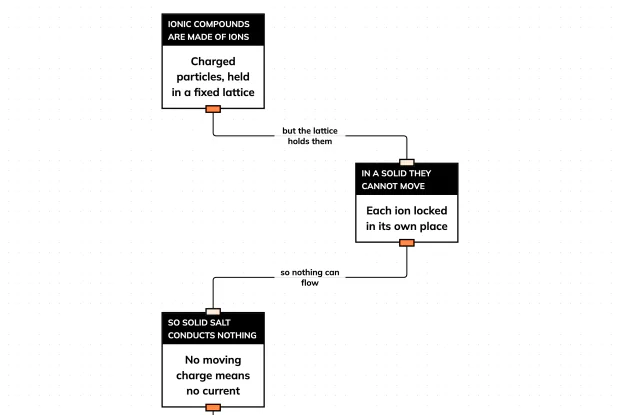
Why Does Electrolysis Need a Liquid?
Solid salt will not conduct electricity, and molten salt will. Nothing has been added — follow the argument that explains the difference, in an interactive playground.
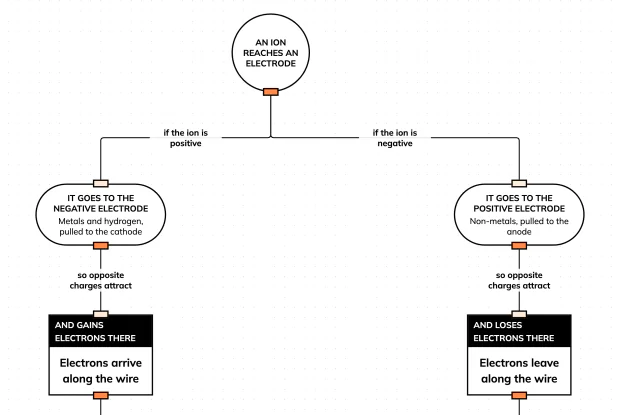
What Happens at Each Electrode? Oxidation and Reduction
Positive ions go one way and negative ions the other, and what happens when they arrive is the opposite in each case. Follow both routes in an interactive playground.
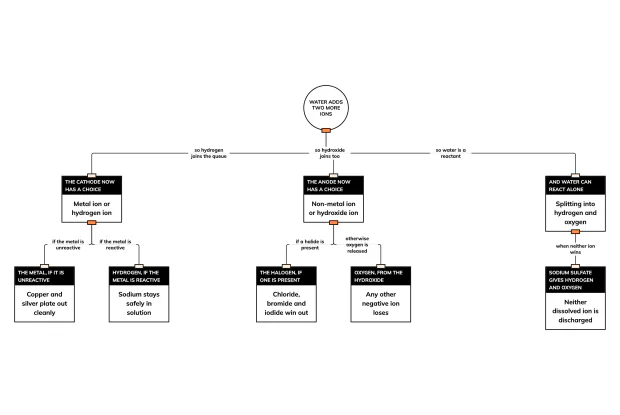
Which Ion Reacts in a Solution? The Water Complication
Electrolysing a molten compound gives its two elements. Electrolysing a solution often gives something else entirely, because the water joins in. Work out which ion wins, in an interactive playground.
How Is Aluminium Extracted by Electrolysis?
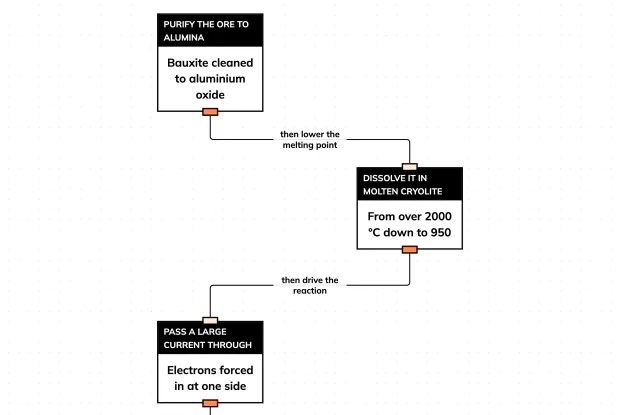
Aluminium is the commonest metal in the Earth’s crust and was once more valuable than gold. Follow the five steps that changed that, in an interactive playground.
What Is Electrolysis Used For? Six Jobs It Does
Electrolysis splits compounds, but half of what it is used for is moving metal from one place to another without splitting anything. Sort the six main jobs in an interactive playground.